Ecclesiastes 1: Lessons from the Book of Ecclesiastes
Solomon’s timeless lessons: The oldest available Jewish writings and the earliest Christian writings both unanimously agreed that King Solomon wrote the book of Ecclesiastes near the end of his life in the tenth century B.C. The book contains several of his timeless lessons.
1) Fear God throughout your life. Solomon’s central message is found at the end of the book. “The conclusion, when everything has been heard, is: fear God and keep His commandments, because this applies to every person.” (Ecc. 12:13). This is consistent with Solomon’s central message in Proverbs (Prov. 1:7; 2:5; 9:10; 15:33; 22:4). The “fear of the Lord” is defined as hating what God calls evil (Prov. 8:13). God gave Solomon incredible wisdom (1 Kgs. 4:29-31). Ecclesiastes begins with his observation that he had grown in greater wisdom than anyone before him (Ecc. 1:16). But without the fear of the Lord, his fleshly desires caused him to embrace evil.
2) Be Spirit-led. Solomon looked back on a life of rebellion against God and lamented that his worldly accomplishments would soon vanish. Paul likewise called his worldly accomplishments before He knew Jesus to be “rubbish” (Phil. 3:8). Life can have important meaning. But it only has lasting meaning and joy when you obey the Holy Spirit (Jo. 16:13; Ro. 8:14; Gal. 5:18, 25). If you are not led by the Spirit, your works will likely feel empty and without lasting importance.
3) Live for Jesus. How do you know if you are being led by the Spirit or the flesh? Paul teaches believers to turn to Jesus, who is wisdom incarnate (1 Cor. 1:24; Col. 2:3). Jesus is the Word who became flesh (Jo. 1:1). Paul also concluded: “For to me, to live is Christ, and to die is gain.” (Phil. 1:21). If you are not living for Jesus, your accomplishments will also soon vanish.
4) Be content. Solomon’s covetousness caused him to hoard wives and money. But Solomon later lamented that his covetousness could never be satisfied (Prov. 27:20). Thus, he was filled with regret for his rebellion and for failing to be content with God’s provision. Paul reached a similar conclusion and urged believers to be content with God’s provision (Phil. 4:11-13).
5) Be humble. Solomon’s covetousness stemmed from pride. He likely felt entitled to countless wives and riches because of his God-given wisdom. But Solomon stressed in Ecclesiastes 1 the fleeting and temporary nature of worldly accomplishments. In his early walk, he was humble before God (e.g., 1 Kgs. 3:7-13; 8:27). But his heart later turned against God (1 Kgs. 11:4).
6) Life-long gratitude. Solomon expressed gratitude when God gave him wisdom (1 Kgs. 3:15). He again expressed gratitude when God allowed him to build the Temple (1 Kgs. 8:22-24). But when his heart for God grew cold, his gratitude also stopped, and Solomon became pessimistic. To avoid making the same mistake, Paul urges believers to always be grateful to God (Phil. 4:6).
7) Hope in Jesus. Solomon described his life while in rebellion as “meaningless” (Ecc. 1:2). In an allusion to this book, Paul translated this same word into Greek as “mataiotés” when he stated that all creation has been subject to “futility.” (Ro. 8:20). In our fallen world, you must respond to life’s struggles and feelings of emptiness by placing your hope in Jesus (Ro. 15:13).
Ecclesiastes 1: Lessons For Finding Meaning and a Fulfilling Life
Introduction: Ecclesiastes 1 begins with Solomon’s laments. From this chapter, the Bible reveals several important lessons for avoiding an empty life that is filled with regret. To find a fulfilling life, you must: (1) live for Jesus, (2) be Spirit-led, (3) hope in Jesus, (4) be content, (5) be transformed through Jesus, (6) seek Jesus’ wisdom, and (7) fear Jesus by hating evil.
First, most likely during his time of apostasy, Solomon lamented that all his accomplishments were “futility,” “vanity,” or “meaningless”. If you are not living for Jesus, your works will also one day become meaningless. Second, during his time of rebellion, Solomon questioned what benefit there was for his labors. If you are not laboring for Jesus, your works will also become meaningless over time. Third, unlike what appeared to be unchanging in nature, Solomon despaired that his worldly accomplishments would soon vanish. Believers should again focus their labor for Jesus. When your labors for Jesus appear unappreciated or without a lasting impact, Jesus wants you to have faith and place your hope in Him. Fourth, Solomon’s pursuit of the things of the flesh offered him no lasting contentment. In contrast, Jesus offers lasting satisfaction when you seek to fulfill His will. Fifth, Solomon also looked with despair that no human accomplishment would last or be remembered. While the things of the flesh do not last, Jesus offers to transform you and make you an eternal, new creation. Sixth, Solomon looked everywhere “under the sun” and lamented that the “crooked cannot be straightened.” Only Jesus’ wisdom can restore what sin has corrupted. Finally, Solomon lamented that he was wiser than anyone who ruled before him. But he only felt grief. While worldly wisdom and pride lead to sorrow, humility and the fear of Jesus by hating what He calls evil leads to peace and joy.
1. Live for Jesus: Unless You Live for Jesus, Your Worldly Endeavors Will Eventually Evaporate Like Smoke and Become Meaningless. Ecc. 1:1-2.
After his many rebellions against God, Solomon viewed his worldly deeds as worthless. Most likely near the end of his life, Solomon looked back at his fleeting accomplishments with regret. “1 The words of the Preacher, the son of David, king in Jerusalem. 2 ‘Futility of futilities,’ says the Preacher, ‘Futility of futilities! All is futility.’” (Ecc. 1:1-2). Some commentators assume that Solomon was not the author of Ecclesiastes.1 But the Jewish Targum concluded long ago that Ecclesiastes records Solomon’s statement of regret for his apostasy against God, which is not found in 1 Kings.2 The earliest second century Christian interpretation of this book also identifies Solomon as the author.3 Protestant reformer Martin Luther only questioned Solomon’s role as scribe, not his authorship of Ecclesiastes.4 Presbyterian minister and author Matthew Henry (1662 – 1714) concludes, “We here behold Solomon returning from the broken and empty cisterns of the world, to the Fountain of living water; recording his own folly and shame, the bitterness of his disappointment, and the lessons he had learned.”5 The Pulpit Commentary also concludes, “there can be no doubt that the description is intended to denote Solomon, though his name is nowhere actually given, as it is in the two other works ascribed to him (Proverbs 1:1; Song of Solomon 1:1). Other intimations of the assumption of Solomon's personality are found in Ecclesiastes 1:12, ‘I Koheleth was king,’ etc.; so in describing his consummate wisdom (Ecclesiastes 1:13, 16; Ecclesiastes 2:15; comp. 1 Kings 3:12; 1 Kings 5:12), and in his being the author of many proverbs (Ecclesiastes 12:9; comp. 1 Kings 4:32) - accomplishments which are not noted in the case of any other of David's descendants. Also the picture of luxury and magnificence presented in Ecclesiastes 2. suits no Jewish monarch but Solomon. The origin of the name applied to him may probably be traced to the historical fact mentioned in 1 Kings 8:55, etc., where Solomon gathers all Israel together to the dedication of the temple, and utters the remarkable prayer which contained blessing and teaching and exhortation. As we have shown in the Introduction (§ 2), the assumption of the name is a mere literary device to give weight and importance to the treatise to which it appertains.” (Pulpit Commentary on Ecc. 1:1).6
Solomon spoke as a regretful preacher, not as the King of Jerusalem. Solomon was the son of David, and the King of Jerusalem (1 Kgs. 2:12). But he identified himself as a (qō·he·leṯ) “קֹהֶ֣לֶת”.7 (Ecc. 1:1). Many translations define this as the “Preacher”. (NASB, KJB, NKJ, Amplified Bible). But others translate this as the “Teacher.” (NIV, ESV, Berean Bible). Solomon’s exact reasons for using this title are not stated. Some cite the use of this title to question Solomon’s authorship.8 Solomon most likely used this term out of humility. He was a regretful sinner. Before God, he was not a king.
Solomon squandered his God-given wisdom. For emphasis, Solomon repeated five times the term (he·ḇêl) “הֲבֵ֤ל”.9 The NASB translates this term as “futility.” Other translations define this term as “vanity.” (KJB, NKJ; ESV, Amplified Bible). Other translations define this term as “meaningless.” (NIV). The differences in translation highlight the lack of a direct English translation for this word. “I want to propose that many well-intended Bible translations have actually led us astray by translating the Hebrew word hebel as ‘meaningless’ in this context …In fact, the Hebrew word hebel is also accurately translated as ‘breath’ or ‘breeze.’ The Preacher is saying that everything is a mist, a vapor, a puff of wind, a bit of smoke …You know what happens when you blow out a candle. How long does the puff of smoke last? You can smell it. It’s very real. But it is also transient, temporary, and vanishes quickly. It comes and goes without a permanent impact or a lasting impression on the world.” (David Gibson on Ecc. 1:2).10 Because of original sin, all creation was subject to “futility.” “For the creation was subjected to futility, not willingly, but because of Him who subjected it, in hope” (Ro. 8:20; Gen. 3:17-19). Solomon observed that his worldly achievements were like smoke.

Without Jesus, your worldly accomplishments will one day vanish like smoke.11
Solomon built up Israel, only to be told that his worldly accomplishments would vanish. God blessed Solomon with greater wisdom and wealth than any other person (1 Kgs. 4:29-34; 10:23; 1 Chr. 29:25). He initially used his gifts for God. But he later misused God’s blessings and committed several deadly sins. First, he took 1,000 wives, including 700 wives and 300 concubines (1 Kgs. 11:3-4). He violated God’s law that he have only one wife 999 times (Dt. 17:17(a)). More importantly, his many wives, especially his pagan ones, turned his heart against God (1 Kgs. 11:4). Second, because of his foreign wives, Solomon began to worship other gods (1 Kgs. 11:5-6). This violated God’s First Commandment (Ex. 20:2-3; Dt. 5:6-7). Because of his foreign wives, he then built idols and pagan altars for the Jews to worship Chemosh and Molech (1 Kgs. 11:5-8). This violated God’s Second Commandment (Ex. 20:4-6; Dt. 5:8-10). Third, to become king, Solomon would have taken an oath to obey God’s laws. His failure to follow his oath as the King of Israel blasphemed God’s holy name (Lev. 19:12). This violated God’s Third Commandment (Ex. 20:7; Dt. 5:11). Fourth, by worshipping other gods, he caused generations of Jews to do the same. Thus, he dishonored both his father David and God the Father. This violated God’s Fifth Commandment (Ex. 20:12; Dt. 5:16). Fifth, after his lust had pulled him from his walk with God, Solomon tried to kill his servant Jeroboam. He did this in rebellion against God after the prophet Ahijah told Solomon that God would give Jeroboam 10 of the 12 tribes because of Solomon’s rebellions (1 Kgs. 11:40). This violated God’s Sixth Commandment (Ex. 20:13; Dt. 5:17). Sixth, Solomon hoarded both gold and wives out of covetousness. This violated God’s Tenth Commandment (Ex. 20:17; Dt. 5:21). Finally, because Solomon’s heart grew hard, he refused to listen to the prophet Ahijah’s warnings that his sins would lead to the division of Israel (1 Kgs. 11:9-13). No other book contains Solomon’s repentance. If he had never repented, he would not be a revered teacher of wisdom. Thus, the book of Ecclesiastes most likely expresses Solomon’s regret over his misuse of his God-given wisdom and his warning for others not to make his same mistakes.
Use your limited time on Earth to live for Jesus. Other passages in the Bible are consistent with Solomon’s lament that life is like smoke “he·ḇêl” (Ecc. 1:2). David also wrote, “Behold, You have made my days like hand widths, and my lifetime as nothing in Your sight; certainly all mankind standing is a mere breath. Selah Certainly every person walks around as a fleeting shadow; they certainly make an uproar for nothing; he amasses riches and does not know who will gather them.” (Ps. 39:5-6). “As for man, his days are like grass; like a flower of the field, so he flourishes.” (Ps. 103:15-16). “Man is like the breath; his days are like a passing shadow. When the wind has passed over it, it is no more, And its place no longer knows about it.” (Ps. 144:4). The brevity of life is also stressed in the New Testament as well. “Yet you do not know what your life will be like tomorrow. For you are just a vapor that appears for a little while, and then vanishes away.” (Jam. 4:14; 1 Pet. 1:24). Thus, you should use your limited time on Earth to live for Jesus and not for yourself (Phil. 1:21). When you live for Jesus, He will bless you with the peace that surpasses understanding. “And the peace of God, which surpasses all comprehension, will guard your hearts and minds in Christ Jesus.” (Phil. 4:7). Your works for Jesus will also be celebrated in heaven as an eternal treasure (Matt. 6:20).
2. Be Spirit-Led: Be Led by the Holy Spirit to Labor for Jesus, or Your Labors Will Be Meaningless Over the Long Term. Ecc. 1:3.
Let the Holy Spirit direct your labor, or it will become meaningless over time. When he walked with God, Solomon ruled with wisdom (1 Kgs. 3:24), he gave God-given wisdom to all who sought it (1 Kgs. 4:34; 10:23-24), and he built the Temple (1 Kgs. 6-7; 2 Chr. 3-4). But after rebelling against God, he questioned everything that was for his own lusts or glory. “3 What advantage does a person have in all his work which he does under the sun?” (Ecc. 1:3). “Effort / labor, another key idea in the book, recalls similar language from the curse of Genesis 3, where God said labor would be painful (Gen. 3:17-19). And under the sun is an important phrase found about 30 times in the book. It means Solomon is looking at the question of meaning from an earthly perspective. If this world is all there is – if there is no God, no afterlife, and no final judgment – then everything is meaningless. The phrase does not necessitate an atheist outlook but rather an uncertainty about what lies beyond this life, its experiences and observations. Solomon expects a negative answer to his question about profit under the sun. If this life is all there is, then what is the point of our existence since all of our activity does not bring a net gain? All of our work, education, and love really gain us nothing because nothing really ever changes.” (Daniel Akin and Jonathan Akin on Ecc. 1:3).12
Be Led by the Holy Spirit and pursue the things of Jesus to find lasting fulfillment13
When you labor to enrich yourself, you do nothing that benefits your eternal soul. Jesus never directly quoted from Ecclesiastes. But Jesus alluded to Solomon’s lament when He warned about the eternal consequences that flow from laboring to merely enrich yourself. “For what does it benefit a person to gain the whole world, and forfeit his soul?” (Mk. 8:36; Matt. 16:26; Mk. 8:36-37). Thus, Paul looked back and also found no value in all his labors for himself. “But whatever things were gain to me, these things I have counted as loss because of Christ. More than that, I count all things to be loss in view of the surpassing value of knowing Christ Jesus my Lord, for whom I have suffered the loss of all things, and count them mere rubbish, so that I may gain Christ,” (Phil. 3:7-8).
When you labor for Jesus as led by the Spirit, you store up treasures in heaven. Not all labor is pointless. In you labor for Jesus, you store up treasures in heaven that will be celebrated for all eternity. “Do not store up for yourselves treasures on earth, where moth and rust destroy, and where thieves break in and steal. But store up for yourselves treasures in heaven, where neither moth nor rust destroys, and where thieves do not break in or steal;” (Matt. 6:19-20; 19:21; Lk. 18:22). Thus, in a possible response to Solomon, Paul concludes, “Therefore, my beloved brothers and sisters, be firm, immovable, always excelling in the work of the Lord, knowing that your labor is not in vain in the Lord.” (1 Cor. 15:58). “Whatever you do, do your work heartily, as for the Lord and not for people, knowing that it is from the Lord that you will receive the reward of the inheritance. It is the Lord Christ whom you serve.” (Col. 3:23-24). “With goodwill render service, as to the Lord, and not to people, knowing that whatever good thing each one does, he will receive this back from the Lord, whether slave or free.” (Eph. 6:7-8).
3. Hope in Jesus: When Your Labor for Jesus Appears Unappreciated or Without a Lasting Impact, Have Faith and Place Your Hope in Him. Ecc. 1:4-7.
The world may appear to be unchanging when your labor with a worldly perspective. Likely after hearing the prophet Ahijah’s warnings that his sins would lead to the division of Israel (1 Kgs. 11:9-13), Solomon looked with despair at his worldly accomplishments. They would vanish, and the world would continue as if he were never Israel’s king. Humanity was transient. From a worldly view, only nature appeared to be permanent. “4 A generation goes and a generation comes, but the earth remains forever. 5 Also, the sun rises and the sun sets; and hurrying to its place it rises there again. 6 Blowing toward the south, then turning toward the north, the wind continues swirling along; and on its circular courses the wind returns. 7 All the rivers flow into the sea, yet the sea is not full. To the place where the rivers flow, there they flow again.” (Ecc. 1:4-7). “It is only the way things appear if we merely look at them ‘under the sun’. This phrase, which occurs in verses 3 and 9 of chapter 1 and dozens of other places in Ecclesiastes, is one of the keys to understanding the book…To see things ‘under the sun’ is to look at them from the ground level, taking an earthly point of view and leaving God out of the picture …There is a God who rules over the sun. So we are not limited to the terrestrial; we can also get outside our solar system and see things from a celestial perspective … This does not mean, of course, that if we believe in God we stop feeling the vanity of life under the sun. We do feel it. But Ecclesiastes shows our need for an ‘above the sun’ perspective that brings joy and meaning to life.” (Philip Ryken on Ecc. 1:3-9).14
Just as the oceans never become full in God’s cycle, worldly things are not fulfilling. Solomon was unfilled by worldly accomplishments. He knew that they would soon vanish, like evaporating water. Just as the rivers do not “fill” the oceans in the water cycle that God created, his worldly desires also could not be fulfilled. “7 All the rivers flow into the sea, yet the sea is not full. To the place where the rivers flow, there they flow again.” (Ecc. 1:7). “[T]he waters of it are caused to pass back again to their respective places from whence they flowed, as follows; unto the place from whence the rivers come, thither they return again; this also illustrates the succession of men, age after age, and the revolution of things in the world, their unquiet and unsettled state; and the unsatisfying nature of all things; as the sea is never full with what comes into it, so the mind of man is never satisfied with all the riches and honour he gains, or the knowledge of natural things he acquires; … And from all these instances it appears that all things are vanity, and man has no profit of all his labour under the sun.” (John Gill on Ecc. 1:7).15
Worldly things will vanish and only appear to be permanent. Even though the mountains, the oceans, and the Earth appear to be unchanging, they will all one day vanish. Only the things of God will last forever. “In time of old You founded the earth, and the heavens are the work of Your hands. Even they will perish, but You endure; all of them will wear out like a garment; like clothing You will change them and they will pass away. But You are the same, and Your years will not come to an end.” (Ps. 102:25-27). This point is repeated for emphasis in Hebrews 1:10-12. All worldly things will one day come to an end (Matt. 24:34; 2 Pet. 3:10-13). Thus, you need an eternal perspective.
Place your hope in the eternal things of God. Even when you labor for God, your work can appear at times to have no lasting impact. Isaiah had to walk naked for 3 years (Is. 20:3). According to Jewish and Christian tradition, King Manasseh later had him sawed in half and killed while hiding in a hollow log. This is believed to be alluded to in Hebrews 11:37. He died without any worldly evidence that his prophetic warnings had any impact. He would have had no way of knowing that his writings would one day be placed first amongst the major Old Testament prophetic books. Your works for Jesus might also seem to go either unappreciated or without any lasting impact. But Jesus designed things so that one person would sow and another would reap, most likely to avoid pride. “For in this case the saying is true: ‘One sows and another reaps.’” (Jo. 4:37). When you suffer or your labors appear pointless, place your hope in Jesus. Paul, who also suffered greatly without knowledge of his impact, wrote: “Now may the God of hope fill you with all joy and peace in believing, so that you will abound in hope by the power of the Holy Spirit.” (Ro. 15:13). “Now may our Lord Jesus Christ Himself and God our Father, who has loved us and given us eternal comfort and good hope by grace, comfort and strengthen your hearts in every good work and word.” (2 Thess. 2:16-17).
You cannot place your hope in your own righteousness. Abel or Havel (הָ֑בֶל)16, the second son of Adam and Eve, could not escape a physical death. (Gen. 4:1-2). His name translates as ‘vanity’ or ‘breath’.”17 His name is related to the word that Solomon used for futility hebel (הָ֫בֶל).18 God accepted Abel’s blood offering that he made in faith (Gen. 4:4). But his brother Cain then killed him out of jealousy (Gen. 4:8). Thus, apart from Jesus’ redemptive work at the cross, there is no hope in your own righteousness.
4. Be Content: While the Flesh Offers No Lasting Satisfaction, Jesus Offers Lasting Satisfaction When You Seek to Fulfill His Will. Ecc. 1:8.
The flesh offers no lasting satisfaction. Solomon lamented that he found no contentment in his worldly endeavors. “8 All things are wearisome; no one can tell it. The eye is not satisfied with seeing, nor is the ear filled with hearing.” (Ecc. 1:8). “In Ecclesiastes 1:8, the verse captures the essence of weariness that can accompany human endeavors and the insatiable nature of our desires. The phrase ‘All things are wearisome’ resonates with the exhaustion that can come from the constant striving for success and fulfillment in a world that never seems to be enough. It speaks to the universal feeling of dissatisfaction that often accompanies our pursuits, no matter how grand or noble they may seem … The verse continues to emphasize the insatiable nature of human desires with the phrase ‘The eye never has enough of seeing, nor the ear its fill of hearing.’ This imagery underscores the endless quest for fulfillment that characterizes much of human existence. It speaks to our perpetual longing for more, whether it be in the form of material possessions, sensory experiences, or intellectual pursuits. This constant craving for satisfaction can lead us down paths of endless consumption and accumulation, never truly finding the peace and contentment we seek.” (Reverend Michael Johnson on Ecc. 1:8).19
Satan offers false thrills that never satisfy. Solomon later lamented that he found no satisfaction from his wealth. “One who loves money will not be satisfied with money, nor one who loves abundance with its income. This too is futility.” (Ecc. 5:10). God also warned that a person cannot find lasting satisfaction by trying to indulge the desires of the flesh. “Why do you spend money for what is not bread, and your wages for what does not satisfy? Listen carefully to Me, and eat what is good, and delight yourself in abundance.” (Is. 55:2). Jesus also warned that there is no benefit to living for your flesh. “It is the Spirit who gives life; the flesh provides no benefit; the words that I have spoken to you are spirit, and are life.” (Jo. 6:63). Paul also repeated these warnings. “But I say, walk by the Spirit, and you will not carry out the desire of the flesh. For the desire of the flesh is against the Spirit, and the Spirit against the flesh; for these are in opposition to one another, in order to keep you from doing whatever you want.” (Gal. 5:16-17).
Seek to fulfill what Jesus desires for you, and He will give you the desires of your heart. Jesus offers you a life of contentment. “Not that I speak from need, for I have learned to be content in whatever circumstances I am.” (Phil. 4:11). “But godliness actually is a means of great gain when accompanied by contentment.” (1 Tim. 6:6). If you delight yourself in Jesus’ will for you, He will give you the desires of your heart. “Delight yourself in the LORD; and He will give you the desires of your heart.” (Ps. 37:4).
5. Be Transformed: While the Flesh Does Not Last, Jesus Offers To Transform You and Make You a Lasting New Creation Through the Spirit. Ecc. 1:9-11.
Only Jesus can transform you and create a lasting work in you. Much like the natural cycle within nature, Solomon looked with despair as the accomplishments of mankind also appeared to be meaningless in the long-term. “9 What has been, it is what will be, and what has been done, it is what will be done. So there is nothing new under the sun. 10 Is there anything of which one might say, ‘See this, it is new’? It has already existed for ages which were before us. 11 There is no remembrance of the earlier things, and of the later things as well, which will occur, there will be no remembrance of them among those who will come later still.” (Ecc. 1:9-11). “Even though the going and coming of generations makes no difference to the earth, is it possible for a generation of people or for individuals to stand out somehow and show some gain? Is it possible for people to make such an impact on history that they will be remembered and at least gain recognition? His pessimistic answer is, No … Human memory is too short… A life oriented toward ensuring its legacy for posterity only pursues the wind … Apart from God, people gain nothing from all their toil.” (Sidney Greidanus on Ecc. 1:9-11).20
Mankind has made important innovations, but none of them will last forever. A secular historian would dispute Solomon’s argument that “there is nothing new under the sun.” (Ecc. 1:9b). Before Solomon was born, the development of agriculture allowed for mankind to shift from a nomadic hunter-gather-based society to one where people could live in fixed locations. This also allowed populations to explode and civilizations to form. The controlled use of fire also changed civilizations. The Bronze Age also allowed for complex nations and long-distance trade networks to form. After Solomon’s death, several important innovations also transformed human society. Examples include the printing press, electricity, plumbing, vaccines, internal combustion engines, airplanes, computers, and artificial intelligence. But all of these things will one day pass away.
The flesh will pass away. Only through Jesus can you find eternal transformation21
God used His prophets to promise a new transformation for His people. Almost in answer to Solomon, God used Isaiah and Ezekial to announce that something new was coming to mankind. God would transform the dead hearts of His people and put a new spirit in them. “Do not call to mind the former things, or consider things of the past. Behold, I am going to do something new, now it will spring up; will you not be aware of it? I will even make a roadway in the wilderness, rivers in the desert. The animals of the field will glorify Me, The jackals and the ostriches, because I have given waters in the wilderness and rivers in the desert, to give drink to My chosen people.” (Is. 43:18-20). “Moreover, I will give you a new heart and put a new spirit within you; and I will remove the heart of stone from your flesh and give you a heart of flesh.” (Ezek. 36:26).
Jesus came to fulfill the promise to transform His people and make them new creations. Jesus came to fulfill these promises. He offers to transform any believer by making them a new creation in the Holy Spirit and with eternal life. “Therefore if anyone is in Christ, this person is a new creation; the old things passed away; behold, new things have come.” (2 Cor. 5:17). “And He who sits on the throne said, ‘Behold, I am making all things new.’ And He said, ‘Write, for these words are faithful and true.”’ (Rev. 21:5). “Let us put ourselves under that great renovating Power which is conviction and affection and motive all in one. ‘He loved me and gave Himself for me.’ And so while we front the future we can feel that, God being in us, and Christ being in us, we shall make it a far brighter and fairer thing than the blurred and blotted past which to-day is buried, and life may go on with grand blessedness and power until we shall hear the great voice from the Throne say, ‘There shall be no more death, no more sorrow, no more crying, no more pain, for the former things are passed away, ‘Behold! I make all things new.’” (Alexander MacLaren’s Expositions of Holy Scripture on Ecc. 1:9).22
You have many reasons to praise Jesus for His new works in you. A person living according to their flesh may see their worldly accomplishments disappear like the ocean erasing a sand castle. But Jesus gives His believers many new things to celebrate. “There may be nothing new under the sun; but thankfully the followers of Jesus – those born again by God’s Spirit – don’t live under the sun in that sense. Their life is filled with new things. · A new name (Isaiah 62:2, Revelation 2:17). · A new community (Ephesians 2:14). · A new help from angels (Psalm 91:11). · A new commandment (John 13:34). · A new covenant (Jeremiah 31:33, Matthew 26:28). · A new and living way to heaven (Hebrews 10:20). · A new purity (1 Corinthians 5:7). · A new nature (Ephesians 4:24). · A new creation in Jesus Christ (2 Corinthians 5:17). · All things become new! (2 Corinthians 5:17, Revelation 21:5).” (David Guzik on Ecc. 1:8-11).23
6. Jesus’ Wisdom: Only the Wisdom that Jesus Provides Can Restore What Sin Has Corrupted. Ecc. 1:12-15.
Only Jesus’ wisdom will last and permanently correct that which sin has corrupted. Solomon also looked with despair at the inability of human wisdom to restore what is good. “12 I, the Preacher, have been king over Israel in Jerusalem. 13 And I set my mind to seek and explore by wisdom about everything that has been done under heaven. It is a sorry task with which God has given the sons of mankind to be troubled. 14 I have seen all the works which have been done under the sun, and behold, all is futility and striving after wind. 15 What is crooked cannot be straightened, and what is lacking cannot be counted.” (Ecc. 1:12-15). Verse 12 is also part of the debate surrounding Solomon’s authorship. Translations are split regarding whether the Hebrew word (hā·yî·ṯî) “הָיִ֥יתִי”24 should be translated in the past tense as “was” or the present perfect tense “have been”. Translations using the past tense include the KJB, NKJ, and NIV. Translations using the present perfect tense include the NASB, Legacy Standard Bible, Amplified Bible, Christian Standard Bible, and Holman Christian Standard Bible.25 If the past tense were correct, some argue that it refutes Solomon’s authorship because he died while he was king (1 Kgs 11:42-43).26 But only three kings in Jerusalem lost their status as king and continued to live. These included Jehoahaz, who was deported into Egyptian captivity in 609 BC (2 Kgs. 23:31-34), Jeconiah, who was deported into Babylonian captivity in 597 BC (2 Kgs. 24:8-16), and Zedekiah, who was also deported into Babylonian captivity in 587 or 586 BC (2 Kgs. 24:19-20). The king in Ecclesiastes spoke “by wisdom” (Ecc. 1:13), which accurately describes God’s gift to Solomon (2 Chr. 1:10-12; 1 Kgs. 3:12; 4:29-34; 10:23-24). In contrast, these three deported kings of Judah were not considered wise. To the contrary, they all did evil in God’s eyes. Nor did they have vast wealth described in Ecclesiastes 2. Thus, for multiple reasons, John James Stewart Perowne (1823-1904) an English Anglican bishop and the General Editor for the Cambridge Bible for Schools and Colleges argued that the better translation for verse 12 is “I … have been king.”27 Adam Clarke (1762-1832), a three-time President of the Wesleyan Methodist Conference and Bible scholar from Ireland, also argued that the better translation is, “I ... have been king.”28 Even if verse 12 were best translated in the past tense, it again could be an expression of Solomon’s humility as a sinner before God.
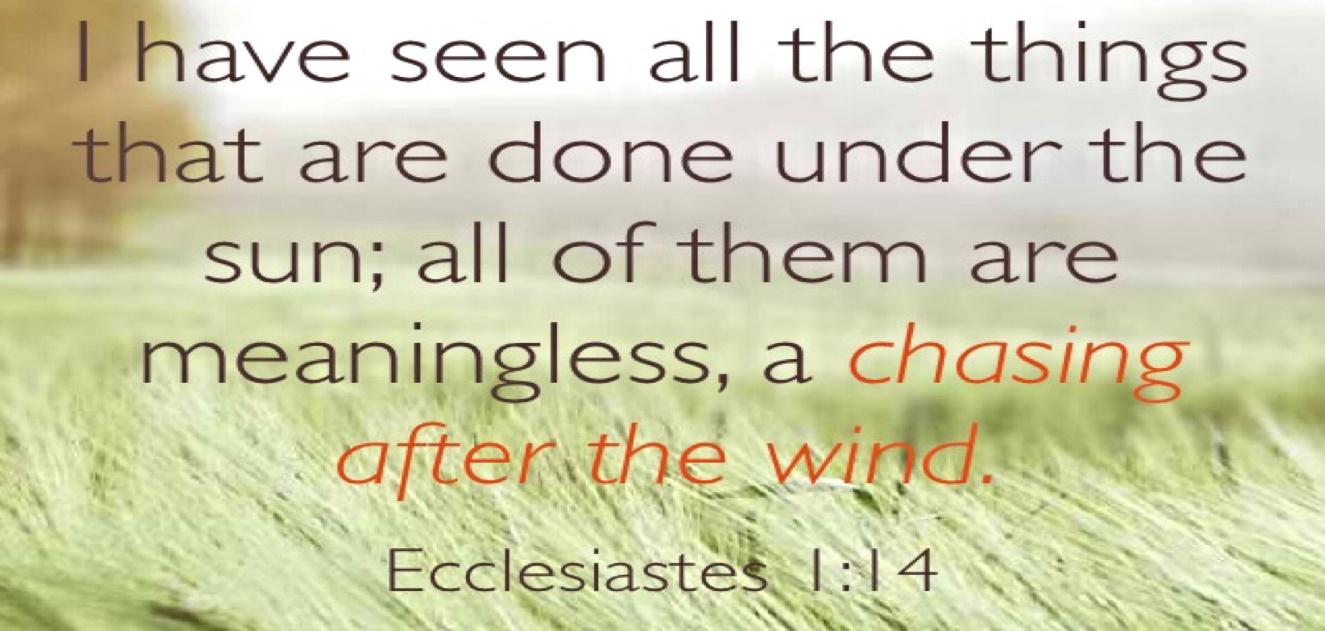
The wisdom of mankind will be one day vanish and become meaningless29
Mankind’s secular, worldly wisdom cannot permanently restore good in the world. Solomon looked at all that was “under heaven” (Ecc. 1:13) and all “done under the sun” (Ecc. 1:14). He could only see the futility of mankind as it tried to live according to its fallen worldly wisdom. Without Yahweh, “15 What is crooked cannot be straightened, and what is lacking cannot be counted.” (Ecc. 1:15). “I think he is making reference here to the fall of man. He is recognizing the fact that it is difficult for men to discover answers. There is something wrong inside of man … It is difficult for man to discover the answers to life, because when he sees something wrong there is yet somehow an inbuilt difficulty that prevents him from correcting it. Have you ever felt, as I have, that when things go wrong in your family, although you long to put them right somehow you cannot get hold of it, you cannot make it right? ‘That which is crooked cannot be made straight.’ One of the great frustrations of life is that no matter how hard you try there are some things you cannot set straight. Also, no matter how much you may discover, there is information you would long to have that you cannot find. ‘That which is lacking cannot be numbered.’ That was this man's problem.” (Ray Stedman on Ecc. 1:16-18).30
True wisdom that transforms and permanently restores comes from Jesus. Solomon revealed that true wisdom comes from Yahweh. “For the LORD gives wisdom; from His mouth come knowledge and understanding.” (Prov. 2:6). Yahweh is another name for the great “I AM”. Jesus revealed that He is the I AM of the Old Testament (Jo. 8:58; Ex. 3:14). Paul also made clear that all true wisdom comes from Jesus. “It is due to Him that you are in Christ Jesus, who became to us wisdom from God, and righteousness and sanctification, and redemption,” (1 Cor. 1:30). “in whom are hidden all the treasures of wisdom and knowledge.” (Col. 2:3). “that the God of our Lord Jesus Christ, the Father of glory, may give you a spirit of wisdom and of revelation in the knowledge of Him.” (Eph. 1:17). If you seek Jesus’ wisdom, you only need to read the Word, pray in faith, and ask for the right reasons. “But if any of you lacks wisdom, let him ask of God, who gives to all generously and without reproach, and it will be given to him.” (Jam. 1:5).
7. Fearing Jesus: While Worldly Wisdom and Pride Leads to Sorrow, Humility and the Fear of Jesus by Hating Evil Leads to Joy. Ecc. 1:16-18.
Worldly wisdom and pride eventually lead to sorrow and regret. God made Solomon wiser than any ruler before him. But he later hoarded wives and wealth out of pride. In the end, he felt only pain because of his lost fellowship with Yahweh. “16 I said to myself, ‘Behold, I have magnified and increased wisdom more than all who were over Jerusalem before me; and my mind has observed a wealth of wisdom and knowledge.’ 17 And I applied my mind to know wisdom and to know insanity and foolishness; I realized that this also is striving after wind. 18 Because in much wisdom there is much grief; and increasing knowledge results in increasing pain.” (Ecc. 1:16-18). Verse 16 again is part of the debate over Solomon’s authorship. Solomon was only the second Jewish king “over Jerusalem.” (Ecc. 1:16). The Jebusites controlled Jerusalem until David defeated them (2 Sam. 5:6-10). Thus, some argue that it would make no sense for Solomon to state that he was wiser than “all who were over Jerusalem before me;” (Ecc. 1:16).31 But these words could not apply to Jehoahaz, Jeconiah, or Zedekiah. They were among Judah’s most foolish kings. At a minimum, their wisdom never surpassed that of Solomon. Solomon was the wisest person to live until Jesus became flesh (2 Chr. 1:10-12; 1 Kgs. 3:12; 4:29-34; 10:23-24). Solomon did not limit himself to say that he was the wisest Jewish king over Jerusalem. Instead, he knew that he was the wisest Jewish or pagan ruler over Jerusalem because God told him that was the case. Thus, he was referring ‘“either to the line of unknown Jebusite rulers, including perhaps Melchizedek (Genesis 14:18), Adonizedek (Joshua 15:63; 2 Samuel 5:7) and others, or to the sages “Ethan the Ezrahite and Heman and Chalcol and Darda the sons of Mahol,’ who are named in 1 Kings 4:31, and who may, in some sense, as teachers and guides, have been ‘over’ as well as ‘in’ Jerusalem.” (Perowne on Ecc. 1:16).32 Solomon’s point was that wisdom was not enough to control his flesh. When he allowed his flesh to control him, he sinned against God. Thus, he felt regret and learned the need to fear God.
True wisdom also includes fearing the Lord by hating evil. Solomon admitted that he at one point gave his mind over to “insanity and foolishness;” (Ecc. 1:17). This could have included building pagan altars for the Jews to worship the pagan gods like Chemosh and Molech (1 Kgs. 11:5-8). Or, it spoke to all of his sins. In Proverbs, Solomon made clear that the beginning of God-given wisdom starts with the fear of the Lord. “The fear of the LORD is the beginning of wisdom, and the knowledge of the Holy One is understanding.” (Prov. 9:10; 1:7). “The fear of the LORD is the instruction for wisdom, and before honor comes humility.” (Prov. 15:33). This is also repeated in the Palms. “The fear of the LORD is the beginning of wisdom; all those who follow His commandments have a good understanding; His praise endures forever.” (Ps. 111:10). The fear of the Lord includes reverence. But Solomon also defined it as “hating” evil (Prov. 8:13). “Do not be wise in your own eyes; fear the LORD and turn away from evil.” (Prov. 3:7). This conclusion is repeated at the end of Ecclesiastes (Ecc. 12:13).
Pursuing the wisdom of your flesh only leads to sorrow. Solomon’s pursuit of his own wisdom only led to his self-gratification, “much grief”, and “increasing pain.” (Ecc. 1:18). Possibly from his own mistakes, Solomon therefore twice warned in Proverbs. “There is a way which seems right to a person, but its end is the way of death.” (Prov. 14:12; 16:25). Paul also warned, “Therefore what benefit were you then deriving from the things of which you are now ashamed? For the outcome of those things is death.” (Ro. 6:21). “For the one who sows to his own flesh will reap destruction from the flesh, but the one who sows to the Spirit will reap eternal life from the Spirit.” (Gal. 6:8).
Humble yourself to fully receive Jesus’ wisdom. Solomon’s wisdom led to his pride, him trusting his flesh, and his downfall. “Do you see a person wise in his own eyes? There is more hope for a fool than for him.” (Prov. 16:12). To avoid the same mistake, you must humble yourself and never seek to rely upon your own wisdom. “Take care that no one deceives himself. If anyone among you thinks that he is wise in this age, he must become foolish, so that he may become wise. For the wisdom of this world is foolishness in the sight of God. For it is written: “He is the One who catches the wise by their craftiness’;” (1 Cor. 3:18-19). “Claiming to be wise, they became fools,” (Ro. 1:22).
Turn to Jesus to find joy. Through Jesus, you can find lasting joy and peace (Jo. 15:11; Ro. 15:13; Phil. 4:4). Everything else either vanishes over time or turns to grief and sorrow. It is not done for Jesus’ glory. ‘“In much wisdom is much grief’ This is the message of the whole paragraph. Even the pursuit of wisdom, like everything else, is vanity and a striving after wind. In all of these negative and pessimistic statements, one should understand that their primary application is to every life that is without the blessed hope in Christ Jesus. This is the message that should be thundered in the ears of all mankind: You are never going to arrive at any worthwhile place without the Savior, the Lord Jesus Christ. You will never chase anything except ‘the wind’ unless you receive and obey Christ.” (James Burton Coffman’s Commentaries on the Bible, Ecc. 1:18).33
Tremper Longman III, The Book of Ecclesiastes, (Grand Rapids, MI, William B. Eerdman’s Publishing Company, 1998) pgs. 2-20.↩︎
E. Levine, The Aramaic Version of Qohlet, (New York, NY, Sepher-Hermon, 1978). p. 28.↩︎
Gregory Thaumaturgos (A.D. 213-270), a student of Origen, J. Jarick, Gregory Thaumaturgos’ Paraphrase of Ecclesiastes, (Scholars Press, Atlanta, GA 1990).↩︎
Scott Jones, 2014, Scandinavian Journal of the Old Testament, (PDF) Solomon's Table Talk: Martin Luther on the Authorship of Ecclesiastes M. Luther, “Notes on Ecclesiastes,” in Luther’s Works, vol. 15, ed. and trans. J. Pelikan (St. Louis, MO, Concordia,1972) p. 12. But others believe that Martin Luther “rejected Solomon as the single author of Ecclesiastes…” Sidney Greidanus, Preaching Christ from Ecclesiastes, (Grand Rapids, MI, William B. Eerdman’s Publishing Company, 2010), p. 7.↩︎
Strong's Hebrew: 6953. קֹהֶ֫לֶת (Qoheleth) -- 7 Occurrences↩︎
Tremper Longman III, The Book of Ecclesiastes, (Grand Rapids, MI, William B. Eerdman’s Publishing Company, 1998) pgs. 2-20.↩︎
David Gibson, Living Life Backward: How Ecclesiastes Teach Us To Live in Light of the End (Wheaton IL, Crossway Bibles, 2017), pgs. 4-9.↩︎
Image credit: southlife.org/may-11-2025/↩︎
Daniel L. Akin and Jonathan Akin, Christ-Centered Exposition, Exalting Jesus in Ecclesiastes, (Brentwood, TN, B&H Publishing Group, 2016), p. 9.↩︎
Image credit: Ecclesiastes 1: It’s All About God! – God Centered Life↩︎
Philip Ryken, Why Everything Matters: The Gospel in Ecclesiastes, (Glasgow, SCO, Crossway Bibles 2024) pgs. 12-13 (italics in original).↩︎
Sidney Greidanus, Preaching Christ from Ecclesiastes, (Grand Rapids, MI, William B. Eerdman’s Publishing Company, 2010), p. 47-48 (italics in original).↩︎
Image credit: Ecclesiastes 1:9↩︎
Ecclesiastes 1:12 I, the Teacher, was king over Israel in Jerusalem.↩︎
Tremper Longman III, The Book of Ecclesiastes, (Grand Rapids, MI, William B. Eerdman’s Publishing Company, 1998) pgs. 2-20.↩︎
Image credit: Ecclesiastes: The Wisest Book of All Time? | Aging Capriciously↩︎
Tremper Longman III, The Book of Ecclesiastes, (Grand Rapids, MI, William B. Eerdman’s Publishing Company, 1998) pgs. 2-20.↩︎
Ecclesiastes 1 - Coffman's Commentaries on the Bible - Bible Commentaries - StudyLight.org↩︎