Ecclesiastes 10: Lessons for Living Your Life with Jesus’ Wisdom
Introduction: Solomon looked back on a life of rebellion against God and lamented that his worldly accomplishments would soon vanish like smoke. Thus, he called life “under the sun” without Yahweh futility, meaningless, or vanity (he·ḇêl) “הֲבֵ֤ל”. Paul also called his worldly accomplishments “rubbish” (Phil. 3:8). Here, Solomon used a proverb-like style to urge people to follow the wisdom of Yahweh, another name for Jesus. Jesus is wisdom incarnate (Jo. 1:1,14). Through Him, the wisdom of God is available to everyone with faith (1 Cor. 1:24, 30). In a fallen world, living your life with Jesus’ wisdom requires: (1) vigilance, (2) diligence, (3) submission, (4) preparation, (5) restraint, (6) seeking Jesus’ guidance, and (7) living for Him.
First, Solomon warned that even a small sin when left unchecked can lead to dishonor. To live your life according to Jesus’ wisdom, Jesus wants you to be vigilant to avoid allowing sin to corrupt you. Second, Solomon warned that fools follow their own path. To avoid making foolish decisions, Jesus also wants you to be diligent to stay on His narrow path for you. Third, Solomon further warned against disobeying God’s appointed order. To live according to Jesus’ wisdom, He wants you to submit to authority unless it involves evil. Fourth, Solomon also warned that fools suffer harm after failing to prepare before implementing their plans. To avoid this outcome, Jesus also wants you to count the costs to prepare for any endeavor. Fifth, Solomon further warned against speaking rash words. To live according to Jesus’ wisdom, He wants you to restrain your flesh to avoid speaking rash words and instead speak words of grace. Sixth, Solomon also warned that fools become fatigued and see their efforts result in futility when they live according to their own wisdom. To avoid this outcome, Jesus also wants you to seek His guidance in all your endeavors and avoid relying upon your own wisdom. Finally, Solomon warned against the futility of a life devoted to pleasure and actions taken outside of God’s appointed times. Jesus wants you to live to fulfill His will and not your own desires.
1. Vigilance: To Live Your Life According to Jesus’ Wisdom, Be Vigilant to Avoid Allowing Sin to Corrupt You. Ecc. 10:1.
Be vigilant in avoiding sin. Solomon warned that even a little sin can quickly bring dishonor. “1 Dead flies turn a perfumer’s oil rancid, so a little foolishness is more potent than wisdom and honor.” (Ecc. 10:1). “When we think of dead flies, we realize they symbolize decay, impurity, and the idea of something being ruined beyond repair. The imagery indicates that regardless of how good or well-crafted the entity might be, a flaw can diminish its value. In this context, ‘ointment’ represents something precious and valuable. It signifies our wisdom, accomplishments, or reputation that we work hard to maintain. Just like a well-made perfume can evoke beauty and joy, our wisdom and honor can have a profound impact on those around us. ‘Folly,’ on the other hand, embodies poor judgment and foolish decisions. Solomon warns us that even a small amount of folly can overthrow a lifetime of wisdom.” (Christianitypath.com on Ecc. 10:1).1
The sin of one can affect the entire community. Solomon had just warned that the sins of one man can destroy much good. “Wisdom is better than weapons of war, but one sinner destroys much good.” (Ecc. 9:18). For example, as a result of Achan’s covetousness and disobedience, the Jews lost the important battle of Ai. (Josh. 7:2-5). “Did not Achan the son of Zerah act unfaithfully in the things under the ban, and wrath fall on all the congregation of Israel? And that man did not perish alone in his iniquity.’” (Josh. 22:20).

Don’t let sin corrupt what Jesus made holy and pure with His sacrifice at the cross.2
Even small, unchecked sins can eventually compromise your walk. Paul likewise warned that small sins can corrupt your overall walk with Jesus. “Your boasting is not good. Do you not know that a little leaven leavens the whole lump of dough?” (1 Cor. 5:6). “A little leaven leavens the whole lump of dough.” (Gal. 5:9). Jesus also warned that He is unlikely to use you if you are compromised by sin. “You are the salt of the earth; but if the salt has become tasteless, how can it be made salty again? It is no longer good for anything, except to be thrown out and trampled underfoot by people.” (Matt. 5:13).
2. Diligence: To Live Your Life According to Jesus’ Wisdom, Be Diligent to Stay on His Narrow Path for You. Ecc. 10:2-3.
Be diligent in staying on Jesus’ narrow path. The wise diligently pursue Jesus’ wisdom to stay on His holy path. In contrast, fools disgrace themselves by following their own instincts on the path that leads to ruin. “2 A wise person’s heart directs him toward the right, but the foolish person’s heart directs him toward the left. 3 Even when the fool walks along the road, his sense is lacking, and he demonstrates to everyone that he is a fool.” (Ecc. 10:2-3). “The right hand is the place of honor, the left of inferiority … The wise man’s mind shows him how to escape dangers and direct his course safely; the fool’s mind helps him not to any good purpose, causes him to err and miss his best object. As soon as ever he sets his foot outside the house, and mixes with other men, he exhibits his folly. If he remained at home he might keep his real ineptitude concealed; but such persons as he are unconscious of their inanity, and take no pains to hide it; they go where, they act as, their foolish heart prompts them.” (Pulpit Commentary, Ecc. 10:2-3).3

Be diligent to stay on Jesus’ narrow path for you.4
Because the heart is wicked, believers should not trust their own instincts. Believers cannot trust their instincts to pursue the correct path because the heart is wicked. “The heart is more deceitful than all else and is desperately sick; who can understand it?” (Jer. 17:9). “One who trusts in his own heart is a fool, but one who walks wisely will flee to safety.” (Prov. 28:26). Believers should instead trust Jesus to know His path. “Trust in the LORD with all your heart and do not lean on your own understanding.” (Prov. 3:5).
Be vigilant in guarding your heart by reading the Word, praying, and avoiding evil. Believers must be diligent in guarding their hearts. “Watch over your heart with all diligence, for from it flow the springs of life.” (Prov. 4:23). You can protect your heart by regularly reading the Word. “How can a young man keep his way pure? By keeping it according to Your word.” (Ps. 119:9). You can also protect your heart through prayer. “But if any of you lacks wisdom, let him ask of God, who gives to all generously and without reproach, and it will be given to him.” (Jam. 1:5; Matt. 7:7-8). You can further protect your heart by avoiding evil. “Every prudent person acts with knowledge, but a fool displays foolishness.” (Prov. 13:16). “A prudent person sees evil and hides himself, but the naive proceed, and pay the penalty.” (Prov. 22:3; 9:10).
The sins of those who trust in themselves soon become obvious. Jesus warns that you will know what path a person is on by the fruits of their actions. “You will know them by their fruits. Grapes are not gathered from thorn bushes, nor figs from thistles, are they?” (Matt. 7:16). “Either assume the tree to be good as well as its fruit good, or assume the tree to be bad as well as its fruit bad; for the tree is known by its fruit.” (Matt. 12:33).
3. Submission: To Live Your Life According to Jesus’ Wisdom, Submit to Authority Unless it Involves Evil. Ecc. 10:4-7.
Unless it involves evil, submit to civil leaders. Those who are wise submit to God’s appointed leaders unless the leaders order believers to engage in evil. “4 If the ruler’s temper rises against you, do not abandon your place, because composure puts great offenses to rest. 5 There is an evil I have seen under the sun, like a mistake that proceeds from the ruler: 6 foolishness is set in many exalted places while the rich sit in humble places. 7 I have seen slaves riding on horses and princes walking like slaves on the land.” (Ecc. 10:4-7). “[v. 4] Walking away from an angry superior might make him or her even more furious… [v. 5] The evil turns out to be the overturning of the political order … [v. 6] The very people who, according to verse 3, ‘lack sense’ have become rulers ... [v. 7] fools are ruling from palaces and servants are riding on horseback. Meanwhile the ruling class finds itself in low places and princes walk on foot…In the political arena, the benefits of wisdom are easily lost to a foolish error.” (Sidney Greidanus on Ecc. 10:4-7).5

Submit to Jesus by obeying His appointed order.6
Unless it involves evil, true wisdom comes in obeying authority. Believers are warned to obey civil authorities (Prov. 16:14; 24:21; Ecc. 10:20). As part of His sovereign plans, Jesus allows these authorities to exist until He returns and institutes His perfect government (Ro. 13:1-2; Dan. 2:21; 1 Pet. 2:13-14; Titus 3:1; Matt. 22:21). Believers should only refuse to obey authority if it involves evil (Ex. 1:17; Dan. 3:18; Acts 5:29).
When possible, try to avoid provoking an angry ruler. When faced with an angry leader, believers should attempt to avoid provoking the leader (Ecc. 10:4). This should include both patience and gentle persuasion. “Through patience a ruler may be persuaded, and a gentle tongue breaks bone.” (Prov. 25:15). “One who is slow to anger has great understanding; but one who is quick-tempered exalts foolishness.” (Prov. 14:29). “A gentle answer turns away wrath, but a harsh word stirs up anger.” (Prov. 15:1). “One who is slow to anger is better than the mighty, and one who rules his spirit, than one who captures a city.” (Prov. 16:32). “You know this, my beloved brothers and sisters. Now everyone must be quick to hear, slow to speak, and slow to anger;” (Jam. 1:19).
Unless leaders embrace evil, God does not want you to challenge leaders. Solomon warned of the evil that frequently follows when God’s intended order is undermined (Ecc. 10:5-7). Similar warnings appear in Proverbs. “Luxury is not fitting for a fool; much less for a slave to rule over princes.” (Prov. 19:10). “Under three things the earth quakes, and under four, it cannot endure: under a slave when he becomes king, …,” (Prov. 30:21-22a). Through Isaiah, God warned that He would overthrow the Jews appointed leaders and appoint unqualified leaders as a punishment. “And I will make mere boys their leaders, and mischievous children will rule over them,” (Is. 3:4).
God’s intended order may include elevating servants to become leaders. As an example to be avoided, Solomon warned against allowing an unqualified servant to lead (Ecc. 10:5-7). But God’s intended order frequently involves challenging the status quo. He frequently elevates the lowly to serve in places of leadership. “He raises the poor from the dust, He lifts the needy from the garbage heap to seat them with nobles, and He gives them a seat of honor as an inheritance; for the pillars of the earth are the LORD’S, and He set the world on them.” (1 Sam. 2:8). “He raises the poor from the dust, He lifts the needy from the garbage heap, to seat them with noblemen, with the noblemen of His people.” (Ps. 113:7-8). For example, through God’s providence, He elevated Joseph from being a slave in jail to becoming the second most powerful person in Egypt under Pharaoh (Gen. 41:40). Through God’s providence, He also elevated Mordecai to become the second most powerful person in Persia under Xerxes, aka Ahasuerus (Esther 10:3).
4. Preparation: To Live According to Jesus’ Wisdom, Prepare for Any Endeavor to Mitigate Risk and to Succeed for Jesus’ Glory. Ecc. 10:8-11.
Preparation is important in minimizing the risk of failure and harm in a fallen world. Those who are wise count the costs and seek God’s wisdom to prepare for any endeavor. Without Spirit-led preparation, some may experience negative outcomes ranging from failure to even injury. “8 One who digs a pit may fall into it, and a serpent may bite one who breaks through a wall. 9 One who quarries stones may be hurt by them, and one who splits logs may be endangered by them. 10 If the axe is dull and he does not sharpen its edge, then he must exert more strength. Wisdom has the advantage of bringing success. 11 If the serpent bites before being charmed, there is no benefit for the charmer. ” (Ecc. 10:8-11). [v. 8] “It is one of a string of proverb-like sayings which all seem to be illustrations of the one thought that every kind of work has its own appropriate and peculiar peril. … ‘He that diggeth a pit shall fall into it,’ often occurs as expressing the retribution in kind that comes down on the cunning plotter against other men’s prosperity, and the conclusion that wisdom suggests in that application of the sentence is, ‘Dig judiciously,’” (Alexander MacLaren’s Expositions of Holy Scripture, Ecc. 10:8).7 [v. 9] “The dangers to which such laborers are exposed are well known … As before said, the paragraph does not speak of retribution, but advises caution, enforcing the lesson by certain homely, allusions to the accidents that may occur in customary occupations. [v.10] The idea is taken up from ver. 8. If one handles a serpent without due precaution or without knowing the secret of charming it, one will suffer for it. [v. 11] The idea is taken up from ver. 8. If one handles a serpent without due precaution or without knowing the secret of charming it, one will suffer for it.” (Pulpit Commentary on Ecc. 10:9-11).8
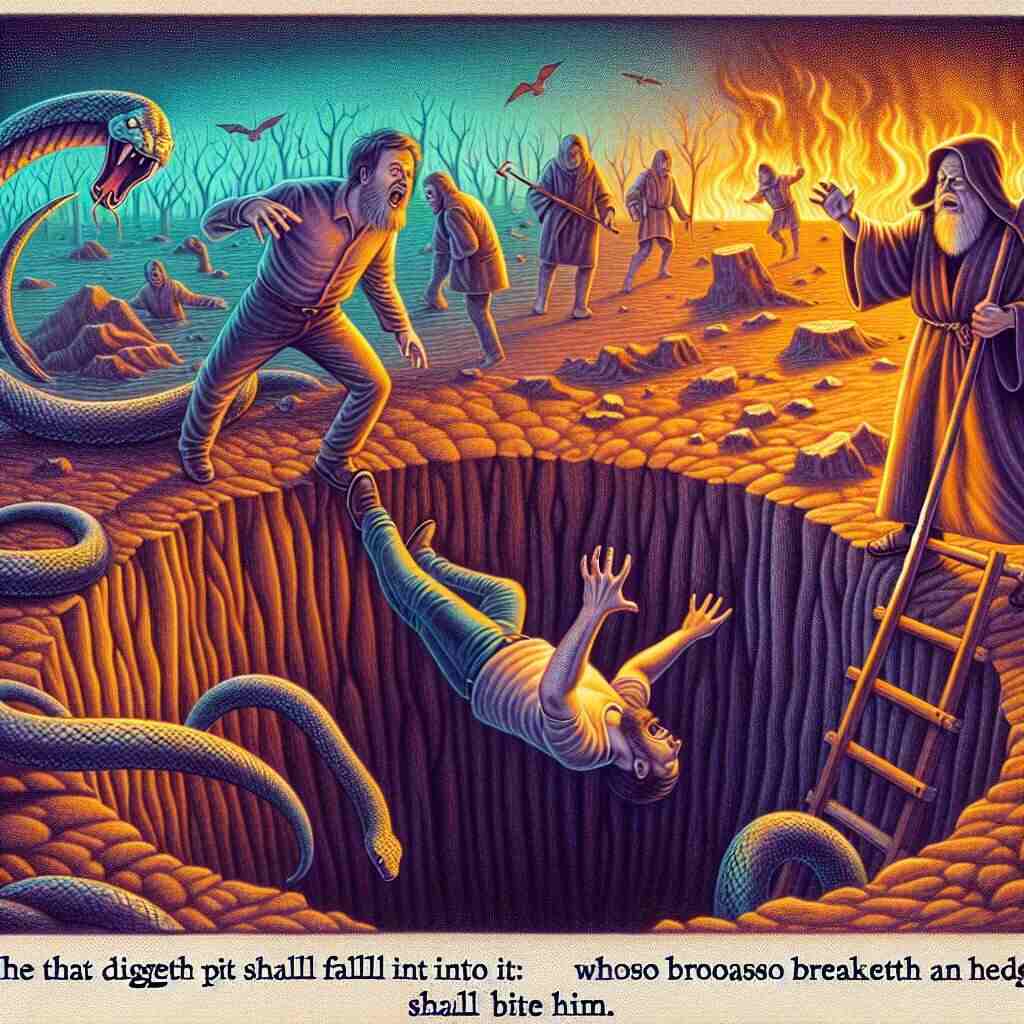
Jesus wants you to count the costs and prepare for the devil’s traps and schemes.9
Those who fail to prepare will frequently reap pain. Solomon warned that a person who digs a pit may fall into it (Ecc. 10:8). This is similar to Solomon’s proverbs warning that a person will reap what they sow. “One who digs a pit will fall into it, and one who rolls a stone, it will come back on him.” (Prov. 26:27). David also used the example of a person digging a pit to warn that people reap what they sow. “He has dug a pit and hollowed it out, and has fallen into the hole which he made. His harm will return on his own head, and his violence will descend on the top of his own head.” (Ps. 7:15-16). “They have prepared a net for my steps; my soul is bowed down; they dug a pit before me; they themselves have fallen into the midst of it. Selah” (Ps. 57:6). Although Solomon’s words in Ecclesiastes are not limited to those who plot evil, it remains true that people reap what they sow (Hos. 10:13; Gal. 6:7). This includes poor preparation.
Jesus wants you to be wise to mitigate risks through Spirit-led planning. Trusting Jesus does not mean that you should ignore the need for planning and preparation. Jesus warned: “For which one of you, when he wants to build a tower, does not first sit down and calculate the cost, to see if he has enough to complete it?” (Lk. 14:28). “The plans of the diligent certainly lead to advantage, but everyone who is in a hurry certainly comes to poverty.” (Prov. 21:5). “Also it is not good for a person to be without knowledge, and one who hurries his footsteps errs.” (Prov. 19:2). Thus, you should read the Word to stay on God’s path (Ps. 119:105). You should also pray for wisdom (Jam. 1:5). You should also seek godly counsel to ensure that a plan is Spirit-led. “Without consultation, plans are frustrated, but with many counselors they succeed.” (Prov. 15:22).
5. Restraint: To Live According to Jesus’ Wisdom, Restrain Your Flesh to Avoid Speaking Rash Words and Instead Speak Words of Grace. Ecc. 10:12-14.
Restrain your desire to speak rash words. Out of humility and to avoid causing careless harm, Solomon urged people to restrain their words. “12 Words from the mouth of a wise person are gracious, while the lips of a fool consume him; 13 the beginning of his talking is foolishness, and the end of it is evil insanity. 14 Yet the fool multiplies words. No person knows what will happen, and who can tell him what will come after him?” (Ecc. 10:12-14). “[v. 12] Qohelet [Solomon] begins his section on fools by comparing their speech to that of the wise. While the latter brings favor, the former brings harm…[v.14] Qohelet adds another stroke to his caricature of the fool: he talks incessantly about subjects that he knows nothing about.” (Tremper Longman III on Ecc. 10:12-14).10
Restrain your tongue from saying evil things and instead speak words of life to others.11
The wise restrain their tongues to avoid speaking rash, hurtful words. Solomon warned people to avoid the temptation to say rash things that can cause harm (Ecc. 10:13-14). “Do not be quick with your mouth or impulsive in thought to bring up a matter in the presence of God. For God is in heaven and you are on the earth; therefore let your words be few.” (Ecc. 5:2) “When there are many words, wrongdoing is unavoidable, but one who restrains his lips is wise … The lips of the righteous know what is acceptable, but the mouth of the wicked, what is perverted.” (Prov. 10:19, 32). “There is one who speaks rashly like the thrusts of a sword, but the tongue of the wise brings healing.” (Prov. 12:18). “One who withholds his words has knowledge, and one who has a cool spirit is a person of understanding.” (Prov. 17:27). “You know this, my beloved brothers and sisters. Now everyone must be quick to hear, slow to speak, and slow to anger;” (Jam. 1:19). “So also the tongue is a small part of the body, and yet it boasts of great things. See how great a forest is set aflame by such a small fire!” (Jam. 3:5).
Have the humility to avoid speaking about things that are beyond your knowledge. Fools speak about things of the future that are beyond their knowledge (Ecc. 10:14). God is sovereign and alone decides the future (Prov. 19:21). Thus, only a prideful fool speaks authoritatively about the future. “Do not boast about tomorrow, for you do not know what a day may bring.” (Prov. 27:1). “Come now, you who say, ‘Today or tomorrow we will go to such and such a city, and spend a year there and engage in business and make a profit.’ Yet you do not know what your life will be like tomorrow. For you are just a vapor that appears for a little while, and then vanishes away. Instead, you ought to say, “If the Lord wills, we will live and also do this or that.” (Jam. 4:13-15).
Those who are wise are gracious and speak words that uplift, encourage, and edify others. Instead of saying words that are rash and foolish, Solomon stated that a person’s words should be gracious Spirit-led words (Ecc. 10:12). “There is one who speaks rashly like the thrusts of a sword, but the tongue of the wise brings healing.” (Prov. 12:18). “Your speech must always be with grace, as though seasoned with salt, so that you will know how you should respond to each person.” (Col. 4:6). “Let no unwholesome word come out of your mouth, but if there is any good word for edification according to the need of the moment, say that, so that it will give grace to those who hear.” (Eph. 4:29).
6. Jesus’ Guidance: To Live According to Jesus’ Wisdom, Seek Jesus’ Guidance in All Your Endeavors and Avoid Relying Upon Your Own Wisdom. Ecc. 10:15.
Without Jesus’ wisdom, the fool frequently engages in futile, tiresome labors. Those who live according to their own wisdom or the wisdom of the world frequently find that their labor is both draining and futile. “15 The labor of a fool makes him so weary that he does not even know how to go to a city.” (Ecc. 10:15). “The labor of fools wearies them: The fool has no desire to work; or when they do, they quickly become wearied. They can’t see that it is wise to work now in order to prepare for the future. … They do not even know how to go to the city: The Preacher continued to subtly back away from his previous under the sun premise. The fool has no sense of direction or goal. They live their life as if it were meaningless, directionless.” (David Guzik on Ecc. 10:15).12
Those who ignore Jesus’ wisdom frequently bring harm to themselves. In Proverbs, Solomon wrote of the disaster that frequently follows for those who ignore Yahweh’s wisdom: “Because I called and you refused, I stretched out my hand and no one paid attention; and you neglected all my advice and did not want my rebuke; I will also laugh at your disaster; I will mock when your dread comes, when your dread comes like a storm and your disaster comes like a whirlwind, when distress and anguish come upon you.” (Prov. 1:24-27). God’s prophets also warned that the Jews brought disaster upon themselves when they failed to seek God’s guidance. “My people are destroyed for lack of knowledge. Since you have rejected knowledge, I also will reject you from being My priest. Since you have forgotten the Law of your God, I also will forget your children.” (Hos. 4:6). “Therefore, My people go into exile for their lack of knowledge; and their nobles are famished, and their multitude is parched with thirst.” (Is. 5:13).
Continually seek Jesus’ wisdom to guide your path. Those who follow the path that seems right in their own eyes frequently find sorrow, destruction, or futility (Prov. 14:12). If you instead follow Jesus’ word, He will guide you. “Your word is a lamp to my feet and a light to my path.” (Ps. 119:105). You will also never walk in darkness. “Then Jesus again spoke to them, saying, ‘I am the Light of the world; the one who follows Me will not walk in the darkness, but will have the Light of life.”’ (Jo. 8:12). But you must pray and obey the Spirit as He guides you. “But if any of you lacks wisdom, let him ask of God, who gives to all generously and without reproach, and it will be given to him.” (Jam. 1:5). “But the Helper, the Holy Spirit whom the Father will send in My name, He will teach you all things, and remind you of all that I said to you.” (Jo. 14:26).
7. Live for Jesus: To Live According to Jesus’ Wisdom, Live to Fulfill His Will and Not Your Own Desires. Ecc. 10:16-20.
The wise serve Jesus for His glory, not their own pleasure. Solomon concluded by warning of the adverse consequences when people live for their own pleasure instead of living for Yahweh and acting appropriately at the appointed times. “16 Woe to you, land whose king is a boy, and whose princes feast in the morning. 17 Blessed are you, land whose king is of nobility, and whose princes eat at the appropriate time—for strength and not for drunkenness. 18 Through extreme laziness the rafters sag, and through idleness the house leaks. 19 People prepare a meal for enjoyment, wine makes life joyful, and money is the answer to everything. 20 Furthermore, in your bedroom do not curse a king, and in your sleeping rooms do not curse a rich person; for a bird of the sky will bring the sound, and the winged one will make your word known.” (Ecc. 10:16-20). “The closing passage of Chapter 10 contrasts good and bad princes… There are three things men (humankind) do to display their foolishness. First, they prepare a meal for enjoyment … Rather than preparing a meal at the appropriate time (after the work is done) to gain strength, the foolish focus on pursuit of sensual pleasures such as drunkenness. They look to wine for gladness. They perceive that wine is what makes life merry. Lastly, they think money is the answer to everything … In all three cases, men display a false perspective of reality. They believe fulfillment in life comes from gaining sensual pleasures (such as food and drink) and the money to purchase such pleasures. Further, they believe anything else they might need is answered by having even more money. Chapter 10 ends with an admonition for the wise to be careful what they say about powerful people who could harm them.” (TheBibleSays.com on Ecc. 10:16-20) (italics in original).13
Avoid living to gratify the desires of your flesh. Solomon warned people not to live for pleasure. Among other things, this includes drunkenness, laziness, or feasting at the wrong times (Ecc. 10:16-19). Proverbs include similar warnings. “One who loves pleasure will become a poor person; one who loves wine and oil will not become rich.” (Prov. 21:17). “It is not for kings, Lemuel, it is not for kings to drink wine, or for rulers to desire intoxicating drink,” (Prov. 31:4). Believers are called upon to deny the desires of the flesh. “Let’s behave properly as in the day, not in carousing and drunkenness, not in sexual promiscuity and debauchery, not in strife and jealousy.” (Ro. 13:13). “for you were once darkness, but now you are light in the Lord; walk as children of light (for the fruit of the light consists in all goodness, righteousness, and truth),” (Eph. 5:8-9).
Avoid making excuses for failing to engage in physical or spiritual work. For emphasis, this was the second time that Solomon condemned a person for inventing excuses for refusing to work. “The lazy one says, ‘There is a lion outside; I will be killed in the streets!”’ (Prov. 22:13). On the day of judgment, many will also try and fail to offer excuses for their failure to serve Jesus. “Now the one who had received the one talent also came up and said, ‘Master, I knew you to be a hard man, reaping where you did not sow, and gathering where you did not scatter seed. And I was afraid, so I went away and hid your talent in the ground. See, you still have what is yours.” (Matt. 25:24-25).
Use your talents to serve Jesus. Solomon’s warnings against hedonism include laziness (Ecc. 10:18). Solomon frequently warned against the sin of slothfulness (Prov. 10:4-5; 12:24; 13:4; 19:15; 21:25; 24:30-34). Jesus judges those who fail to use their gifts for serving His Kingdom, which includes helping others in need. “But his master answered and said to him, ‘You worthless, lazy slave! Did you know that I reap where I did not sow, and gather where I did not scatter seed?’... For to everyone who has, more shall be given, and he will have an abundance; but from the one who does not have, even what he does have shall be taken away. And throw the worthless slave into the outer darkness; in that place there will be weeping and gnashing of teeth.” (Matt. 25:26, 29-30).
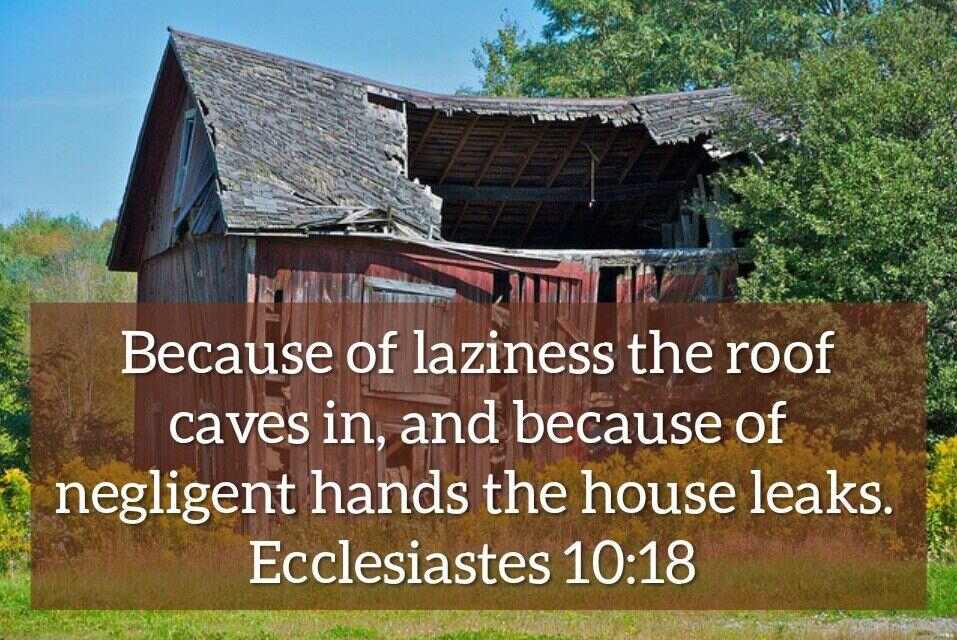
Diligently serve Jesus’ house with your time, talent, and treasure.14
Use your limited time to live for Jesus. Instead of living for pleasure, Jesus wants you to live for Him. “For to me, to live is Christ, and to die is gain.” (Phil. 1:21). “I have been crucified with Christ; and it is no longer I who live, but Christ lives in me; and the life which I now live in the flesh I live by faith in the Son of God, who loved me and gave Himself up for me.” (Gal. 2:20). When you live for Jesus, He will bless you with the peace that surpasses understanding. “And the peace of God, which surpasses all comprehension, will guard your hearts and minds in Christ Jesus.” (Phil. 4:7). Your works for Jesus will also be celebrated in heaven as an eternal treasure (Matt. 6:20).
Ecclesiastes 10:1 Meaning & Explanation (with Related Verses) - Christianity Path↩︎
Image credit: Ecclesiastes 10:1 | Bible verse pictures, Bible words images, Bible study verses↩︎
Image credit: A website for members and friends of the Church of the Nazarene↩︎
Sidney Greidanus, Preaching Christ from Ecclesiastes, (Grand Rapids, MI, William B. Eerdman’s Publishing Company, 2010), pgs. 252-253.↩︎
Image credit: https://i.pinimg.com/736x/74/d0/66/74d066fc8c45dde111de94fefa8d3447.jpg↩︎
Image credit: Ecclesiastes 10:8 Artwork | Bible Art↩︎
Tremper Longman III, The Book of Ecclesiastes, (Grand Rapids, MI, William B. Eerdman’s Publishing Company, 1998) pgs. 247-49.↩︎
Image credit: Ecclesiastes 10:12 - Bible verse (KJV) - DailyVerses.net↩︎
Enduring Word Bible Commentary Ecclesiastes Chapter 10 (italics in original).↩︎
Image credit: Day 2392 – Wisdom Nuggets – Ecclesiastes 10:15-20 – Daily Wisdom - Wisdom-Trek ©↩︎
