Ecclesiastes 11: Lessons For a Blessed Life Through Jesus’ Wisdom
Introduction: Here, Solomon continued his proverb-like teaching to urge people to follow the wisdom of Yahweh, another name for Jesus. Jesus is wisdom incarnate, and He makes His wisdom available to all (Jo. 1:1,14; 1 Cor. 1:24, 30). Through Solomon’s poetic words, the Bible reveals seven lessons for leading a blessed life. These include: (1) liberal giving, (2) faith in action, (3) faithfulness, (4) trust, (5) diligent service, (6) hope, and (7) gratitude contentment.
First, through a proverb, Solomon urged people to give generously to others in need and to trust in Yahweh to return what they gave in faith. Those who generously give to others in need with the right motives will lead a blessed life. Second, through a different proverb, Solomon revealed that Yahweh acts in mysterious ways and gives His people unexpected opportunities. Those who show that their faith is alive through their works with the opportunities Jesus provides will lead a blessed life. Third, through another proverb, Solomon cautioned that mankind will never be able to fully understand the details of God’s wondrous works. During times of uncertainty, those who faithfully serve Jesus without having all the answers will lead a blessed life. Fourth, through an additional proverb, Solomon warned that many parts of Yahweh’s sovereign rule will remain a mystery for most people. During both good and bad times, those who trust in Jesus’ loving sovereignty will lead a blessed life. Fifth, through a different proverb, Solomon cautioned against allowing uncertainty to delay serving Yahweh. Those who diligently serve Jesus without delay, even when life is uncertain, will lead a blessed life. Sixth, through the imagery of light and darkness, Solomon urged believers to put their hope in Yahweh when faced with days of darkness and the futility of a life that will end in death. During both good and bad times, those who put their hope in Jesus will lead a blessed life. Finally, Solomon urged believers to enjoy Yahweh’s provision while also being aware of Yahweh’s future judgment. Those who are both grateful and content with Jesus’ provision are blessed when they enjoy life as He intended.
1. Liberal Giving: Those Who Generously Give to Others in Need with the Right Motives Will Lead a Blessed Life. Ecc. 11:1-2.
Out of faith, be a good steward by giving liberally to the needy, and Jesus will provide. With bread being a symbol of Yahweh’s life-giving provision, Solomon urged believers to generously give away Yahweh’s provision to others who are in need. Yahweh in turn promises to fully provide for the needs of His faithful stewards. “1 Cast your bread on the surface of the waters, for you will find it after many days. 2 Divide your portion to seven, or even to eight, for you do not know what misfortune may occur on the earth.” (Ecc. 11:1-2). “In the Middle Ages, commentators often understood the words, ‘Send out your bread upon the waters’ as, Give to the oppressed! Give alms to the poor! That’s taking a real risk. From a secular perspective giving to the poor looks like money down the drain. We don’t know what the poor will do with the money. Moreover, we’ll never see that money again. But the Teacher assures us, ‘For after many days you will get it back.’ It will bear fruit. It will come back to you …verse 2 encourages us not to hang on to our possessions so tightly…Possessions cannot buy happiness. Possessions are to be used to help those in need. So verse 2 suggests that we ought to give liberally to the poor while we have possessions to give, ‘for you do not know what disaster may happen.’ That’s taking a big risk. It requires stepping out in faith with the assurance of verse 1 that ‘after many days you will get it back.”’ (Sidney Greidanus on Ecc. 11:1-2).1
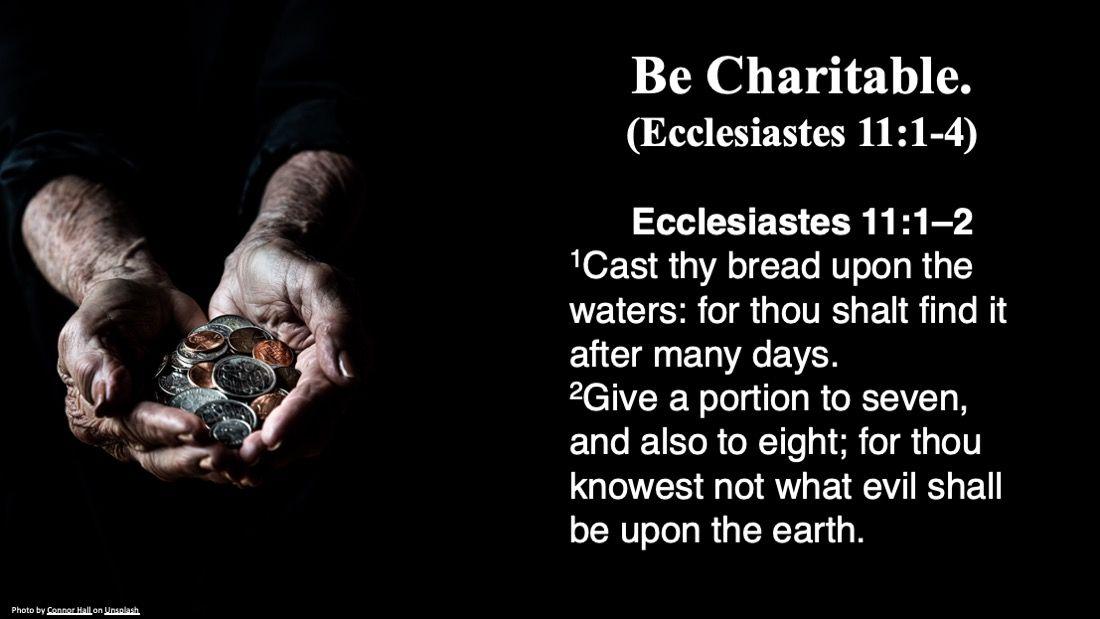
Be a generous giver of your time, talent, and treasure to help others in need.2
The fruit of your faith should include compassion for the needy. Those who have been made righteous through faith, should show Jesus’ love to others who are in need. “7 The righteous is concerned for the rights of the poor; the wicked does not understand such concern.” (Prov. 29:7). “Pure and undefiled religion in the sight of our God and Father is this: to visit orphans and widows in their distress, and to keep oneself unstained by the world.” (Jam. 1:27). Without a love for the poor, a person’s faith may be “dead”. “If a brother or sister is without clothing and in need of daily food, and one of you says to them, ‘Go in peace, be warmed and be filled,’ yet you do not give them what is necessary for their body, what use is that? In the same way, faith also, if it has no works, is dead, being by itself.” (Jam. 2:15-17). Failing to help the poor is a sin against Jesus. “For I was hungry, and you gave Me something to eat; I was thirsty, and you gave Me something to drink; I was a stranger, and you invited Me in; naked, and you clothed Me; I was sick, and you visited Me; I was in prison, and you came to Me.” (Matt. 25:35-36).
Jesus will provide for your needs when you provide for His people. Solomon promised that generosity will eventually return to you (Ecc. 11:1). Jesus will faithfully provide for your needs (not your wants) when you help others in need with the right motives. “One who is gracious to a poor person lends to the LORD, and He will repay him for his good deed.” (Prov. 19:17). “One who gives to the poor will never lack anything, but one who shuts his eyes will have many curses.” (Prov. 28:27). “Give, and it will be given to you. They will pour into your lap a good measure—pressed down, shaken together, and running over. For by your standard of measure it will be measured to you in return.” (Lk. 6:38). ‘“Bring the whole tithe into the storehouse, so that there may be food in My house, and put Me to the test now in this,’ says the LORD of armies, ‘if I do not open for you the windows of heaven and pour out for you a blessing until it overflows.”’ (Mal. 3:10).
Jesus loves a cheerful giver. Solomon urged believers to “2 Divide your portion to seven, or even to eight,” (Ecc. 11:2). Seven is the number of completeness. This suggests that Solomon urged believers to have the faith to fully give from the “first fruits” of their provision. “Honor the LORD from your wealth, and from the first of all your produce.” (Prov. 3:9; Dt. 26:1-2). Jesus loves a cheerful giver. “There is one who scatters, and yet increases all the more, and there is one who withholds what is justly due, and yet it results only in poverty. A generous person will be prosperous, and one who gives others plenty of water will himself be given plenty.” (Prov. 11:24-25). “Now I say this: the one who sows sparingly will also reap sparingly, and the one who sows generously will also reap generously. Each one must do just as he has decided in his heart, not reluctantly or under compulsion, for God loves a cheerful giver.” (2 Cor. 9:6-7).
Jesus’ timing may not be your timing. Solomon warned that the bread would return “after many days.” (Ecc. 11:1). Thus, you should not expect that Jesus will immediately restore what you give in faith. He will reward you in His perfect timing. “One who is generous will be blessed, because he gives some of his food to the poor.” (Prov. 22:9).
2. Faith Through Action: Those Who Show That Their Faith is Alive By Seizing The Opportunities That Jesus Provides Will Lead a Blessed Life. Ecc. 11:3.
Have faith in God’s provision and act upon the opportunities that He provides. To encourage believers to give liberally, Solomon reminded believers that Yahweh is both the source of life-giving rain and the author of every opportunity that a person encounters. “3 If the clouds are full, they pour out rain on the earth; and whether a tree falls toward the south or toward the north, wherever the tree falls, there it lies.” (Ecc. 11:3). ‘“Clouds full of rain’ illustrates God’s provision and reign over creation. Rain is a symbol of nourishment and blessing. Often in life, we find ourselves waiting for ‘rain’ to nourish our spiritual lives; this reminds us that God’s timing does not necessarily align with our expectations. Hence, we must trust His plans, knowing that what falls from the sky can enrich our lives. On the other hand, ‘a tree falls’ conveys something different. The idea of the tree remaining where it falls accentuates permanence. Decisions we make and events we experience may shape our trajectory in life, and we must learn to live with those outcomes. The natural world reflects God’s truths, and as we engage with it, we learn about our own path. This metaphor calls us to think carefully about our actions today because they will result in a specific outcome tomorrow. As we contemplate these phrases, we recognize that life is a combination of things we can control and things we cannot. The beauty of obedience lies in following God’s guidance while owning the gifts He provides us. In doing so, we foster a relationship with Him that is deeply rooted in trust and understanding, leading to a fruitful life.” (Christianitypath.com on Ecc. 11:3).3

In the face of the unknown, act in faith upon the opportunities that Jesus provides.4
Show your faith in Jesus’ provision by acting upon the opportunities that He provides. Yahweh is the author of life, and He decides who lives and when each person dies. “‘See now that I, I am He, and there is no god besides Me; it is I who put to death and give life. I have wounded and it is I who heal, and there is no one who can save anyone from My hand.” (Dt. 32:39). He alone provides the life-giving rain. “When He utters His voice, there is a roar of waters in the heavens, and He makes the clouds ascend from the end of the earth; He makes lightning for the rain, and brings out the wind from His storehouses.” (Jer. 10:13). “He also loads the clouds with moisture; He disperses the cloud of His lightning. It changes direction, turning around by His guidance, that it may do whatever He commands it on the face of the inhabited earth. Whether for correction, or for His earth, or for goodness, He causes it to happen.” (Job 37:11-13). He also provides every opportunity for you to serve. “The One forming light and creating darkness, causing well-being and creating disaster; I am the LORD who does all these things.” (Is. 45:7).
Show that your faith is alive by acting on the opportunities that Jesus provides. The symbolism of a fallen tree suggested an unexpected opportunity to harvest and use the wood for good (Ecc. 11:3). You can show that your faith is alive and well by acting upon the opportunities that Jesus provides. “For just as the body without the spirit is dead, so also faith without works is dead.” (Jam. 2:26). “for it is not the hearers of the Law who are righteous before God, but the doers of the Law who will be justified.” (Ro. 2:13).
3. Faithfulness: During Times of Uncertainty, Those Who Faithfully Serve Jesus Without Having All the Answers Will Lead a Blessed Life. Ecc. 11:4.
Do not allow uncertainty to delay service. Solomon used the image of an overly cautious farmer to urge all to faithfully serve Yahweh without delay: “4 One who watches the wind will not sow and one who looks at the clouds will not harvest.” (Ecc. 11:4). “Trusting in God’s timing can be difficult in times of uncertainty …When faced with uncertainty or impatience, we can find peace in knowing that God’s timing is always perfect … Ecclesiastes 11:4 reminds us to act now and not let fear or doubt freeze us. Just as you can’t guarantee which work idea or family moment will succeed, you must take that leap and invest in kindness, love, and generosity.” (Reverend Michael Johnson, Ecc. 11:4).5
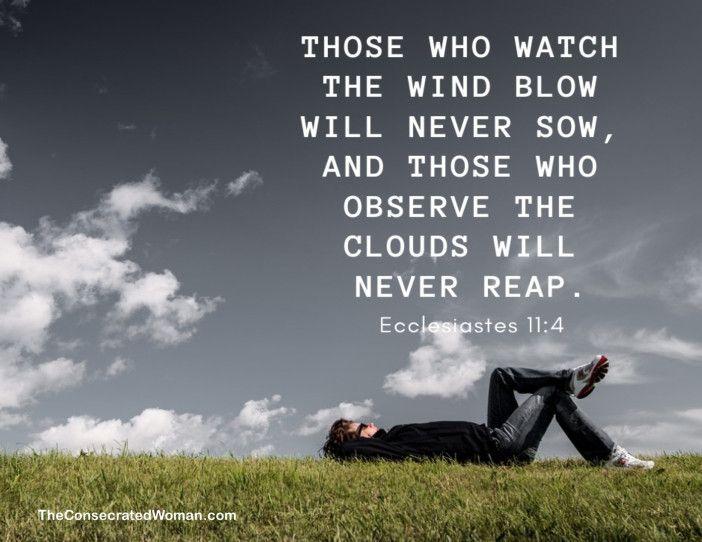
Being a spectator is not a spiritual gift. Be faithful to serve Jesus at all times.6
Use your limited time to faithfully serve Jesus. Because life is like a vapor, Solomon urged every person to use the opportunities that Yahweh provides to faithfully serve Him. “The lazy one does not plow after the autumn, so he begs during the harvest and has nothing.” (Prov. 20:4). “Whatever your hand finds to do, do it with all your might; for there is no activity or planning or knowledge or wisdom in Sheol where you are going.” (Ecc. 9:10). Solomon frequently warned against being slothful (Ecc. 10:18; Prov. 10:4-5; 12:24; 13:4; 19:15; 21:25; 24:30-34). Jesus judges those who fail to use their gifts for serving His Kingdom, which includes helping others in need. “But his master answered and said to him, ‘You worthless, lazy slave! Did you know that I reap where I did not sow, and gather where I did not scatter seed?’... For to everyone who has, more shall be given, and he will have an abundance; but from the one who does not have, even what he does have shall be taken away. And throw the worthless slave into the outer darkness; in that place there will be weeping and gnashing of teeth.” (Matt. 25:26, 29-30).
Jesus has given you a ministry field for service wherever He has placed you. Like Solomon, Paul urged believers to faithfully serve Jesus in whatever you do. “Whatever you do, do your work heartily, as for the Lord and not for people,” (Col. 3:23). “Therefore, my beloved brothers and sisters, be firm, immovable, always excelling in the work of the Lord, knowing that your labor is not in vain in the Lord.” (1 Cor. 15:58). “With goodwill render service, as to the Lord, and not to people,” (Eph. 6:7). “not lagging behind in diligence, fervent in spirit, serving the Lord;” (Rom. 12:11).
Show your appreciation by your faithfulness. To show their gratitude for their unearned redemption, Moses urged Israel to serve God with all their heart and soul: “And now, Israel, what does the LORD your God require of you, but to fear the LORD your God, to walk in all His ways and love Him, and to serve the LORD your God with all your heart and with all your soul,” (Dt. 10:12). Joshua gave a similar exhortation. “Now, therefore, fear the LORD and serve Him in sincerity and truth; and do away with the gods which your fathers served beyond the Euphrates River and in Egypt, and serve the LORD.” (Josh. 24:14). Samuel also implored the Jews to show their love for God through their service. “If you will fear the LORD and serve Him, and listen to His voice and not rebel against the command of the LORD, then both you and the king who reigns over you will follow the LORD your God. . . Only fear the LORD and serve Him in truth with all your heart; for consider what great things He has done for you.” (1 Sam. 12:14, 24).
Jesus is faithful to reward those who faithfully serve. You should not serve for rewards. But Jesus is faithful to honor those who faithfully serve Him. “With goodwill render service, as to the Lord, and not to people, knowing that whatever good thing each one does, he will receive this back from the Lord, whether slave or free.” (Eph. 6:7-8). “For God is not unjust so as to forget your work and the love which you have shown toward His name, by having served and by still serving the saints.” (Heb. 6:10).
4. Trust: During Both Good and Bad Times, Those Who Trust in Jesus’ Loving Sovereignty Will Lead a Blessed Life. Ecc. 11:5.
In the face of uncertainty, trust in Jesus’ loving providence. Like the path of the wind and formation of life inside the womb, there are many mysteries in life that most people do not fully understand. No matter what uncertainties you face, you can trust in Jesus’ sovereignty. “5 Just as you do not know the path of the wind, and how bones are formed in the womb of the pregnant woman, so you do not know the activity of God who makes everything.” (Ecc. 11:5). “In this verse are presented one or two examples of man's ignorance of natural facts and processes as analogous to the mysteries of God’s moral government. The word translated ‘spirit’ (ruach) may mean also ‘wind,’ … In this view there would be two instances given, viz. the wind and the embryo. Certainly, the mention of the wind seems to come naturally after what has preceded; and man’s ignorance of its way, and powerlessness to control it, are emblematic of his attitude towards Divine providence … And as everything lies in God’s hands, it must needs be secret and beyond human ken. This is why to ‘the works of God’ (Ecclesiastes 7:13) is added, ‘who maketh all.’ The God of nature is Lord of the future (comp. Amos 3:6; Ecclus. 18:6); man must not disquiet himself about this.” (Pulpit Commentary on Ecc. 11:5).7
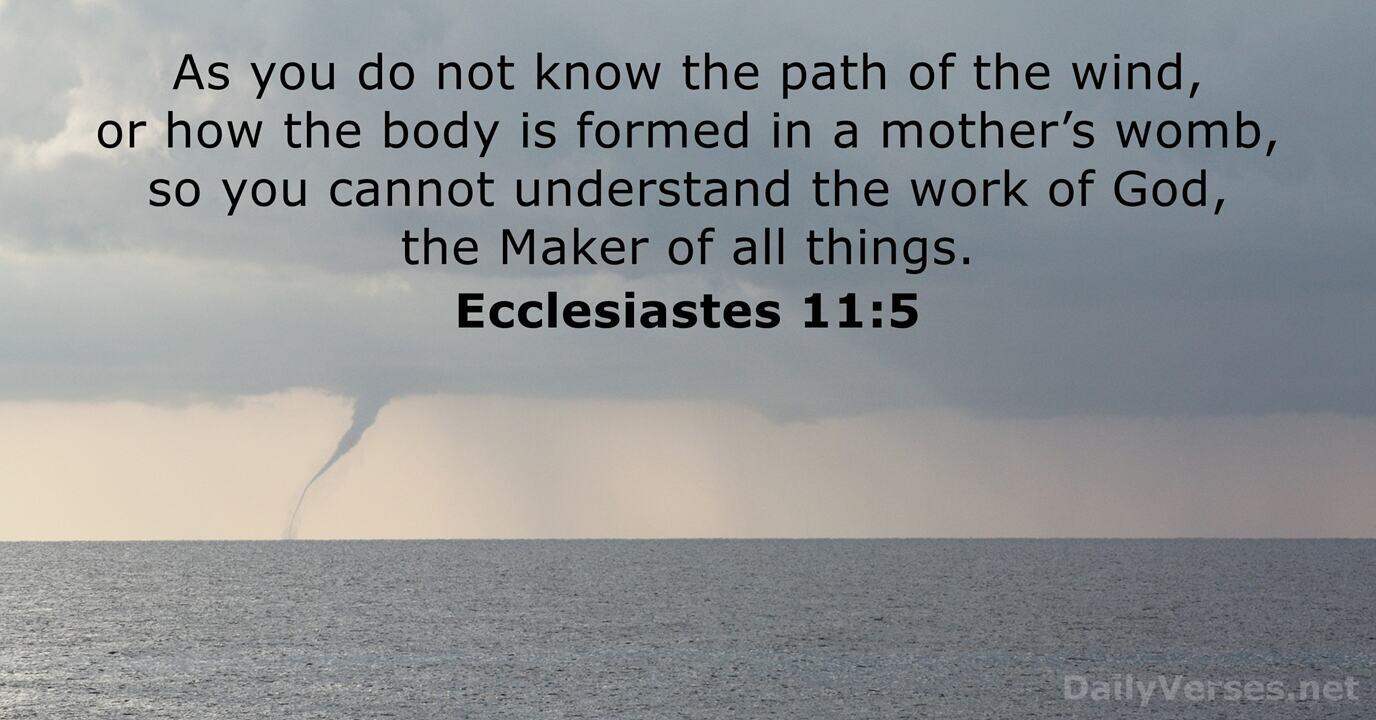
Even when the reasons for a trial are unclear, place your trust in Jesus’ sovereign power.8
No one is like Jesus or comparable to His sovereign power. Yahweh is the author of life inside the womb (Ps. 139:13-16). Thus, David proclaimed in awe, “8 There is no one like.” (Ps. 86:8). Moses and others made similar declarations: “Who is like You among the gods, LORD? Who is like You, majestic in holiness, awesome in praises, working wonders?” (Ex. 15:11). “You were shown these things so that you might know that the LORD, He is God; there is no other besides Him.” (Dt. 4:35). “‘See now that I, I am He, and there is no god besides Me; it is I who put to death and give life. I have wounded and it is I who heal, and there is no one who can save anyone from My hand.” (Dt. 32:39). “There is no one holy like the LORD, indeed, there is no one besides You, nor is there any rock like our God.” (1 Sam. 2:2). “For this reason You are great, Lord GOD; for there is no one like You, and there is no God except You, according to all that we have heard with our ears.” (2 Sam. 7:22). Neither Satan nor any other being comes close to God’s power. You can trust in Jesus’ power because He loves you (Jo. 3:16).
Jesus uses His sovereign will for good. Because Jesus creates both life-giving rain and life in the womb (Ecc. 11:5), you can trust that He uses His sovereign power for good. “And we know that God causes all things to work together for good to those who love God, to those who are called according to His purpose.” (Ro. 8:28). “In Him we also have obtained an inheritance, having been predestined according to the purpose of Him who works all things in accordance with the plan of His will,” (Eph. 1:11). “For our momentary, light affliction is producing for us an eternal weight of glory far beyond all comparison,” (2 Cor. 4:17). “The LORD has made everything for its own purpose,...” (Prov. 16:4). During uncertain times, you should therefore trust that Jesus is in control.
5. Diligent Service: Those Who Diligently Serve Jesus Without Delay, Even When Life is Uncertain, Will Lead a Blessed Life. Ecc. 11:6.
Even in the face of uncertainty, Jesus wants you to diligently serve. Only Jesus knows which labors will bear fruit. A person without faith might be paralyzed with inaction in the face of such uncertainty. Even when you don’t know the outcome, Jesus wants you to diligently serve Him at all times. “6 Sow your seed in the morning and do not be idle in the evening, for you do not know whether one or the other will succeed, or whether both of them alike will be good.” (Ecc. 11:6). “In the morning — Early and late, in all seasons, and on all occasions; do it speedily and continually: be not weary of it. Sow thy seed - Do all good works, especially that of alms-giving, as sowing means, 2 Corinthians 9:6; Galatians 6:7. In the evening withhold not thy hand — From working, or giving. For thou knowest not whether shall prosper -.” (Joseph Benson Commentary on Ecc. 11:6).9
Diligence requires daily prayer and reading the Word. In the face of the unknown, Jesus wants you to first seek His wisdom to know where to serve. This includes regular prayer. “Evening and morning and at noon, I will complain and moan, and He will hear my voice.” (Ps. 55:17). This also requires reading the Word on a regular basis. “Your word is a lamp to my feet and a light to my path.” (Ps. 119:105). “He awakens Me morning by morning, He awakens My ear to listen as a disciple.” (Is. 50:4b).
Do not delay in serving Jesus. Jesus has also given every believer an inheritance of “talents” that are to be used for His glory (Matt. 25:14-30). When one disciple asked Jesus, “‘Lord, permit me first to go and bury my father,’” He responded, “‘Follow Me, and allow the dead to bury their own dead.’” (Matt. 8:21-23). Thus, Jesus does not want you to wait to get your personal affairs in order or until you build your wealth before you go and serve Him. If you have been given gifts for teaching, preaching, hospitality, prayer or any other skill, He wants you to use those talents for His glory without delay.
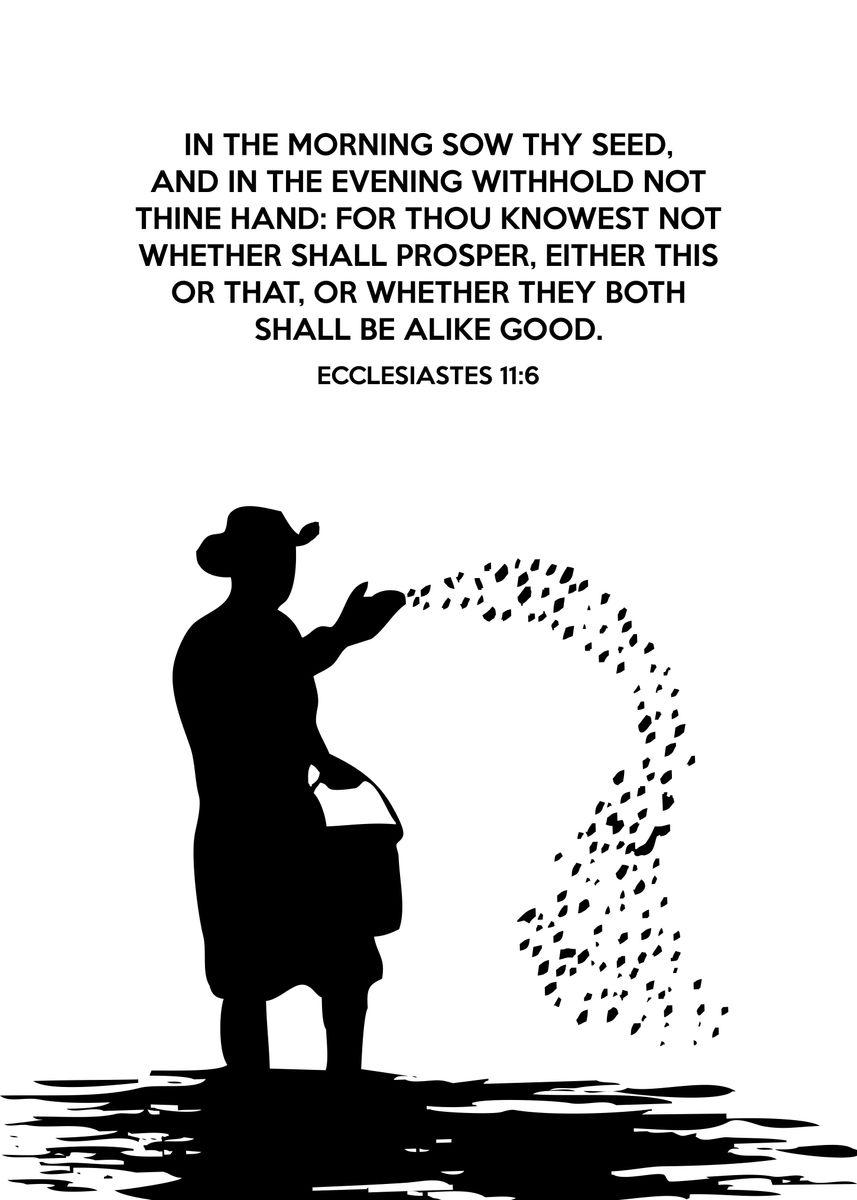
Diligently serve Jesus at all times by sowing the seed of His Word to the lost.10
6. Hope: During Both Good and Bad Times, Those Who Put Their Hope in Jesus Will Lead a Blessed Life. Ecc. 11:7-8.
During both good and bad times, put your hope in Jesus. Solomon warned that everything “under the sun” will eventually disappear like smoke. Thus, in both good and dark times, believers should put their hope in the light that Jesus provides. “7 The light is pleasant, and it is good for the eyes to see the sun. 8 Indeed, if a person lives many years, let him rejoice in them all; but let him remember the days of darkness, for they will be many. Everything that is to come will be futility.” (Ecc. 11:7-8). “Solomon makes a statement about a proper attitude toward our lifespan. The ‘daylight’ of our lifetime. As we grow old, we progress toward the end of day, the darkness of death. But life has episodes of darkness scattered throughout. The light is pleasant, and it is good for the eyes to see the sun. But there will be days of darkness as well … In many respects, the days of darkness bring potential for added gratitude for the light … This passage ends with a statement that summarizes our investment approach to thinking about the future: everything that is to come will be futility. The word translated futility is ‘hebel,’ which means vaporous, mysterious … We cannot make choices in the future. But our choices in the present can impact what the future will become.” (TheBibleSays.com, Ecc. 11:7-8).11
Jesus’ light offers hope to those trapped in darkness. Solomon referred to “The light” as both “pleasant” and “good for the eyes to see the sun.” (Ecc. 11:7). It is not pleasant to look directly into the “sun.” This verse instead foreshadows the pleasant light of the “Son” of God the Father, Jesus. He is the light of the world. “Then Jesus again spoke to them, saying, ‘I am the Light of the world; the one who follows Me will not walk in the darkness, but will have the Light of life.”’ (Jo. 8:12). While Solomon warned that life at times includes “days of darkness” (Ecc. 11:8), Jesus’ light frees you from having to remain in that darkness. But many can’t see past life “under the sun” to life “under the Son”. “In Him was life, and the life was the Light of mankind. And the Light shines in the darkness, and the darkness did not grasp it.” (Jo. 1:4-5). “I have come as Light into the world, so that no one who believes in Me will remain in darkness.” (Jo. 12:46).

Find hope in the light that Jesus provides to persevere through your trials.12
When you put your hope in Jesus, He offers His light during your “days of darkness.” Life has both darkness and futility because sin makes death inevitable (Ecc. 11:7-8). James also warned that life will vanish quickly (Jam. 4:14). But for those made righteous through faith, the light of Jesus can bring hope during the dark times. “Light is sown like seed for the righteous, and gladness for the upright in heart.” (Ps. 97:11). “The people who walk in darkness will see a great light; those who live in a dark land, the light will shine on them.” (Is. 9:2; Matt. 4:16). “For God, who said, ‘Light shall shine out of darkness,’ is the One who has shone in our hearts to give the Light of the knowledge of the glory of God in the face of Christ.” (2 Cor. 4:6). Paul urged believers to find strength by keeping their hope in Jesus. “For our momentary, light affliction is producing for us an eternal weight of glory far beyond all comparison, while we look not at the things which are seen, but at the things which are not seen; for the things which are seen are temporal, but the things which are not seen are eternal.” (2 Cor. 4:17-18; Ro. 8:24-25).
In the face of the futility of life under the sun, there is hope of eternal life under the Son. During the darkness of his trials when all life seemed futile, Job had the hope that his soul would be redeemed to see God’s light. “He has redeemed my soul from going to the pit, and my life will see the light.’” (Job 33:28). During his times of darkness, David also had hope that his soul would be redeemed to see this light. “For the fountain of life is with You; in Your light we see light.” (Ps. 36:9). “For You have saved my soul from death, indeed my feet from stumbling, so that I may walk before God in the light of the living.” (Ps. 56:13). Believers will one day no longer be forced to live under the futility of death “under the sun.” (Ecc. 11:8). They will instead enjoy the eternal light of joy and living under God the Father’s Son, Jesus Christ. “And there will no longer be any night; and they will not have need of the light of a lamp nor the light of the sun, because the Lord God will illuminate them; and they will reign forever and ever.” (Rev. 22:5).
7. Grateful Contentment: Those Who Are Both Grateful and Content With Jesus’ Provision Are Blessed When They Enjoy Life as Jesus Intended. Ecc. 11:9-10.
Be joyful with Jesus’ provision while enjoying His gifts in the manner that He intended. From their youth until their old age, believers should rejoice and enjoy every day that Jesus provides. But believers should fear judgment by enjoying life in the way Jesus intends. “9 Rejoice, young man, during your childhood, and let your heart be pleasant during the days of young manhood. And follow the impulses of your heart and the desires of your eyes. Yet know that God will bring you to judgment for all these things. 10 So remove sorrow from your heart and keep pain away from your body, because childhood and the prime of life are fleeting.” (Ecc. 11:9-10). “Solomon references judgment to encourage the reader to enjoy life, but to enjoy life as God intended, not following after our ‘own thoughts’ (Isa 65:2; cf. Ecc 7:29). The book has longed for judgment - for things to be set right. One thing judgment does is make our actions meaningful … Therefore, enjoy life responsibly as God designed. That means we don’t determine for ourselves how we will do marriage, food, drink, sex, finances, family, work, and relationships. We enjoy things in those areas of life the way the Bible has instructed us to. That’s how we seize the day.” (Daniel Akin and Jonathan Akin on Ecc. 11:9-10).13
Be grateful for Jesus’ provision. Instead of coveting evil things, Solomon repeatedly urged believers to be joyful and content with their God-given provision (Ecc. 9:7-9; 2:24; 3:12-13; 5:18-20; 8:15). Jesus wants you to be content (Phil. 4:11-13). He provides the means to live a joyful life. “Instruct those who are rich in this present world not to be conceited or to set their hope on the uncertainty of riches, but on God, who richly supplies us with all things to enjoy.” (1 Tim. 6:17). But His kingdom is more than just indulging in your God-given food and beverages. “for the kingdom of God is not eating and drinking, but righteousness and peace and joy in the Holy Spirit.” (Rom. 14:17). As you eat and drink, do so for Jesus’ glory by giving Him credit and expressing gratitude for His provision. “Therefore, whether you eat or drink, or whatever you do, do all things for the glory of God.” (1 Cor. 10:31). “Whatever you do in word or deed, do everything in the name of the Lord Jesus, giving thanks through Him to God the Father.” (Col. 3:17). “Then he said to them, “Go, eat the festival foods, drink the sweet drinks, and send portions to him who has nothing prepared; for this day is holy to our Lord. Do not be grieved, for the joy of the LORD is your refuge.” (Neh. 8:10; Dt. 12:7; Ps. 104:15).

Find joy and contentment in Jesus’ provision.14
Enjoy life by reaping the things of the Spirit and not the flesh. Even believers will be held to account for their decisions. “For we must all appear before the judgment seat of Christ, so that each one may receive compensation for his deeds done through the body, in accordance with what he has done, whether good or bad.” (2 Cor. 5:10). To properly enjoy Jesus’ gifts, be Spirit-led in all that you do. “But I say, walk by the Spirit, and you will not carry out the desire of the flesh.” (Gal. 5:16). “for if you are living in accord with the flesh, you are going to die; but if by the Spirit you are putting to death the deeds of the body, you will live.” (Ro. 8:13). If you delight in what Jesus wants for you, He will give you the desires of your heart. “Delight yourself in the LORD; and He will give you the desires of your heart.” (Ps. 37:4). “He will fulfill the desire of those who fear Him; He will also hear their cry for help and save them.” (Ps. 145:19).
Sidney Greidanus, Preaching Christ from Ecclesiastes, (Grand Rapids, MI, William B. Eerdman’s Publishing Company, 2010), p. 269-270.↩︎
Image credit: Four Guiding Principles for a Rewarding and Happy Life (Ecclesiastes 11) - "From The Heart of A Shepherd" by Pastor Travis D. Smith↩︎
Ecclesiastes 11:3 Meaning & Explanation (with Related Verses) - Christianity Path↩︎
Image credit: Ecclesiastes 11:3 Prayer: A Prayer for Understanding and Contentment in Life's Cycles | Bible Art↩︎
Image credit: Redirecting...↩︎
Image credit: Ecclesiastes 11:5 - Bible verse - DailyVerses.net↩︎
Image credit: 'Ecclesiastes 11 6' Poster, picture, metal print, paint by ABConcepts | Displate↩︎
Image credit: Day 2395 – Wisdom Nuggets – Ecclesiastes 11:7-10 – Daily Wisdom - Wisdom-Trek ©↩︎
Daniel L. Akin and Jonathan Akin, Christ-Centered Exposition, Exalting Jesus in Ecclesiastes, (Brentwood, TN, B&H Publishing Group, 2016), p. 114.↩︎
Image credit: Ecclesiastes 11:10 - Bible verse - DailyVerses.net↩︎