Ecclesiastes 12: Lessons for Avoiding the Futility and Emptiness of a Worldly Life and Instead Living Life as Jesus Intended for You
Introduction: Solomon found that everything “under the sun” without Yahweh is (he·ḇêl) “הֶ֙בֶל֙”, “futility,” “vanity,” or “meaningless”. Here, Solomon concluded with advice for avoiding a futile life. To avoid a life that is meaningless and to live life as Jesus intended, Jesus wants you to: (1) serve Him from childhood until death, (2) serve Him without delay, (3) serve Him with the best you have to offer, (4) put your hope in Him, (5) continually seek His Wisdom, (6) trusting in the guidance of your Good Shepherd, and (7) fear Him by obeying Him out of love.
First, Solomon urged believers to remember their Creator from childhood until death. To avoid an empty life and to live as Jesus intended, Jesus also wants you to remember and serve Him for your whole life, beginning in your childhood. Second, using poetic language used for the Day of Judgement, Solomon warned people to turn to Yahweh and serve Him before it is too late. Jesus also wants you to serve Him without delay. No one knows the day or the hour when their life will come to an end. Third, again using poetic language, Solomon warned that the human body will decay and grow weak with age. To avoid the regret of a wasted life, Jesus wants you to serve Him with the “first fruits” or the best of your life before you are physically or mentally unable to do so. Fourth, Solomon saw all life as broken and destined for a physical death. Because sin has placed everyone under the curse of a physical death, Jesus wants you to put your hope in Him for eternal life. Fifth, to help believers, Solomon shared his God-given wisdom through his many proverbs. Jesus makes the wisdom of God available to all. To avoid an empty life and to live as Jesus intended, Jesus also wants you to seek wisdom and guidance through His Word and prayer. Sixth, Solomon urged believers to trust in the guidance of the one “Shepherd.” Jesus is the “Good Shepherd”. He also wants you to trust in His guidance. Finally, Solomon concluded by urging believers to fear God by keeping His Commandments. To avoid an empty life of regret and to live as Jesus intended, Jesus also wants you to cling to what He calls good and hate what He calls evil (Prov. 8:13). This includes obeying His Commandments out of love.
1. Love Jesus from Childhood: To Avoid an Empty Life and to Live as Jesus Intended, Love Jesus for Your Whole Life, Beginning in Your Childhood. Ecc. 12:1.
Trust in Jesus as your loving Creator while you are still young. Solomon began his conclusions by urging believers to turn to Yahweh and to trust Him as their loving Creator from their youth. Those who wait will one day experience regret. “1 Remember also your Creator in the days of your youth, before the evil days come and the years approach when you will say, ‘I have no pleasure in them’;” (Ecc. 12:1). “The name of ‘Creator’ carries us back to Genesis, and suggests one great reason for the injunction. It is folly to forget Him on whom we depend for being; … The temptation of the young is to live in the present … Conversion is possible at any age, but it is less likely as life goes on. Most men who are Christians have become so in the formative period between boyhood and thirty. After that age, the probabilities of radical change diminish rapidly … If ever you turn to God in your older days, nothing will be so painful as the remembrance that you forgot Him so long. … Forget God, and life is a desert. Remember Him, and ‘the desert will rejoice and blossom as the rose.’… How dreary, too, it will be, if God is not the ‘strength of the heart,’ when ‘heart and flesh fail’! Therefore it is plain common sense, in view of the future, not to put off to old age what will bless youth, and keep the advent of old age from being wretched.” (Alexander MacLaren on Ecc. 12:1).1
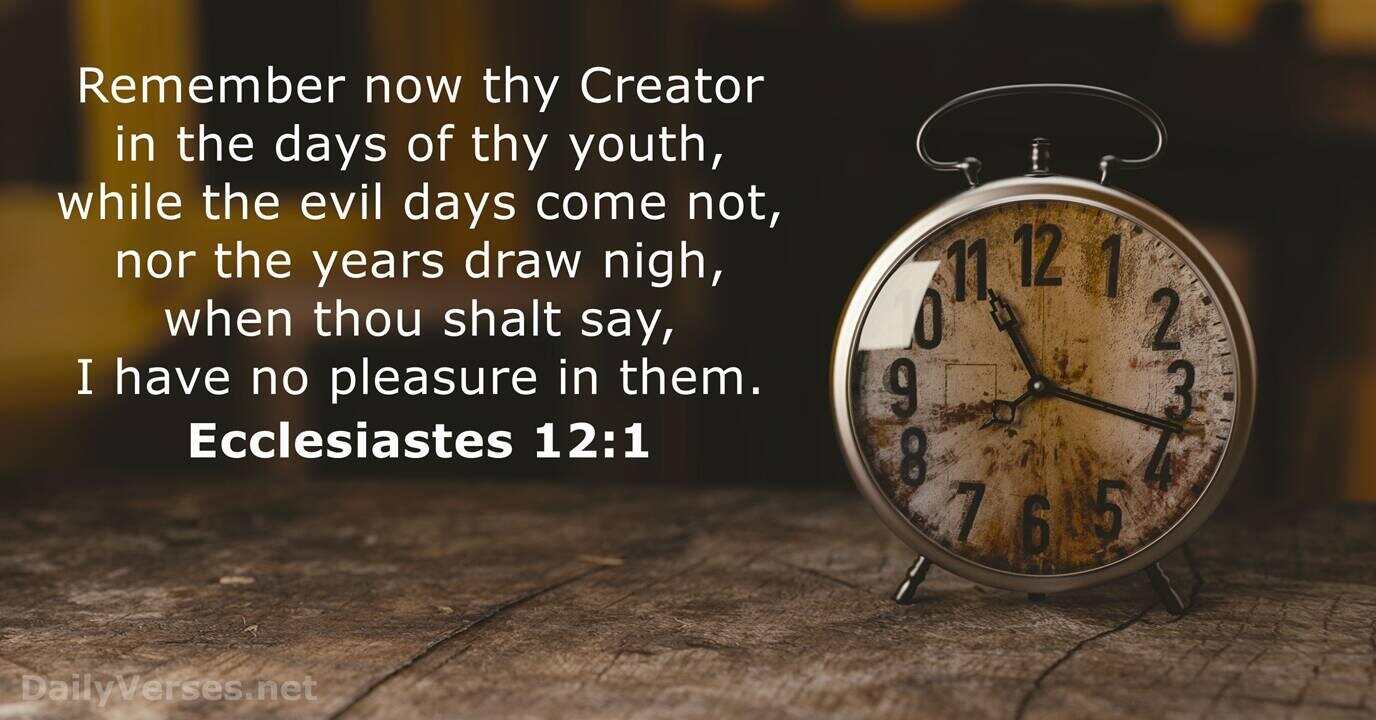
Serve God from your youth to avoid feelings of regret in your old age.2
As a young boy, David learned to place his hope in God. As a young shepherd, David placed his hope in God for survival: “for You are my hope; Lord God, You are my confidence from my youth.” (Ps. 71:5).3 David knew that God had been with him since He formed him in his mother’s womb (Ps. 71:6; Ps. 22:9-10). Other men of faith reached the same conclusion. “It is good for a man to bear the yoke in his youth.” (Lam. 3:37).
Every young person should read and place their trust in Jesus’ Word. To make Jesus your hope as a young person, you must read and learn to trust His Word. “How can a young man keep his way pure? By keeping it according to Your word.” (Ps. 119:9). “and that from childhood you have known the sacred writings which are able to give you the wisdom that leads to salvation through faith which is in Christ Jesus.” (2 Tim. 3:15).
Always have a child-like faith in Jesus. In addition to relying upon Jesus as a child, Jesus wants you to maintain faith in Him like a child does for a parent for as long as you live. “But Jesus called for the little ones, saying, ‘Allow the children to come to Me, and do not forbid them, for the kingdom of God belongs to such as these. But Jesus called for the little ones, saying, ‘Allow the children to come to Me, and do not forbid them, for the kingdom of God belongs to such as these.”’ (Lk. 18:16-17; Matt. 19:14; Mk. 10:14).
Throughout his life, David depended upon God to protect him from danger. From his youth he was a young shepherd protecting his flock until his old age when he protected God’s flock, David always depended upon God alone to deliver him from his many enemies: “Also, David was in great distress because the people spoke of stoning him, for all the people were embittered, each one because of his sons and his daughters. But David felt strengthened in the LORD his God.” (1 Sam. 30:6). “Arise, LORD; save me, my God! For You have struck all my enemies on the cheek; You have shattered the teeth of the wicked.” (Ps. 3:7). “Arise, LORD, confront him, make him bow down; save my soul from the wicked with Your sword,” (Ps. 17:13). “Save my soul from the sword, my only life from the power of the dog.” (Ps. 22:20). “Lord, how long will You look on? Rescue my soul from their ravages, my only life from the lions.” (Ps. 35:17). “For the music director. A Psalm of David. Rescue me, LORD, from evil people; protect me from violent men.” (Ps. 140:1). Thus, his hope was always in God: “And now, Lord, for what do I wait? My hope is in You.” (Ps. 39:7). “My soul, wait in silence for God alone, for my hope is from Him.” (Ps. 62:5). “For the needy will not always be forgotten, nor the hope of the afflicted perish forever.” (Ps. 9:18). “Blessed is he whose help is the God of Jacob, whose hope is in the LORD his God,” (Ps. 146:5). Throughout your life, Jesus also wants you to place your hope in Him alone: “This hope we have as an anchor of the soul, a hope both sure and reliable and one which enters within the veil,” (Heb. 6:19). It is human nature to rely upon our own abilities. But Jesus wants you to trust Him alone.
Throughout your life, always be thankful for Jesus’ many blessings in your life. Jesus wants you to “remember” Him with a life of sincere gratitude and worship for His love, mercy, grace, faithfulness, and deliverance. “And you shall remember all the way which the LORD your God has led you in the wilderness these forty years, in order to humble you, putting you to the test, to know what was in your heart, whether you would keep His commandments or not.” (Dt. 8:2). Among other times, Communion is one of your many opportunities to stop and “remember” Jesus’ blessings. “And when He had taken some bread and given thanks, He broke it and gave it to them, saying, ‘This is My body, which is being given for you; do this in remembrance of Me.”’ (Lk. 22:19; 1 Cor. 11:23-25).
Teach your children from an early age to put their trust in Jesus. You can also show your love for Jesus by teaching your children from an early age to also place their trust in Him. “And you shall love the LORD your God with all your heart and with all your soul and with all your strength. These words, which I am commanding you today, shall be on your heart. And you shall repeat them diligently to your sons and speak of them when you sit in your house, when you walk on the road, when you lie down, and when you get up.” (Dt. 6:5-67; 4:9). “We will not conceal them from their children, but we will tell the generation to come the praises of the LORD, and His power and His wondrous works that He has done.” (Ps. 78:4; 102:18; 145:4: Is. 38:19). “Train up a child in the way he should go, even when he grows older he will not abandon it.” (Prov. 22:6; Eph. 6:4).
2. Serve Jesus Without Delay: To Avoid an Empty Life and to Live as Jesus Intended, Serve Him Without Delay Before It is Too Late to Do So. Ecc. 12:2-4.
Turn to Jesus and serve Him before it is too late. Solomon used language from the Day of Judgment to urge everyone to turn to Yahweh and serve Him before each person suffers an unexpected end to their life. “2 before the sun and the light, the moon and the stars are darkened, and clouds return after the rain;” (Ecc. 12:2). “Solomon’s intention in this section is to explain that today is the day to turn to God – don’t delay … In order to accomplish his purpose, Solomon gives a sobering picture of the curse of death with the hope that it will drive us to God now… The vocabulary of the poem is apocalyptic. It uses language often used in passages that describe the end of the world, such as the darkening of the sun and moon (cf. Joel 3:15). The point in Ecclesiastes 12 is that your world personally will in death … we must turn to God before the astrological lights go out (12:2) … the clouds could refer to troubles that were minor setbacks in youth, but now the aged do not recover as quickly from them, or they never recover from them. Thus, the clouds never go away. ” (Daniel Akin and Jonathan Akin on Ecc. 12:2).4
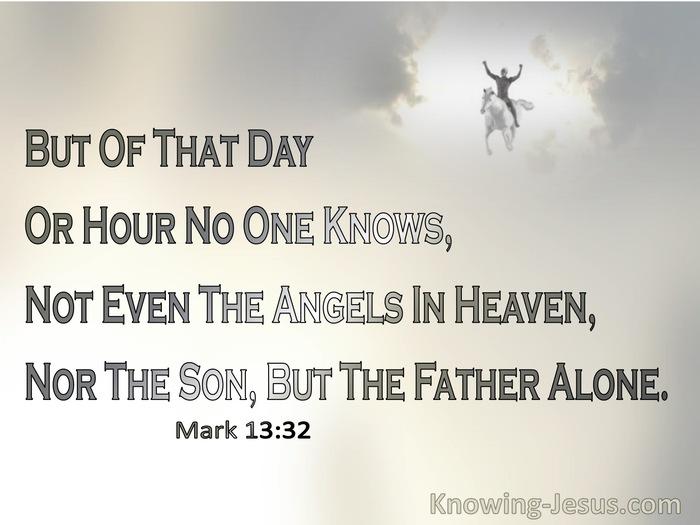
Do not delay because no one knows when your life will end or when Jesus will return.5
Do not delay in serving Jesus because you do not know when your health or life will end. The astrological imagery that Solomon used is similar to the imagery used throughout the Old Testament for the Day of Judgment. “For the stars of heaven and their constellations will not flash their light; the sun will be dark when it rises and the moon will not shed its light.” (Is. 13:10). “Before them the earth quakes, the heavens tremble, the sun and the moon become dark, and the stars lose their brightness.” (Joel 2:10). Jesus is clear that absolutely no one knows the exact day or the hour of His return (Matt. 24:36; Mk. 13:32). “But the day of the Lord will come like a thief, in which the heavens will pass away with a roar and the elements will be destroyed with intense heat, and the earth and its works will be discovered.” (2 Pet. 3:10). Believers should live each day expecting His return. Like the virgins who missed the bridegroom (Jesus) because they failed to fill their flasks with oil (symbolizing the Holy Spirit), you should always be ready for His return (Matt 25:1-13). If He had told you the exact time of His return, you would put off preparing for His return (Matt. 25:13). Thus, you should not delay in turning to Jesus.
Life is short and should not be squandered on futile, worldly things. Solomon previously lamented that life is like smoke “he·ḇêl” (Ecc. 1:2). Life quickly disappears. David also wrote, “Behold, You have made my days like hand widths, and my lifetime as nothing in Your sight; certainly all mankind standing is a mere breath. Selah Certainly every person walks around as a fleeting shadow; they certainly make an uproar for nothing; he amasses riches and does not know who will gather them.” (Ps. 39:5-6). “As for man, his days are like grass; like a flower of the field, so he flourishes.” (Ps. 103:15-16). “Man is like the breath; his days are like a passing shadow. When the wind has passed over it, it is no more, and its place no longer knows about it.” (Ps. 144:4). The brevity of life is also stressed in the New Testament as well. “Yet you do not know what your life will be like tomorrow. For you are just a vapor that appears for a little while, and then vanishes away.” (Jam. 4:14; 1 Pet. 1:24). Thus, you should use your limited time on Earth to live for Jesus and not for yourself (Phil. 1:21). When you live for Jesus, He will bless you with the peace that surpasses understanding. “And the peace of God, which surpasses all comprehension, will guard your hearts and minds in Christ Jesus.” (Phil. 4:7). Your works for Jesus will also be celebrated in heaven as an eternal treasure (Matt. 6:20).
Do not delay in your appointed calling to serve Jesus. Jesus created every person with a special purpose to serve Him and others in need with good works for His Kingdom. “For we are His workmanship, created in Christ Jesus for good works, which God prepared beforehand so that we would walk in them.” (Eph. 2:10). “Therefore, if anyone cleanses himself from these things, he will be a vessel for honor, sanctified, useful to the Master, prepared for every good work.” (2 Tim. 2:21). Jesus has also given you gifts for you to use as a co-builder of His Church: “As each one has received a special gift, employ it in serving one another as good stewards of the manifold grace of God.” (1 Pet. 4:10; Ro. 12:6-8; Eph. 4:11-12; 1 Cor. 12:1-7). Every person’s gift is needed in the body of Christ because no one person has them all (1 Cor. 12:13-27). But just as a star will dim after it burns out, so too will the human body. Jesus wants you to turn to Him and serve Him while you still have the energy and ability to do so. Throughout the Bible, God condemned those who delayed in fulfilling their vows to Him (Dt. 23:21; Ps. 119:60; Ecc. 5:4). Jesus also condemns those who delay in making vows to serve Him. For example, He rebuked a disciple who wanted to delay in serving Him: “Another of the disciples said to Him, ‘Lord, permit me first to go and bury my father.”’ (Matt. 8:21). Jesus also gave us the parable of the ten virgins to illustrate that some will foolishly wait until it is too late to accept Him (Matt. 25:1-13). Before you lose your health from an accident, illness, or age, turn to Jesus and serve Him as He intended.
3. Give Jesus Your First Fruits: To Avoid the Pain of a Wasted Life, Give Jesus the First Fruits or the Best of Your Life Before Your Strength Fades. Ecc. 12:3-5.
Serve Jesus before your body deteriorates from age or illness. Using poetic imagery to represent distinct parts of a body failing due to age or illness, Solomon urged believers to serve Yahweh before they are physically unable to do so. “3 on the day that the watchmen of the house tremble, and strong men are bent over, the grinders stop working because they are few, and those who look through windows grow dim; 4 and the doors on the street are shut as the sound of the grinding mill is low, and one will arise at the sound of the bird, and all the daughters of song will sing softly. 5 Furthermore, people are afraid of a high place and of terrors on the road; the almond tree blossoms, the grasshopper drags itself along, and the caper berry is ineffective. For man goes to his eternal home while the mourners move around in the street.” (Ecc. 12:3-5). “The Preacher uses the way in which a once magnificent building becomes dilapidated and ruined to depict what it is like to find your body failing with age. It is a powerful collection of metaphors and allusions. The ‘keepers of the house,’ which now tremble, are your hands, once strong and capable of defending you and providing for others…The ‘strong men’ now stooping are legs, no longer able to bear your own weight. ‘Grinders’ are teeth, ‘windows’ are eyes, ‘doors’ are ears, and eventually they each fail, no longer able to chew sufficiently, or see completely, or hear perfectly… Old age brings with it light sleep and early waking, a fear of crashing to the ground, of the unknown, and of venturing outdoors (12:5)… Hair turns snow white: ‘the almond tree blossoms.’…It all ends, of course, with a funeral. One day death arrives.” (David Gibson on Ecc. 12:3-5).6

Serve Jesus with the first fruits of your life before age robs you of the ability to serve.7
The strength of life will fade quickly. During his trials, Job lamented that life is short. Under the curse of sin, all will wither in strength over time. “Man, who is born of woman, is short-lived and full of turmoil. Like a flower he comes out and withers. He also flees like a shadow and does not remain.” (Job 41:1-2). Unlike Jesus’ Word, the strength of a person will fade like the grass. “A voice says, ‘Call out.’ Then he answered, ‘What shall I call out?’ All flesh is grass, and all its loveliness is like the flower of the field. The grass withers, the flower fades, when the breath of the LORD blows upon it; the people are indeed grass! The grass withers, the flower fades, but the word of our God stands forever.” (Is. 40:6-8; Ps. 102:11; 103:15-16; 1 Pet. 1:24-25).
Many have become spiritually blind during the prime of their lives. Solomon lamented how old age robs most people of sight, “those who look through windows grow dim.” (Ecc. 12:3). Old age can also rob people of the ability to clearly hear, “the doors on the street are shut as the sound of the grinding mill is low,” (Ecc. 12:4). But Jesus pointed out that many are spiritually blind when they are in perfect health. “Therefore I speak to them in parables; because while seeing they do not see, and while hearing they do not hear, nor do they understand.” (Matt. 13:13; Mk. 4:12; Lk. 8:10).
Give Jesus the first fruits of your life. As a sign of their love for Yahweh, believers are encouraged to give the first fruits of their time, talent, and treasure. “Honor the LORD from your wealth, and from the first of all your produce;” (Prov. 3:9; Dt. 26:1-2). This includes making your life a living sacrifice for Jesus. “Therefore I urge you, brothers and sisters, by the mercies of God, to present your bodies as a living and holy sacrifice, acceptable to God, which is your spiritual service of worship.” (Ro. 12:1). You have far more to offer Jesus as a servant when you are young and full of energy than in old age.
When you turn to Jesus, He will be with you and can strengthen you in your old age. Although everyone will age and lose strength, Jesus will not abandon you as you turn old. “Even to your old age I will be the same, and even to your graying years I will carry you! I have done it, and I will bear you; and I will carry you and I will save you.” (Is. 46:4). “And even when I am old and gray, God, do not abandon me, until I declare Your strength to this generation, Your power to all who are to come.” (Ps. 71:18). “They will still yield fruit in advanced age; they will be full of sap and very green,” (Ps. 92:14). Even as your body fails from poor health or advancing age, Jesus can renew you and strengthen you if you turn to Him. “Therefore we do not lose heart, but though our outer person is decaying, yet our inner person is being renewed day by day.” (2 Cor. 4:16).
4. Hope in Jesus: Because Sin Has Placed Everyone Under the Curse of a Physical Death, Put Your Hope in Jesus for Eternal Life. Ecc. 12:6-8.
Faith in Jesus as Lord and Savior is the only hope of escaping the curse of death. Without knowing the hope that Jesus offers, Solomon saw life as “broken” and destined to an inevitable death. Any attempt to find eternal meaning in life on Earth is “he·ḇêl” or futility. “6 Remember your Creator before the silver cord is broken and the golden bowl is crushed, the pitcher by the spring is shattered and the wheel at the cistern is crushed; 7 then the dust will return to the earth as it was, and the spirit will return to God who gave it. 8 ‘Futility of futilities,’ says the Preacher, ‘all is futility!’” (Ecc. 12:6-8). “Note the repetition in verse 6: ‘broken,’ ‘broken,’ ‘broken.’ Life is broken beyond repair. Death is final and irreversible. Remember your Creator before you die! …[v.7] Here, the Teacher pictures death as the reversal of creation. The dust from which God made us returns to the earth: dust to dust… Our life is a gift from God. At death God takes it back again.” The Teacher has stretched the reality of human deterioration and death so graphically for only one reason: to urge young people to remember their Creator before it is too late… [v.8] Literally he says, ‘vapor of vapors; all is vapor’. A vapor exists on earth for only a moment and then it’s gone. Human life is like vapor. Your life on earth is fleeting. It goes by in a flash … The Old Testament Teacher thought that death was the end. From the New Testament we know that Jesus conquered death and that through him there is life beyond death.” (Sidney Greidanus on Ecc. 12:6-8).8
When each person dies, he or she will give an account of their lives. Upon death, “the spirit will return to God who gave it.” (Ecc. 12:7b). “This is why it is so important to remember your Creator in this life; because when this life is over, one will answer to the eternal God and to eternity.” (David Guzik on Ecc. 12:7) (emphasis in original).9
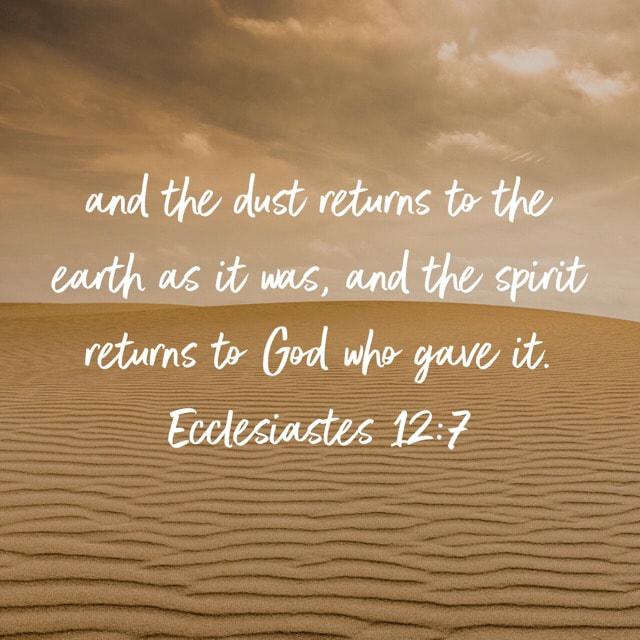
Put your hope in Jesus because there is no lasting hope in the things of this world.10
Without Jesus, there is no hope. Solomon saw life “under the sun” without Yahweh as hopeless, futile, or meaningless (Ecc. 1:2, 1:14; 2:11; 2:17; 2:26; 3:19; 4:4; 5:10; 6:12; 7:7; 8:14; 9:9; 11:8l 12:8.) Without Jesus, life will come to an end without hope of life after death. Jesus made you from the dust (Gen. 2:7). When you die, you will return to the dust (Gen. 3:19; Ecc. 12:7). “For there is hope for a tree, when it is cut down, that it will sprout again, and its shoots will not fail. Though its roots grow old in the ground, and its stump dies in the dry soil, at the scent of water it will flourish and produce sprigs like a plant. But a man dies and lies prostrate. A person passes away, and where is he? As water evaporates from the sea, and a river becomes parched and dried up, so a man lies down and does not rise. Until the heavens no longer exist, he will not awake nor be woken from his sleep.” (Job 14:7-12). “For the wages of sin is death,…” (Rom. 6:23a). “For the creation was subjected to futility, not willingly, but because of Him who subjected it, in hope” (Rom 8:20). It is also futile to think that you can take anything with you after dying to help you find eternal life or eternal comfort. “As he came naked from his mother’s womb, so he will return as he came. He will take nothing from the fruit of his labor that he can carry in his hand.” (Ecc. 5:15). “For we have brought nothing into the world, so we cannot take anything out of it, either.” (1 Tim. 6:7).
When you suffer, Jesus offers hope. All will die and suffer because of sin. But, when you suffer or face trials, Jesus offers you the hope of a joyful eternal life with Him in heaven. “For since by a man death came, by a man also came the resurrection of the dead. For as in Adam all die, so also in Christ all will be made alive … For this perishable must put on the imperishable, and this mortal must put on immortality. But when this perishable puts on the imperishable, and this mortal puts on immortality, then will come about the saying that is written: ‘Death has been swallowed up in victory.”’ (1 Cor. 15:21-22, 53-54). “For we know that if our earthly tent which is our house is torn down, we have a building from God, a house not made by hands, eternal in the heavens. For indeed, in this tent we groan, longing to be clothed with our dwelling from heaven, since in fact after putting it on, we will not be found naked.” (2 Cor. 5:1-3). “who will transform the body of our lowly condition into conformity with His glorious body, by the exertion of the power that He has even to subject all things to Himself.” (Phil. 3:21).
A life devoted to Jesus is meaningful. When you live for Jesus, the devil will try to make you think that your life has no lasting impact. Isaiah had to walk naked for 3 years (Is. 20:3). According to Jewish and Christian tradition, King Manasseh later had him sawed in half and killed while hiding in a hollow log. This is believed to be alluded to in Hebrews 11:37. He died without any worldly evidence that his prophetic warnings had any impact. He would have had no way of knowing that his writings would one day be placed first amongst the major Old Testament prophetic books. Your works for Jesus might also seem to go either unappreciated or without any lasting impact. But Jesus designed things so that one person would sow and another would reap, most likely to avoid pride. “For in this case the saying is true: ‘One sows and another reaps.’” (Jo. 4:37). When you suffer or your labors appear pointless, place your hope in Jesus. Paul, who also suffered greatly without knowledge of his impact, wrote: “Now may the God of hope fill you with all joy and peace in believing, so that you will abound in hope by the power of the Holy Spirit.” (Ro. 15:13). “Now may our Lord Jesus Christ Himself and God our Father, who has loved us and given us eternal comfort and good hope by grace, comfort and strengthen your hearts in every good work and word.” (2 Thess. 2:16-17).
5. Seek Jesus’ Wisdom: To Avoid an Empty Life and to Live as Jesus Intended, Seek Wisdom and Guidance Through Jesus’ Word and Prayer. Ecc. 12:9-10.
Throughout your life, Jesus wants you to seek His Wisdom through His Word and prayer. Jesus gave Solomin wisdom that was greater than any other person (1 Kgs. 3:12; 4:29-34; 10:23-24; 2 Chr. 9:22-23). To help believers live meaningful and fulfilling lives, Solomon shared this wisdom through his proverbs. “9 In addition to being wise, the Preacher also taught the people knowledge; and he pondered, searched out, and arranged many proverbs. 10 The Preacher sought to find delightful words and to write words of truth correctly.” (Ecc. 12:9-10). Solomon is the author of all but the last two chapters of Proverbs (Prov. 1:1; 25:1). But some modern scholars argue that a new writer drafted this epilogue on the belief that the author allegedly “studied proverbs and did not invent new ones”.11 Yet others adopt the view that Solomon was the author, possibly aided by a scribe. “Solomon’s teachings encourage us to value wisdom and knowledge, and to see these traits as essential tools in guiding ourselves and others toward a more meaningful life…Wisdom, in this context, goes beyond mere knowledge. It involves a relationship with God and a deep understanding of human nature. Wise individuals often approach life with humility and a desire to learn continually.”12
True wisdom is found in Jesus’ Word, prayer, and the Spirit. Paul stated that Jesus’ wisdom was beyond his ability to find it on his own (Ro. 11:33-34). But Paul revealed that God’s wisdom is made known to us through faith in Jesus Christ: “that their hearts may be encouraged, having been knit together in love, and that they would attain to all the wealth that comes from the full assurance of understanding, resulting in a true knowledge of God’s mystery, that is, Christ Himself, in whom are hidden all the treasures of wisdom and knowledge.” (Col. 2:2-3). “To me, the very least of all saints, this grace was given, to preach to the Gentiles the unfathomable riches of Christ, . . . so that the multifaceted wisdom of God might now be made known through the church to the rulers and the authorities in the heavenly places.” (Eph. 3:8, 10). Jesus is the Word and wisdom who became flesh (Jo. 1:1, 14; 1 Cor. 1:30). He will freely give you His wisdom when you read his Word (Ps. 119:105), pray (Jam. 1:5), and submit to the Spirit (Jo. 14:26).
Diligence requires daily prayer and reading the Word. The search for Jesus’ wisdom does not end until you get to heaven. Just as the Jews had to turn every day to God in the wilderness for their mana, you must turn to Jesus daily to find how His wisdom applies to the changing needs of your life. “Evening and morning and at noon, I will complain and moan, and He will hear my voice.” (Ps. 55:17). You must also listen and apply the wisdom that He provides: “The Lord GOD has given Me the tongue of disciples, so that I may know how to sustain the weary one with a word. He awakens Me morning by morning, He awakens My ear to listen as a disciple.” (Is. 50:4).
Share Jesus’ wisdom with others. Jesus is the Word who became flesh (Jo. 1:1, 14). He proclaimed that the Kingdom of Heaven, which includes God’s wisdom, is like a hidden treasure in a field that a wise person will do everything possible to acquire and protect: “The kingdom of heaven is like a treasure hidden in the field, which a man found and hid again; and from joy over it he goes and sells everything that he has, and buys that field.” (Matt. 13:44). That means that you can share Jesus’ wisdom merely by sharing the Word and encouraging those who hear it to believe. There are many who are searching for treasures in the wrong places. Many of these people are lost in darkness. Thus, Jesus wants you to share His wisdom as part of the Great Commission (Matt. 28:16-20).
6. Trust in the Good Shepherd’s Guidance: To Avoid an Empty Life and to Live as Jesus Intended, Trust the Guidance of the Good Shepherd. Ecc. 12:11-12.
Jesus is your one true Shepherd, and you can trust in His guidance. The Word of the one true Shephard brings true wisdom that can both guide and protect you. “11 The words of the wise are like goads, and masters of these collections are like driven nails; they are given by one Shepherd. 12 But beyond this, my son, be warned: the writing of many books is endless, and excessive study is wearying to the body.” (Ecc. 12:11-12). “Goads were ancient cattle prods; pricks on sticks used to make an animal move from a place where they are comfortable to a place desired by the livestock manager, perhaps a pasture with better grazing. It is a metaphor of guidance … As well-driven nails hold together a house, bringing it integrity, so do these collections of proverbs do for our lives. They make all the pieces of our lives fit together in unity. Israel’s king was charged with shepherding His chosen nation (2 Samuel 5:2). As a work of wisdom, Ecclesiastes demonstrates Solomon is exceptionally qualified to govern the nation of Israel as its God—appointed shepherd and to provide the insights in this book. But Solomon says here that the masters of these collections are given by one Shepherd. God is one, and He is consistently described as the Shepherd of His people, the one who nourishes, guides, and protects (Genesis 48:15; Psalms 23:1; Isa 40:11). God is the ultimate source of all wisdom … Solomon’s warning: pursue wisdom but trust in God alone, the one Shepherd who is the source of all wisdom. Be intentional about your choices but be wary of your emotions and expectations. Focus on faith.” (TheBibleSays.com on Ecc. 12:11-12).13
The Good Shepherd loved His flock enough to sacrifice His life for His lost sheep. Solomon referenced the “one Shepherd.” (Ecc. 12:11). Moses was the first to call God the “Shepherd” of Israel (Gen. 49:24). Jesus later revealed that He is the “Good Shepherd”: “11a I am the good shepherd; . . .” (Jo. 10:11a). The author of Hebrews also calls Him the “great Shepherd”: “Now may the God of peace, who brought up from the dead the great Shepherd of the sheep through the blood of the eternal covenant, that is, Jesus our Lord,” (Heb. 13:20). Peter also called Jesus the “Chief Shepherd”: “And when the Chief Shepherd appears, you will receive the unfading crown of glory.” (1 Pet. 5:4). A good shepherd is willing to risk his life to save his sheep. As our Good Shepherd, Jesus loved His flock enough to die to save them: “11b the good shepherd lays down His life for the sheep.” (Jo. 10:11b). As this verse foreshadows, the Shepherd had “driven nails”. (Ecc. 12:11). Jesus was pierced with nails (Jo. 19:37; 20:25-26). He died for everyone at the cross so that all who believe can be members of His flock (Jo. 3:16).
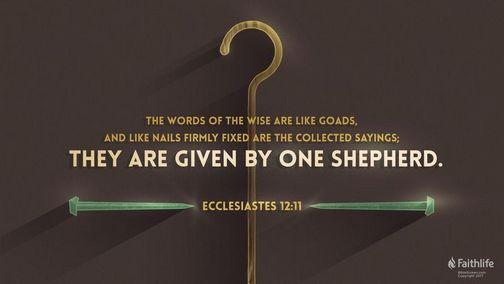
Jesus is the Good Shepherd who was pierced with nails to guide you to eternal life.14
The Good Shepherd seeks to reclaim all His lost sheep. Without a shepherd, sheep will wander off. Sin does the same thing to us. “For you were continually straying like sheep, but now you have returned to the Shepherd and Guardian of your souls.” (1 Pet. 2:25). But our Shepherd came to reclaim His sheep: “All of us, like sheep, have gone astray, each of us has turned to his own way; but the LORD has caused the wrongdoing of us all to fall on Him.” (Is. 53:6). “As a shepherd cares for his herd in the day when he is among his scattered sheep, so I will care for My sheep and will deliver them from all the places to which they were scattered on a cloudy and gloomy day.” (Ezek. 34:12). “… ‘I was sent only to the lost sheep of the house of Israel.’” (Matt. 15:24). Like sheep, each person must hear and respond to the Shepherd’s call. “For He is our God, and we are the people of His pasture and the sheep of His hand. Today, if you will hear His voice, (Ps. 95:5).
Jesus’ Word can both guide and protect you. Jesus’ Word acts like “goad” for sheep to redirect you when you stray from the correct path. “Even though I walk through the valley of the shadow of death, I fear no evil, for You are with me; Your rod and Your staff, they comfort me.” (Ps. 23:4). “All Scripture is inspired by God and beneficial for teaching, for rebuke, for correction, for training in righteousness;” (2 Tim. 3:16).
For Jesus to be your Good Shepherd, you must accept that He is also your master. To some, it offends their pride to be called “sheep”. But Jesus wants you to accept that He is your Shepherd the same way that David called Yahweh “my shepherd” (Ps. 23:1a). This means praising Jesus because He is your loving Master: “So we Your people and the sheep of Your pasture will give thanks to You forever; to all generations we will tell of Your praise.” (Ps. 79:13). “Know that the LORD Himself is God; it is He who has made us, and not we ourselves; we are His people and the sheep of His pasture.” (Ps. 100:3).
For Jesus to be your Good Shepherd, you must also submit and obey Him. Many sheep will not willingly submit to their shepherds. Likewise, not everyone who hears Jesus’ calling accepts Him as their Lord and Savior. Many sadly prefer the darkness and sin that are found off the narrow path that He offers His flock: “And this is the judgment, that the Light has come into the world, and people loved the darkness rather than the Light; for their deeds were evil.” (Jo. 3:19). If Jesus is to be your Shepherd, you must submit to Him: “I have other sheep, which are not of this fold; I must bring them also, and they will hear My voice; and they will become one flock with one shepherd.” (Jo. 10:16). “Not everyone who says to Me, ‘Lord, Lord,’ will enter the kingdom of heaven, but the one who does the will of My Father who is in heaven will enter.” (Matt. 7:21). “Now why do you call Me, ‘Lord, Lord,’ and do not do what I say?” (Lk. 6:46).
Let the Holy Spirit guide your path with His wisdom. Solomon warned about looking for wisdom in the wrong places or seeking mere book knowledge without faith “excessive study is wearying to the body.” (Ecc. 12:12b). Jesus’ wisdom is available to all who seek it in faith (Jam. 1:5; Prov. 2:6; Ps. 51:6; Ecc. 2:26). His wisdom is found from diligently studying His Word. “Your word is a lamp to my feet and a light to my path.” (Ps. 119:105; 2 Pet. 1:19). When you pray and submit to Jesus, the Holy Spirit will then guide your path and reveal His wisdom to you: “But when He, the Spirit of truth, comes, He will guide you into all the truth; for He will not speak on His own initiative, but whatever He hears, He will speak; and He will disclose to you what is to come.” (Jo. 16:13). “But the Helper, the Holy Spirit, whom the Father will send in My name, He will teach you all things, and bring to your remembrance all that I said to you.” (Jo. 14:16).
7. Fear Jesus: To Avoid an Empty Life of Regret and To Live as Jesus Intended, Fear Him by Clinging to What He Calls Good and Hating Evil. Ecc. 12:13-14.
You cannot live a fulfilling life as Jesus intended unless you love good and hate evil. Solomon concluded that living a meaningful life is not possible without reverence and obedience to Yahweh’s Ten Commandments. “13 The conclusion, when everything has been heard, is: fear God and keep His commandments, because this applies to every person. 14 For God will bring every act to judgment, everything which is hidden, whether it is good or evil.” (Ecc. 12:13-14). “The teaching of the whole book is now gathered up in two weighty sentences … [v.13] one duty remained plain and unchanging - the duty of piety and obedience … [v. 14] The doctrine that the most secret things shall be revealed in the dies irae is often brought forward in the New Testament, which makes plain the personal nature of this final investigation, which the earlier Scriptures invest with a more general character (see Romans 2:16; Romans 14:12; 1 Corinthians 4:5). So this wonderful book closes with the enunciation of a truth found nowhere else so clearly defined in the Old Testament, and thus opens the way to the clearer light shed upon the awful future by the revelation of the gospel.” (Pulpit Commentary on Ecc. 12:13-14).15
Solomon built up Israel, only to be told that his worldly accomplishments would vanish. God blessed Solomon with greater wisdom and wealth than any other person (1 Kgs. 4:29-34; 10:23; 1 Chr. 29:25). He initially used his gifts for God. But he later misused God’s blessings and committed several deadly sins. First, he took 1,000 wives, including 700 wives and 300 concubines (1 Kgs. 11:3-4). He violated God’s law that he have only one wife 999 times (Dt. 17:17(a)). More importantly, his many wives, especially his pagan ones, turned his heart against God (1 Kgs. 11:4). Second, because of his foreign wives, Solomon began to worship other gods (1 Kgs. 11:5-6). This violated God’s First Commandment (Ex. 20:2-3; Dt. 5:6-7). Because of his foreign wives, he then built idols and pagan altars for the Jews to worship Chemosh and Molech (1 Kgs. 11:5-8). This violated God’s Second Commandment (Ex. 20:4-6; Dt. 5:8-10). Third, to become king, Solomon would have taken an oath to obey God’s laws. His failure to follow his oath as the King of Israel blasphemed God’s holy name (Lev. 19:12). This violated God’s Third Commandment (Ex. 20:7; Dt. 5:11). Fourth, by worshipping other gods, he caused generations of Jews to do the same. Thus, he dishonored both his father David and God the Father. This violated God’s Fifth Commandment (Ex. 20:12; Dt. 5:16). Fifth, after his lust had pulled him from his walk with God, Solomon tried to kill his servant Jeroboam. He did this in rebellion against God after the prophet Ahijah told Solomon that God would give Jeroboam 10 of the 12 tribes because of Solomon’s rebellions (1 Kgs. 11:40). This violated God’s Sixth Commandment (Ex. 20:13; Dt. 5:17). Sixth, Solomon hoarded both gold and wives out of covetousness. This violated God’s Tenth Commandment (Ex. 20:17; Dt. 5:21). Finally, because Solomon’s heart grew hard, he refused to listen to the prophet Ahijah’s warnings that his sins would lead to the division of Israel (1 Kgs. 11:9-13). No other book contains Solomon’s repentance. As a teacher of wisdom, Solomon urged believers to avoid making his same mistakes by fearing Yahweh.
Reverent fear includes pursuing what Jesus calls as good and hating what He calls evil. After observing the mistakes in his own life, Solomon formed the Spirit-led foundational truth for the entire book of Proverbs and Ecclesiastes. “The fear of the LORD is the beginning of knowledge; fools despise wisdom and instruction.” (Prov. 1:7). He repeated this conclusion many times. “fear of the Lord, and discover the knowledge of God.” (Prov. 2:5). “The fear of the LORD is the beginning of wisdom, and the knowledge of the Holy One is understanding.” (Prov. 9:10). A psalmist later repeated Solomon’s revelation that, “The fear of the Lord is the beginning of wisdom;” (Ps. 111:10). The prophet Samuel also urged believers in his farewell address to fear Yahweh: “Only fear the LORD and serve Him in truth with all your heart; for consider what great things He has done for you.” (1 Sam. 12:24). Job reached the same conclusion ‘“Behold, the fear of the Lord, that is wisdom; and to turn away from evil is understanding.’” (Job 28:18). You fear the Lord when you hate what He calls evil. “The fear of the LORD is to hate evil; pride, arrogance, the evil way, and the perverted mouth, I hate.” (Prov. 8:13).
The fear of the Lord includes obedience. Solomon’s definition of the fear of the Lord includes obeying the Ten Commandments (Ecc. 12:13). Moses also proclaimed that fearing God includes a desire to obey out of obedience. “And now, Israel, what does the LORD your God require of you, but to fear the LORD your God, to walk in all His ways and love Him, and to serve the LORD your God with all your heart and with all your soul,” (Dt. 10:12). Job was “blameless” because his reverent fear of God led him to always obey God: “There was a man in the land of Uz whose name was Job; and that man was blameless, upright, fearing God and turning away from evil.” (Job 1:1).
The Creator of the universe deserves your reverence and obedience.16
Reverent obedience and fearing Jesus should be based upon your love for Him. Jesus said that if you love Him, you will keep His “Commandments” (Jo. 14:15, 21; 15:10; 1 Jo. 5:3; 2 Jo. 1:6; Matt. 19:17). He is the great “I AM” who gave Moses the Ten Commandments (Jo. 8:58; Ex. 3:14). Thus, because Jesus is Yahweh and the author of the Ten Commandments, He is entitled to reverent fear. But He came to correct people’s motives in following the Ten Commandments. He wants your obedience to be motivated by love and not obligation. He therefore summarized the Ten Commandments as something that comes naturally once a person loves the LORD and his or her neighbor (Matt. 22:35-38; Lk. 10:27; Dt. 6:5). Moses taught us to live obediently as it is written. Jesus taught us to love obediently as it is written. Whether you keep the Ten Commandments out of love (and not obligation) is also the test regarding whether you really “know” Jesus: “By this we know that we have come to know Him, if we keep His commandments.” (1 Jo. 2:3). Some will come to Jesus boasting of their works or compliance with the Law. But if their works or their compliance with the Law was not motivated by a love for Him, He may respond “I never knew you.” (Matt. 7:23). If you obey the Law for the right reasons, you become a slave to righteousness. But if you do not obey the Law, you are likely to become a slave to sin (Ro. 6:12, 16; Jo. 8:34).
Jesus is not your Lord if you disobey Him. When your faith does not lead to obedience, it is time to examine your heart: “Even so faith, if it has no works, is dead, being by itself.” (Jam. 2:17). A believer may proclaim Jesus as Lord. But He is not your Lord if you disobey Him: “Not everyone who says to Me, ‘Lord, Lord,’ will enter the kingdom of heaven, but he who does the will of My Father who is in heaven will enter.” (Matt. 7:21). “Why do you call Me, ‘Lord, Lord,’ and do not do what I say?” (Lk. 6:46). “But prove yourselves doers of the word, and not merely hearers who delude themselves.” (Jam. 1:22). “Therefore everyone who hears these words of Mine and acts on them, may be compared to a wise man who built his house on the rock.” (Matt. 7:24). “Everyone who hears these words of Mine and does not act on them, will be like a foolish man who built his house on the sand.” (Matt. 7:26). Jesus also warned: “For the gate is narrow and the way is constricted that leads to life, and there are few who find it.” (Matt. 7:14).
Fearing the Lord includes knowing that you will be held to account for your actions. Solomon warned that “God will bring every act to judgment, everything which is hidden, whether it is good or evil.” (Ecc. 12:14). Believers will have to give an account of their actions. “For we must all appear before the judgment seat of Christ, so that each one may receive compensation for his deeds done through the body, in accordance with what he has done, whether good or bad.” (2 Cor. 5:10). Jesus will also judge those who have not accepted Him as their Savior against His perfect law. “And I saw the dead, the great and the small, standing before the throne, and books were opened; and another book was opened, which is the book of life; and the dead were judged from the things which were written in the books, according to their deeds.” (Rev. 20:12; Heb. 4:13; 1 Cor. 4:5).
Live in reverent obedience because Jesus will hold you accountable for your actions.17
Be holy and avoid evil. If you have accepted that Jesus paid the price for your sins at the cross and saved you from eternal judgment, you can respond by being holy for His use: “Then the Lord spoke to Moses, saying: 2 ‘Speak to all the congregation of the sons of Israel and say to them, You shall be holy, for I the Lord your God am holy.”’ (Lev. 19:1-2; 11:44-45; Ex. 19:6). God’s exhortation to be holy is repeated in the New Testament: “[B]ecause it is written, ‘You shall be holy, for I am holy.’” (1 Pet. 1:16; Eph. 1:4). “Therefore you are to be perfect, as your heavenly Father is perfect.” (Matt. 5:48).
Image credit: Ecclesiastes 12:1 - Bible verse (KJV) - DailyVerses.net↩︎
The author of Psalm 71 is not identified. But strong arguments exist for attributing it to David. Psalm 71: Lessons For Maintaining a Life-Long Walk With Jesus | Inspired Scripture↩︎
Daniel L. Akin and Jonathan Akin, Christ-Centered Exposition, Exalting Jesus in Ecclesiastes, (Brentwood, TN, B&H Publishing Group, 2016), pgs. 115-117.↩︎
Image credit: 16 Bible verses about The Time Unknown↩︎
David Gibson, Living Life Backward: How Ecclesiastes Teach Us To Live in Light of the End (Wheaton IL, Crossway Bibles, 2017), pgs. 142-43.↩︎
Image credit: Depressed man Photos - Download Free High-Quality Pictures | Freepik↩︎
Sidney Greidanus, Preaching Christ from Ecclesiastes, (Grand Rapids, MI, William B. Eerdman’s Publishing Company, 2010), p. 293.↩︎
Image credit: Morning Minute↩︎
E.g., Tremper Longman III, The Book of Ecclesiastes, (Grand Rapids, MI, William B. Eerdman’s Publishing Company, 1998) pgs. 2-20, 277. John James Stewart Perowne, the General Editor for the Cambridge Bible for Schools and Colleges, believed that the writer was “probably the President of the Sanhedrin, or some other Master of the Wise, such as were Hillel and Gamaliel.” See, Ecclesiastes 12 Cambridge Bible for Schools and Colleges.↩︎
Ecclesiastes 12:9 Meaning & Explanation (with Related Verses) - Christianity Path; Scott Jones, 2014, Scandinavian Journal of the Old Testament, (PDF) Solomon's Table Talk: Martin Luther on the Authorship of Ecclesiastes M. Luther, “Notes on Ecclesiastes,” in Luther’s Works, vol. 15, ed. and trans. J. Pelikan (St. Louis, MO, Concordia,1972) p. 12.↩︎
Image credit: Daily Encouragement↩︎
Image credit: Ecclesiastes 12:13 The end of the matter; all has been heard. Fear God and keep his commandments, for this is the whole duty of man. | English Standard Version Revision 2016 (ESV) | Download The Bible App Now↩︎
Image credit: Ecclesiastes 12:14 | joshtinpowers | Flickr↩︎