Ecclesiastes 2: Lessons for Finding a Fulfilling Life in Jesus
Introduction: God blessed Solomon with greater wealth than any person (1 Kgs. 3:13). But as he turned from God, he abused his wealth to indulge every carnal desire of his flesh. In the end, he discovered that his foolish pursuits of the flesh were all (he·ḇel) “הֶ֙בֶל֙”. They were “futility,” “vanity,” or “meaningless”. They would evaporate like smoke. From Solomon’s mistakes and the whole counsel of God, the Bible reveals seven lessons for finding a fulfilling life in Jesus. These include: (1) avoiding a life of self-gratification, (2) avoiding greed, (3) avoiding lust, (4) avoiding worldly wisdom, (5) avoiding vanity, (6) grateful contentment, and (7) serving Jesus.
First, Solomon tested himself to see if he could find fulfillment by indulging in every pleasure available to him. But he learned that this was ultimately meaningless. A fulfilling life in Jesus includes denying the desires of the flesh for self-gratification and excessive pleasures. Second, Solomon also tested himself to see if he could find fulfillment by acquiring greater wealth, homes, land, and flocks than anyone who lived previously. But he learned that this was also ultimately meaningless. A fulfilling life in Jesus also includes denying yourself of greed, covetousness, and gluttony. Third, Solomon tested himself to see if he could find fulfillment by giving into sexual gratification with 1,000 wives or concubines. But this also failed to provide any lasting fulfillment. A fulfilling life in Jesus also includes denying yourself of the lusts of your flesh. Fourth, as he turned from God, Solomon next tried to find fulfillment through his intellect and human wisdom. But this also ultimately proved to be meaningless and empty. A fulfilling life in Jesus also includes avoiding worldly wisdom that seeks to justify or minimize sin. Fifth, after God’s prophet Ahijah told Solomon that all he acquired would vanish after his death, Solomon was filled with despair that all his labors for a worldly legacy would soon vanish. A fulfilling life in Jesus also includes denying yourself of the vain desires of your flesh for recognition or a worldly legacy. Sixth, Solomon concluded that he could only find true happiness by being grateful and content with God’s provision. A fulfilling life in Jesus also includes being grateful and content with His provision. If you delight yourself in what Jesus desires, He will give you the desires of your heart. Finally, Solomon also concluded that God will bless a person who “is good in His sight.” A person’s actions apart from Jesus are filthy rags. Only faith in Jesus can make you righteous. But faith without works is dead. Thus, a fulfilling life includes serving Jesus and performing His good works to show His love to others.
1. Avoid Seeking Self-Gratification: A Fulfilling Life in Jesus Includes Denying the Desires of the Flesh for Self-Gratification and Excessive Pleasures. Ecc. 2:1-3.
Over time, a life devoted to self-gratification is meaningless and empty. Solomon misused his God-given wisdom and wealth to see if he could find fulfillment through self-gratification. In the end, he realized that his actions were foolish. “1 I said to myself, ‘Come now, I will test you with pleasure. So enjoy yourself.’ And behold, it too was futility. 2 I said of laughter, ‘It is senseless,’ and of pleasure, ‘What does this accomplish?’ 3 I explored with my mind how to refresh my body with wine while my mind was guiding me wisely; and how to seize foolishness, until I could see what good there is for the sons of mankind to do under heaven for the few years of their lives.” (Ecc. 2:1-3). “The previous section saw Solomon look for the meaning of life in wisdom – wisdom as it can be understood apart from eternity. He found no meaning in skillful, wise living under the sun. Now he continued his search for meaning and tested a life of pleasure and amusement…Solomon tested life’s meaning in mirth and pleasure. He tested the theory many live under today; that the meaning of life is found in more and varied pleasures, entertainments, and excitements … The Preacher will shortly explain how he came to this conclusion; but he tells us the result of the testing at the beginning … Solomon tested the life lived for laughter, pleasure, and fun. Like a modern celebrity he ran from party to party, entertainment to entertainment. At the end of it all, he judged it to be “Madness” and without accomplishment.” (David Guzik on Ecc. 2:1-3) (emphasis in original).1
Solomon indulged in every pleasure only to find emptiness and sorrow2
Living a life devoted to carnal pleasure leads to sorrow. In Proverbs, Solomon warned that a life devoted to pleasure leads to spiritual poverty and frequently worldly poverty as well. “One who loves pleasure will become a poor person; one who loves wine and oil will not become rich.” (Prov. 21:17). Jesus also strongly condemned those who live for worldly pleasure while ignoring the things of God. “And I will say to myself, ‘You have many goods stored up for many years to come; relax, eat, drink, and enjoy yourself!’ But God said to him, ‘You fool! This very night your soul is demanded of you; and as for all that you have prepared, who will own it now?’” (Lk. 12:19-20). Paul also warned that the enemies of Jesus focus on their own worldly desires at their own peril, “whose end is destruction, whose god is their appetite, and whose glory is in their shame, who have their minds on earthly things.” (Phil. 3:19). “If from human motives I fought with wild beasts at Ephesus, what good is it to me? If the dead are not raised, let’s eat and drink, for tomorrow we die.” (1 Cor. 15:32). Other passages in the New Testament also warn of the judgment that awaits non-repentant sinners who live for self-gratification. “You have lived for pleasure on the earth and lived luxuriously; you have fattened your hearts in a day of slaughter.” (Jam. 5:5). “But she who indulges herself in luxury is dead, even while she lives.” (1 Tim. 5:6). “To the extent that she [Babylon] glorified herself and lived luxuriously, to the same extent give her torment and mourning; for she says in her heart, ‘I sit as a queen and I am not a widow, and will never see mourning.’” (Rev. 18:7).
The wise will heed Jesus’ wisdom and avoid the sin of drunkenness. Solomon “explored with my mind how to refresh my body with wine.” (Ecc. 2:3). The Bible does not condemn the drinking of alcohol under any circumstances. But it does condemn those who choose to become drunk from alcohol. “Woe to those who rise early in the morning so that they may pursue intoxicating drink, who stay up late in the evening so that wine may inflame them! Their banquets are accompanied by lyre and harp, by tambourine and flute, and by wine; but they do not pay attention to the deeds of the LORD, nor do they consider the work of His hands.” (Is. 5:11-12). “Woe to him who makes his neighbor drink; to you who mix in your venom even to make your neighbors drunk, so as to look at their genitalia!” (Hab. 2:15). These warnings are repeated in the New Testament. “And do not get drunk with wine, in which there is debauchery, but be filled with the Spirit,” (Eph. 5:18). “For the time already past is sufficient for you to have carried out the desire of the Gentiles, having pursued a course of indecent behavior, lusts, drunkenness, carousing, drinking parties, and wanton idolatries.” (1 Pet. 4:3). “Let’s behave properly as in the day, not in carousing and drunkenness, not in sexual promiscuity and debauchery, not in strife and jealousy.” (Rom. 13:13; Gal. 5:19-21). “Or do you not know that the unrighteous will not inherit the kingdom of God? Do not be deceived; … nor those habitually drunk … will inherit the kingdom of God.” (1 Cor. 6:9-10). Jesus also warns believers to guard their hearts by staying sober. “But be on your guard, so that your hearts will not be weighed down with dissipation and drunkenness and the worries of life, and that this day will not come on you suddenly, like a trap;” (Lk. 21:34). This prohibition applies with even greater force to leaders. “It is not for kings, Lemuel, it is not for kings to drink wine, or for rulers to desire intoxicating drink, otherwise they will drink and forget what is decreed, and pervert the rights of all the needy.” (Prov. 31:4-5).
2. Avoid Greed: A Fulfilling Life in Jesus Includes Denying Yourself of Greed, Covetousness, and Gluttony. Ecc. 2:4-8a.
Worldly goods will one day vanish and become meaningless. Solomon acquired palaces, vineyards, servants, flocks, and incredible riches. But he realized in the end that these worldly accomplishments were meaningless. “4 I enlarged my works: I built houses for myself, I planted vineyards for myself; 5 I made gardens and parks for myself, and I planted in them all kinds of fruit trees; 6 I made ponds of water for myself from which to irrigate a forest of growing trees. 7 I bought male and female slaves, and I had slaves born at home. I also possessed flocks and herds larger than all who preceded me in Jerusalem. 8a I also amassed for myself silver and gold, and the treasure of kings and provinces.” (Ecc. 2:4-8a). “Solomon had a passion for erecting magnificent buildings. We have various accounts of his works of this nature in 1 Kings 7. and 9; 2 Chronicles 8. There was the huge palace for himself, which occupied thirteen years in building; there was the ‘house of the forest of Lebanon,’ a splendid hall constructed with pillars of cedar; the porch of pillars; the hall of judgment; the harem for the daughter of Pharaoh. Then there were fortresses, store-cities, chariot-towns, national works of great importance; cities in distant lands which he founded, such as Tadmor in the wilderness. I planted me vineyards. David had vineyards and olive yards (1 Chronicles 27:27, 28), which passed into the possession of his son; and we read in Song of Solomon 8:11 of a vineyard that Solomon had in Baal-hamon, which some identify with Belamon (Judith 8:3), a place near Shunem, in the Plain of Esdraelon.” (Pulpit Commentary on Ecc. 2:4).3
Solomon built great works that glorified him. Solomon confessed, “I enlarged my works: I built houses for myself…” (Ecc. 2:4). He spent seven years building the Temple (1 Kgs. 6:38). The Temple is not listed in Solomon’s confession because it was for God. But he spent 13 years building an even bigger palace for himself (1 Kgs 7:1-6). It was a large rectangular palace that was 75 feet wide, 150 feet long and 45 feet high. The palace had three rows of a total of 45 cedar pillars from Lebanon. This was meant to create the sensation that the person was in a forest of splendor. He later added 300 gold shields to these pillars to create a sense of opulence (1 Kgs. 10:17; 2 Chr. 9:16). His grand palace included a hall where he judged cases in an open court, his residence, a residence for his harem, and a separate structure for his Egyptian queen (1 Kgs. 7:7-12). His palace was not only bigger than the Temple, it rivaled the Temple in beauty and strength with its expensive cedar wood from Lebanon and its costly polished stones over nearly every surface. The palace had a courtyard at its center that opened up to the exterior with a porch. Here, the king sat on an ivory throne where he tried cases as the highest judge in Israel (1 Kings 7:7; 10:18; Dt. 17:8). He also built a special palace for Pharaoh’s daughter (1 Kgs. 3:1; 7:8; 9:24). Solomon’s confession in Ecclesiastes strongly suggests that he built other homes for himself that are not listed in 1 Kings. In Psalms, he confessed that any building project that does not involve God will not last, “A Song of Ascents, of Solomon. Unless the LORD builds a house, they who build it labor in vain; unless the LORD guards a city, the watchman stays awake in vain.” (Ps. 127:1).
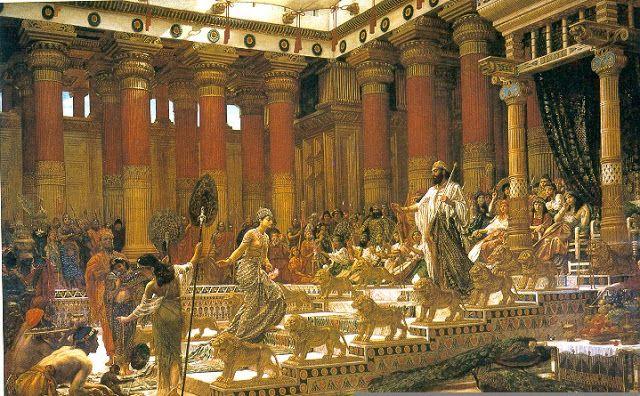
Solomon built an opulent palace for himself to display his God-given wealth4
Solomon received greater wealth than any prior ruler. God previously promised to bless Solomon with great financial wealth because he only asked for wisdom while serving as king: “I have also given you what you have not asked, both riches and honor, so that there will not be any among the kings like you all your days.” (1 Kgs. 3:13). Here, Solomon stated that he “possessed flocks and herds larger than all who preceded me in Jerusalem.” (Ecc. 2:7). He “also amassed for myself silver and gold, and the treasure of kings and provinces.” (Ecc. 2:8a). He received 666 talents of gold annually (1 Kgs. 10:14). This is the same number given for the beast in the end times (Rev. 13:18). A talent equaled approximately 75 pounds. Thus, he received approximately 49,950 pounds of gold per year. This was in addition to the money that he received as a tax from trade within his territories (1 Kgs. 10:15). At first, he used this wealth to bless the people (1 Kgs. 4:20). But he then invested in opulent displays that flaunted his great wealth.
Giving into covetousness and gluttony leads to sorrow. Coveting violates God’s Tenth Commandment (Ex. 20:17; Dt. 5:21). Jesus warned that people who devote their lives to the accumulation of worldly goods will have nothing to offer to redeem their souls. “For what good will it do a person if he gains the whole world, but forfeits his soul? Or what will a person give in exchange for his soul?” (Matt. 16:26). Based upon his own mistakes, Solomon warned against coveting or overconsuming more than what you need. “Have you found honey? Eat only what you need, so that you do not have it in excess and vomit it.” (Prov. 25:16). Paul also warned against the sin of covetousness (Phil. 3:19).
Greed is another form of covetousness. From his own sins, Solomon learned that the love of money and possessions will never bring satisfaction. “One who loves money will not be satisfied with money, nor one who loves abundance with its income. This too is futility. When good things increase, those who consume them increase. So what is the advantage to their owners except to look at them?” (Ecc. 5:10-11). Isaiah also condemned those who hoarded land. “Woe to those who attach house to house and join field to field, until there is no more room, and you alone are a landowner in the midst of the land!” (Is. 5:8). Jesus also warned against the sin of greed. “But He said to them, ‘Beware, and be on your guard against every form of greed; for not even when one is affluent does his life consist of his possessions.”’ (Lk. 12:15). If you embrace greed, it will eventually pull you off your walk. “No one can serve two masters; for either he will hate the one and love the other, or he will be devoted to one and despise the other. You cannot serve God and wealth.” (Matt. 6:24). Those who give into greed also face misery. “Come now, you rich people, weep and howl for your miseries which are coming upon you. Your riches have rotted and your garments have become moth-eaten. Your gold and your silver have corroded, and their corrosion will serve as a testimony against you and will consume your flesh like fire. It is in the last days that you have stored up your treasure!” (Jam. 5:1-3). “But those who want to get rich fall into temptation and a trap, and many foolish and harmful desires which plunge people into ruin and destruction. For the love of money is a root of all sorts of evil, and some by longing for it have wandered away from the faith and pierced themselves with many griefs.” (1 Tim. 6:9-10).
Store up your treasures in heaven. Jesus encourages believers to focus on storing up their treasures in heaven, not Earth. “Do not store up for yourselves treasures on earth, where moth and rust destroy, and where thieves break in and steal. But store up for yourselves treasures in heaven, where neither moth nor rust destroys, and where thieves do not break in or steal; for where your treasure is, there your heart will be also.” (Matt. 6:19-21).
Deny the desires of your flesh to fight covetousness. Believers are warned to walk in the power of the Holy Spirit and not according to the desires of their flesh. “But I say, walk by the Spirit, and you will not carry out the desire of the flesh. For the desire of the flesh is against the Spirit, and the Spirit against the flesh; for these are in opposition to one another, in order to keep you from doing whatever you want…Now those who belong to Christ Jesus crucified the flesh with its passions and desires.” (Gal. 5:16-17, 24). “For those who are in accord with the flesh set their minds on the things of the flesh, but those who are in accord with the Spirit, the things of the Spirit.” (Ro. 8:5). Paul controlled his bodily desires. “but I strictly discipline my body and make it my slave, so that, after I have preached to others, I myself will not be disqualified.” (1 Cor. 9:27). Daniel also disciplined himself in front of the king, even though he risked offending the king through his faith. “But Daniel made up his mind that he would not defile himself with the king’s choice food or with the wine which he drank; so he sought permission from the commander of the officials that he might not defile himself.” (Dan. 1:8). Believers should always pray for the strength to resist temptation. “‘And do not lead us into temptation, but deliver us from evil.’” (Matt. 6:13; 1 Cor. 10:13; 2 Thess. 3:3).
3. Avoid Lust: A Fulfilling Life in Jesus Includes Denying Yourself of the Lusts of Your Flesh. Ecc. 2:8b-11.
Lust produces sorrow with no lasting benefits. Solomon spared no pleasure for himself. In addition to entertainment, he also indulged himself with a 1,000 wives or concubines. In the end, he also realized that all these things created no lasting value. “8b I provided for myself male and female singers, and the pleasures of the sons of mankind: many concubines. 9 Then I became great and increased more than all who preceded me in Jerusalem. My wisdom also stood by me. 10 All that my eyes desired, I did not refuse them. I did not restrain my heart from any pleasure, for my heart was pleased because of all my labor; and this was my reward for all my labor. 11 So I considered all my activities which my hands had done and the labor which I had exerted, and behold, all was futility and striving after wind, and there was no benefit under the sun.” (Ecc. 2:8b-11). “the delights of the sons of men] The use of the word in Song Song of Solomon 7:6 leaves little doubt that the phrase is an euphemism for sensual pleasures, and as such it helps to determine the meaning of the words that follow… [וֹת׃] (wə·šid·dō·wṯ) [concubines] (NASB/NIV/Berean/Amplified).5 Most modern scholars however agree, though differing as to its etymology, some finding its root-meaning in “couch,” and some in the “female breast,” and others in “captives taken in war,” in rendering it as a “concubine.” This agrees, it is obvious, with the context and with what is recorded of Solomon’s seraglio with its thousand inmates (Song Song of Solomon 6:8; 1 Kings 11:3)” (John James Stewart Perowne, General Editor, Cambridge Bible for Schools and Colleges, v. 8).6
Solomon violated God’s law by marrying 1,000 wives or concubines. Although God blessed Solomon with wisdom, Solomon disregarded his God-given wisdom to pursue the worldly wisdom of taking foreign wives to build foreign alliances (1 Kgs. 11:1-2). In a misguided effort to protect Israel, Solomon used foreign wives to establish foreign treaties. For example, Solomon married a pagan princess from Egypt to prevent a war on his southern border and to increase his wealth(1 Kgs. 3:1). Out of lust and pride, Solomon eventually married 1,000 wives or concubines. But his lust, pride, and his pagan wives eventually turned his heart against God. “3 He had seven hundred wives, princesses, and three hundred concubines, and his wives turned his heart away. 4 For when Solomon was old, his wives turned his heart away after other gods; and his heart was not wholly devoted to the Lord his God, as the heart of David his father had been.” (1 Kgs. 11:3-4).

Solomon indulged his ever carnal desire and then committed apostacies against God7
Solomon violated God’s law against having multiple spouses. There were few laws that Solomon had to follow to serve God. Limiting himself to only one wife was one of them: “He shall not multiply wives for himself, or else his heart will turn away; . ..” (Dt. 17:17(a)). From the beginning, God intended for marriage to be limited to one man and one woman (Matt. 19:4-6; Gen. 2:23-24; 1 Tim. 3:2). Solomon’s marriages violated God’s law 999 times. He further defamed God by allowing non-believers to allege that God must have condoned polygamy because he engaged in this practice.
Solomon modeled his life after the behavior of his father David. As the ruler of Israel, there was no more important role model for Solomon than David. David also disregarded God’s law in this area. Before arriving in Hebron, David had two wives (1 Sam. 25:43). During his seven-year reign in Hebron, he took four additional wives (2 Sam. 3:2-5). David then forced Abner to kidnap his former wife Michal and make her his seventh wife (2 Sam. 3:12-16). After becoming king, David took more wives and concubines (2 Sam. 5:13-14). He then again showed his disregard for the laws of sexual purity when he committed adultery with Bathsheba (2 Sam. 11:2-4).
Coveting cannot be satisfied by giving in to temptation. Solomon’s coveting began with money and power. It then grew to include women. But no matter how hard he tried, he could not satisfy his coveting by feeding it. The coveting that the devil offers can only be satisfied through more coveting (Heb. 11:25; Lk. 12:19-20). “And the dogs are greedy, they are not satisfied. And they are shepherds who have no understanding; they have all turned to their own way, each one to his unjust gain, to the last one.” (Is. 56:11; Hab. 2:5). “Sheol, and the barren womb, earth that is never satisfied with water, and fire that never says, ‘Enough’.” (Prov. 30:16). Giving into your temptations only leads to misery as you are unable to find peace and contentment. Are you giving into your temptations?
God’s mercy and grace should not be used as a license to sin more. Despite giving into covetousness, God still honored His promises to Solomon. “9 Then I became great and increased more than all who preceded me in Jerusalem. My wisdom also stood by me.” (Ecc. 2:9). This matches the accounts of Solomon’s God-given greatness in 1 Kings and 2 Chronicles (1 Kgs. 3:12-13; 4:29-30; 10:23; 2 Chr. 9:22). Solomon misused God’s gifts to indulge his every carnal desire. “10 All that my eyes desired, I did not refuse them. I did not restrain my heart from any pleasure, for my heart was pleased because of all my labor; and this was my reward for all my labor.” (Ecc. 2:10). But this was evil in God’s eyes. “So Solomon did what was evil in the sight of the LORD, and did not follow the LORD fully, as his father David had done.” (1 Kgs. 11:6). Thus, God declared that Israel would be torn from him (1 Kgs. 11:9-11). Solomon then realized how all his carnal accomplishments were (he·ḇel) “הֶ֙בֶל֙”. They were “futility” (NASB/Berean), “vanity” (NKJ/KJB/Amplified), and “meaningless” (NIV). They would evaporate like smoke: “11 So I considered all my activities which my hands had done and the labor which I had exerted, and behold, all was futility and striving after wind, and there was no benefit under the sun.” (Ecc. 2:11). Only the holy things of God will endure over time. “For all that is in the world, the lust of the flesh and the lust of the eyes and the boastful pride of life, is not from the Father, but is from the world. The world is passing away and also its lusts; but the one who does the will of God continues to live forever.” (1 Kgs. 2:16-17). If God shows you grace when you sin, this should never be used as a license to sin more (Ro. 6:1-2; Gal. 5:13). Misusing God’s grace as Solomon did only leads to sorrow.
4. Avoid Worldly Wisdom: A Fulfilling Life in Jesus Includes Avoiding Worldly Wisdom that Justifies or Excuses Sin. Ecc. 2:12-17.
Human wisdom is foolishness to God. After his hedonism failed to bring any lasting contentment, Solomon turned to his own intellect and wisdom to find fulfillment. But he realized that only the wisdom of God will endure in the long term. “12 So I turned to consider wisdom, insanity, and foolishness; for what will the man do who will come after the king, except what has already been done? 13 Then I saw that wisdom surpasses foolishness as light surpasses darkness. 14 The wise person’s eyes are in his head, but the fool walks in darkness. And yet I know that one and the same fate happens to both of them. 15 Then I said to myself, ‘As is the fate of the fool, it will also happen to me. Why then have I been extremely wise?’ So I said to myself, ‘This too is futility.’ 16 For there is no lasting remembrance of the wise, along with the fool, since in the coming days everything will soon be forgotten. And how the wise and the fool alike die! 17 So I hated life, for the work which had been done under the sun was unhappy to me; because everything is futility and striving after wind.” (Ecc. 2:12-17). “Solomon found that knowledge and prudence were preferable to ignorance and folly, though human wisdom and knowledge will not make a man happy. The most learned of men, who dies a stranger to Christ Jesus, will perish equally with the most ignorant; and what good can commendations on earth do to the body in the grave, or the soul in hell? And the spirits of just men made perfect cannot want them. So that if this were all, we might be led to hate our life, as it is all vanity and vexation of spirit.” (Matthew Henry on Ecc. 2:12-17).8
Human wisdom that excuses, justifies, or minimizes sin is foolishness before God. Solomon discovered that his attempts justify his sins through his incredible intellect was ultimately foolishness, “12 So I turned to consider wisdom, insanity, and foolishness; … Why then have I been extremely wise?’ So I said to myself, ‘This too is futility.’” (Ecc. 2:12, 15). In Proverbs, Solomon also warned against using your intellect to justify or excuse what God defines as sin. “Do not be wise in your own eyes; fear the LORD and turn away from evil.” (Prov. 3:7). “Do you see a person wise in his own eyes? There is more hope for a fool than for him.” (Prov. 26:12). “One who trusts in his own heart is a fool, but one who walks wisely will flee to safety.” (Prov. 28:26). Isaiah also warned against the deceitful nature of human wisdom. “Woe to those who are wise in their own eyes and clever in their own sight!” (Is. 5:21). Paul also condemned those who rely upon human wisdom to ignore or justify what Jesus defines as sin. “Take care that no one deceives himself. If anyone among you thinks that he is wise in this age, he must become foolish, so that he may become wise. For the wisdom of this world is foolishness in the sight of God. For it is written: “He is the One who catches the wise by their craftiness’;” (1 Cor. 3:18-19). “For the word of the cross is foolishness to those who are perishing, but to us who are being saved it is the power of God. For it is written: ‘I will destroy the wisdom of the wise, and the understanding of those who have understanding, I will confound.’ Where is the wise person? Where is the scribe? Where is the debater of this age? Has God not made foolish the wisdom of the world?” (1 Cor. 1:18-20).
When followed, God’s wisdom can guide you out of the darkness of sin. After realizing the futility of his own intellect, he realized that only God’s wisdom offered a path back to fellowship with Him. “Then I saw that wisdom surpasses foolishness as light surpasses darkness.” (Ecc. 2:13). This is also similar to the conclusion that Solomon reached in Proverbs. “But the path of the righteous is like the light of dawn that shines brighter and brighter until the full day.” (Prov. 4:18). “A person who wanders from the way of understanding will rest in the assembly of the dead.” (Prov. 21:16). Believers must stay on the narrow path that Jesus offers through the wisdom found in His Word and prayer. “Enter through the narrow gate; for the gate is wide and the way is broad that leads to destruction, and there are many who enter through it. For the gate is narrow and the way is constricted that leads to life, and there are few who find it.” (Matt. 7:13-14). His Word will guide you out of darkness if you follow it. “For God, who said, ‘Light shall shine out of darkness,’ is the One who has shone in our hearts to give the Light of the knowledge of the glory of God in the face of Christ.” (2 Cor. 4:6; Jo. 8:12).
5. Avoid Vanity: A Fulfilling Life in Jesus Includes Denying Yourself of the Vain Desires of Your Flesh for Recognition. Ecc. 2:18-23.
Worldly wealth that you labor for out of vanity will one day vanish. Based upon the prophet Ahijah’s judgment that Solomon tried in vain to stop (1 Kgs. 11:11-12), Solomon lamented that all his united nation of Israel and his worldly wealth would vanish soon after his death. “18 So I hated all the fruit of my labor for which I had labored under the sun, because I must leave it to the man who will come after me. 19 And who knows whether he will be wise or a fool? Yet he will have control over all the fruit of my labor for which I have labored by acting wisely under the sun. This too is futility. 20 Therefore I completely despaired over all the fruit of my labor for which I had labored under the sun. 21 When there is a person who has labored with wisdom, knowledge, and skill, and then gives his legacy to one who has not labored for it; this too is futility and a great evil. 22 For what does a person get in all his labor and in his striving with which he labors under the sun? 23 Because all his days his activity is painful and irritating; even at night his mind does not rest. This too is futility.” (Ecc. 2:18-23). “Solomon quickly finds the idea of work vain. Work is meaningless: we exert all of this effort to amass possessions we never really get to enjoy because we were working all the time, and then we leave them to someone else, and he may be a fool who squanders all we worked to earn! What is the point in working so hard to accumulate so much we cannot take with us? … Even the legacy game will not work because your descendants will waste that for which you worked so hard. Statistics say that in 60 percent of cases, inherited wealth is completely gone by the end of the second generation … Solomon will no longer live by the myth that hard work and well-earned wealth validate life … Solomon exposes us to the failure of all his experiments to show us that what he missed in all his efforts was the simple joys God held out to him.” (Daniel Akin and Jonathan Akin on Ecc. 2:18-23).9
You cannot take your worldly wealth with you when you die. Without naming his son, Solomon lamented that someone else would inherit all his physical possessions. “18 So I hated all the fruit of my labor for which I had labored under the sun, because I must leave it to the man who will come after me.” (Ecc. 2:18). He later repeated that you cannot take anything out of the world. “As he came naked from his mother’s womb, so he will return as he came. He will take nothing from the fruit of his labor that he can carry in his hand.” (Ecc. 5:15). Job made a similar declaration (Job 1:21). David also made similar observations. “Certainly every person walks around as a fleeting shadow; they certainly make an uproar for nothing; he amasses riches and does not know who will gather them.” (Ps. 39:6). “For he sees that even wise people die; the foolish and the stupid alike perish and leave their wealth to others.” (Ps. 49:10). “For we have brought nothing into the world, so we cannot take anything out of it, either.” (1 Tim. 6:7).
Solomon’s son squandered the physical inheritance that Solomon provided. Modern commentators who dispute Solomon’s authorship also dispute that these verses reference his heir Rehoboam.10 But the Jews historically understood these verses to reference Rehoboam.11 The Jews’ interpretation is supported by the lack of any other king who had similar wealth, and the fact that Rehoboam squandered Solomon’s inheritance. He first lost 10 of the 12 tribes in a civil war that he instigated because of his cruelty and refusal to listen to godly counsel (1 Kgs. 12:1-24). After he failed to repent of sins and turn back to God, God allowed the Egyptians to plunder and steal the wealth that Solomon accumulated. “Now it happened in the fifth year of King Rehoboam, that Shishak the king of Egypt marched against Jerusalem. And he took away the treasures of the house of the LORD and the treasures of the king’s house, and he took everything; he even took all the shields of gold which Solomon had made.” (1 Kgs. 14:25-26; 2 Chr. 12:19).
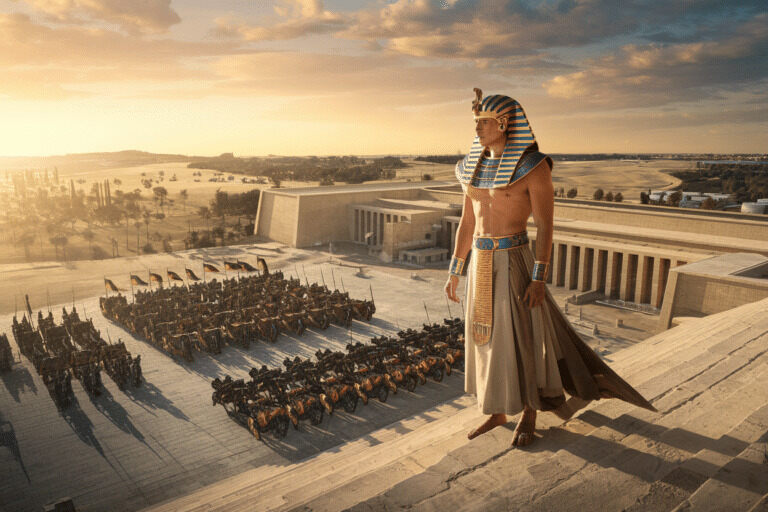
King Shishak of Egypt marched against Jerusalem and looted Solomon’s wealth12
The desire to amass wealth and have a legacy based upon wealth is foolish vanity. In the parable of the rich fool, the wealthy man tried to hoard as much wealth as he could. But Jesus warned that this was foolish vanity. It would do nothing to redeem his soul when he died. “But God said to him, ‘You fool! This very night your soul is demanded of you; and as for all that you have prepared, who will own it now?’” (Lk. 12:20; Jam. 4:13-15). Only the treasures that you store up in heaven in service to Jesus will last (Matt. 6:19-21).
6. Grateful Contentment: A Fulfilling Life in Jesus Includes Being Grateful and Content With His Provision. Ecc. 2:24-25.
Instead of striving for the things of the flesh, be grateful and content with God’s gifts. After realizing that his self-indulgence, greed, lust, worldly wisdom, and vanity were all meaningless, Solomon concluded that the answer was in part to be grateful and content with God’s provision. “24 There is nothing better for a person than to eat and drink, and show himself some good in his trouble. This too I have seen, that it is from the hand of God. 25 For who can eat and who can have enjoyment without Him?” (Ecc. 2:24-25). “These verses are an oasis of optimism in a wilderness of despair. Thus they mark a turning point in Ecclesiastes – just on the subject of work, for the entire argument of the book. Martin Luther called the end of Ecclesiastes 2 ‘a remarkable passage, one that explains everything preceding and following it.’ It is ‘the principal conclusion,’ Luther said, ‘in fact the point of the whole book.’ … Up to this point in Ecclesiastes God has hardly been mentioned, … But here God’s presence makes all the difference. No one can ever find any true joy in anything apart from Him…If we are deeply dissatisfied, this could be the reason: we have been taking good things and making them ultimate things, when in fact they are God-given things.” (Philip Ryken on Ecc. 2:24-25).13
Give thanks that God provides for every good and perfect thing in your life. It is a false vanity to take credit for the good things in your life. Instead, you should thank God because they all come from His loving grace. “Every good thing given and every perfect gift is from above, coming down from the Father of lights, with whom there is no variation or shifting shadow.” (Jam. 1:17). “Instruct those who are rich in this present world not to be conceited or to set their hope on the uncertainty of riches, but on God, who richly supplies us with all things to enjoy.” (1 Tim. 6:17). “He causes the grass to grow for the cattle, and vegetation for the labor of mankind, so that they may produce food from the earth, and wine, which makes a human heart cheerful, so that he makes his face gleam with oil, and food, which sustains a human heart.” (Ps. 104:14-15).

Instead of striving for your flesh, be content and trust in Jesus’ provision14
Be content with God’s provision. Instead of striving for worldly things, God wants you to be content with His provision. “Not that I speak from need, for I have learned to be content in whatever circumstances I am. I know how to get along with little, and I also know how to live in prosperity; in any and every circumstance I have learned the secret of being filled and going hungry, both of having abundance and suffering need. I can do all things through Him who strengthens me.” (Phil. 4:11-13). “The Teacher’s message, then, is that since all our worldly endeavors are futile, since all our striving apart from God is futile, we ought to find enjoyment in the gifts God gives us every day. We ought to savor the moment and find enjoyment in our present eating, drinking, and work because these things are God’s gift to us.” (Sidney Greidanus on Ecc. 2:24-25).15
Delight yourself in things of God. If you desire what God wants for you, He will fulfill your heart’s desires and bless you with contentment. “Delight yourself in the LORD; and He will give you the desires of your heart.” (Ps. 37:4). “But seek first His kingdom and His righteousness, and all these things will be provided to you.” (Matt. 6:33).
7. Serving Jesus: A Fulfilling Life in Jesus Includes Serving Him and Performing His Good Works That His Has Called You to Do. Ecc. 2:26.
The righteous through faith who serve Jesus will be blessed. Solomon concluded that God will bless those who do “good in His sight” with “wisdom and knowledge and joy.” “26 For to a person who is good in His sight, He has given wisdom and knowledge and joy, while to the sinner He has given the task of gathering and collecting so that he may give to one who is good in God’s sight. This too is futility and striving after wind.” (Ecc. 2:26). “No man is of himself good, or naturally so, but evil, very evil, as all the descendants of Adam are … The phrase is rendered, ‘whoso pleaseth God’, Ecclesiastes 7:26; and he is one that is accepted with God in Christ, his beloved Son, in whom he is well pleased; who is clothed with his righteousness, made comely through his comeliness, and so is irreprovable in his sight; and who by faith looks to and lays hold on this righteousness, and does all he does in the exercise of faith, without which it is impossible to please God. To such a man God gives wisdom, and knowledge, and joy; wisdom to acquire knowledge, to keep, use, and improve it; and joy, to be cheerful and thankful for the good things of life:” (John Gill’s Exposition on the Bible, Ecc. 2:26).16
Jesus’ gifts are based upon grace. Solomon could not find lasting joy based upon his works. “God is also the one who gives ‘wisdom and knowledge and joy’ (2:26). It is so striking that now, at the end of the Preacher’s epic quest through life for happiness, he discovers where it comes from. Not from his striving, but from God’s giving. God gives these things to the person ‘who pleases him.”’ (David Gibson on Ecc. 2:26).17
Jesus’ gifts were meant for His glory. Solomon’s mistake was to assume that God gave Solomon his gifts for his pleasure and glory. Jesus has given you gifts for you to use as a co-builder of His Church: “As each one has received a special gift, employ it in serving one another as good stewards of the manifold grace of God.” (1 Pet. 4:10). “Since we have gifts that differ according to the grace given to us, each of us is to exercise them accordingly: . . .” (Ro. 12:6-8). “And He gave some as apostles, and some as prophets, and some as evangelists, and some as pastors and teachers, 12 for the equipping of the saints for the work of service, to the building up of the body of Christ;” (Eph. 4:11-12). “Now concerning spiritual gifts, brethren, I do not want you to be unaware. . . . .4 Now there are varieties of gifts, but the same Spirit . . .” (1 Cor. 12:1-7). Every person’s gift is needed in the body because no one person has them all (1 Cor. 12:13-27). Moses could not have built the Tabernacle on his own. Solomon also could not build the Temple by himself. Jesus wants you to use His gifts to labor for the Church (Col. 3:23). When you labor to serve Jesus, you receive His “wisdom and knowledge and joy.” (Ecc. 2:26).
Serving Jesus is your highest calling. Jesus has called you by name before the foundation of the world to do good works for Him: “For we are His workmanship, created in Christ Jesus for good works, which God prepared beforehand so that we would walk in them.” (Eph. 2:10). “Therefore, if anyone cleanses himself from these things, he will be a vessel for honor, sanctified, useful to the Master, prepared for every good work.” (2 Tim. 2:21). Thus, you fulfill your highest calling when you use Jesus’ gifts for His “good works.”

Find fulfillment by following Jesus’ example and helping others in need18
Serve others for the good of the Body of Christ. As a believer, you are also called upon to work together within the Body of Christ: “so we, who are many, are one body in Christ, and individually members one of another.” (Ro. 12:5). “Since there is one bread, we who are many are one body; for we all partake of the one bread.” (1 Cor. 10:17; 12:12; Eph. 4:4). Thus, within the Body of Christ, you can be Jesus’ hands and feet to help others.
Image credit: Ecclesiastes 2:1-11, The Emptiness of Pleasure – West Palm Beach church of Christ↩︎
Image credit: (150) Pinterest↩︎
Ecclesiastes 2 Cambridge Bible for Schools and Colleges. Instead of “concubines”, the King James Bible and New King James Bible instead state “and musical instruments of all kinds.”↩︎
Image credit: Solomon's 700 Wives and 300 Mistresses: A Tale of Promise, Wisdom, and Downfall↩︎
Daniel L. Akin and Jonathan Akin, Christ-Centered Exposition, Exalting Jesus in Ecclesiastes, (Brentwood, TN, B&H Publishing Group, 2016), pgs. 29-31.↩︎
Tremper Longman III, The Book of Ecclesiastes, (Grand Rapids, MI, William B. Eerdman’s Publishing Company, 1998) p. 102.↩︎
C.D. Ginsburg, The Song of Songs and Coheleth, ed. H. M. Orlisnsky (New York: KSTAV, 1970 [1861]), p. 295.↩︎
Image credit: Shishak: A Biblical King’s Lessons on Humility and Obedience↩︎
Philip Ryken, Why Everything Matters: The Gospel in Ecclesiastes, (Glasgow, SCO, Crossway Bibles 2024) pgs. 51-53; quoting, Martin Luther, ‘Notes on Ecclesiastes’ in Luther’s Works, trans and ed. by Jaroslav Pelikan, 56 vols. (St Louis, MO: Concordia, 1972), 15:46.↩︎
Image credit: Pin on Bible Verses Inspired Word↩︎
Sidney Greidanus, Preaching Christ from Ecclesiastes, (Grand Rapids, MI, William B. Eerdman’s Publishing Company, 2010), p. 67.↩︎
David Gibson, Living Life Backward: How Ecclesiastes Teach Us To Live in Light of the End (Wheaton IL, Crossway Bibles, 2017), p. 47.↩︎
Image credit: Daily Scriptural Verse - Page 27 - MikeLigalig.com↩︎