Ecclesiastes 4: Lessons Regarding What Jesus Offers When Life Feels Meaningless
Introduction: In the prior chapter, Solomon explained the hope that lies in Yahweh for everything “under heaven” because He is sovereign (Ecc. 3:1). But for things of the flesh “under the sun” (Ecc. 1:3, 9; 3:16), life is (he·ḇel) “הֶ֙בֶל֙”, “futility,” “vanity,” or “meaningless”. It will eventually evaporate like smoke. Here, Solomon continued with these warnings. Through the whole counsel of God, the Bible reveals seven things that Jesus provides in the face of a life that might feel meaningless. These include His: (1) comfort, (2) hope, (3) contentment, (4) purpose, (5) the Body of Christ, (6) godly fellowship and unity, and (7) His justice and righteousness.
First, Solomon began by lamenting that worldly oppression has no end. Jesus warns that you will experience trials and tribulations in the world. But when life feels oppressive, Jesus wants you to turn to Him for comfort. Second, Solomon lamented that for the things of the flesh “under the sun,” the living are no better off than the dead. When life feels hopeless, Jesus wants you to turn to Him for hope. Third, Solomon declared that most labor out of jealousy and selfish ambition. But he declared that labor motivated for these reasons is ultimately meaningless. When life feels empty, Jesus offers you contentment. Fourth, Solomon further declared that the extremes of selfish laziness and busy work were both meaningless in the end. When life feels meaningless, Jesus offers you purpose. Fifth, Solomon also observed that lonely people who endlessly accumulate wealth without a family or others to share it with engage in pointless greed. When life feels lonely and empty, Jesus offers purpose by sharing through the Body of Christ to help others in need. Sixth, using symbolism, Solomon spoke of the strength of two cords and the even greater strength that exists when a third cord binds the two together. For a fulfilling life, Jesus wants you to turn to Him to find godly fellowship and unity. Finally, Solomon declared the futility in finding justice and righteousness through everchanging kings. Instead of trusting in politics or government leaders, Jesus wants you to turn to Him for justice and righteousness.
1. Comfort: When Life Feels Oppressive, Turn to Jesus for Comfort. Ecc. 4:1.
Jesus is the only source for lasting deliverance from oppression. Mankind can sometimes obtain short-term relief from worldly oppression. But without Jesus, oppression will return. “1 Then I looked again at all the acts of oppression which were being done under the sun. And behold, I saw the tears of the oppressed and that they had no one to comfort them; and power was on the side of their oppressors, but they had no one to comfort them.” (Ecc. 4:1). “After a brief flirtation with hope, the Preacher once again turned to despair at the end of Ecclesiastes 3 when he considered the problem of injustice. Continuing with that idea, he then considered all the oppression that is done under the sun.· Oppression of people by a king (Prov. 28:16). · Oppression of a servant by his master (Deut. 24:14). · Oppression of the poor by the affluent (Prov. 22:16). · Oppression of the poor by the bureaucracy (Ecc. 5:8). · Oppression of the poor by other poor people (Prov. 28:3). · Oppression of the alien, the fatherless, and the widow (Jer. 7:6; Ez. 22:7; Zech. 7:10). · Oppression by charging high interest (Ez. 22:12, 29). · Oppression by using false weights and measures (Hos. 12:7).” (David Guzik on Ecc. 3:1).1
Without Jesus, there is no lasting comfort for oppression. When Solomon looked “under the sun”, he saw oppression without a lasting remedy. Those who trust in their wealth, themselves, or the flesh have all the comfort that they will receive. “But woe to you who are rich, for you are receiving your comfort in full.” (Lk. 6:24). This trust in the flesh is also short lived. It will ultimately fail and lead to misery. “This is what the LORD says: ‘Cursed is the man who trusts in mankind and makes flesh his strength, and whose heart turns away from the LORD. For he will be like a bush in the desert, and will not see when prosperity comes, but will live in stony wastes in the wilderness, a land of salt that is not inhabited.”’ (Jer. 17:5-6). “One who trusts in his riches will fall, but the righteous will flourish like the green leaf.” (Prov. 11:28). “Come now, you rich people, weep and howl for your miseries which are coming upon you.” (Jam. 5:1). Jesus warned that all will experience trials and tribulations in our fallen world. But He offers hope. “These things I have spoken to you so that in Me you may have peace. In the world you have tribulation, but take courage; I have overcome the world.” (Jo. 16:33).

When you face oppression, turn to Jesus for both deliverance and comfort2
With faith, Jesus offers you His compassion. Jesus had compassion for the masses (Matt. 9:36). When you are oppressed, He longs to show you His compassion: “Therefore the LORD longs to be gracious to you, and therefore He waits on high to have compassion on you.” (Is. 30:18a). “I, I Myself, am He who comforts you. . . ” (Is. 51:12). “And He said, ‘I Myself will make all My goodness pass before you, and will proclaim the name of the LORD before you; and I will be gracious to whom I will be gracious, and will show compassion to whom I will show compassion.”’ (Ex. 33:19). When the world turns against you, Jesus offers you comfort: “Blessed be the God and Father of our Lord Jesus Christ, the Father of mercies and God of all comfort, who comforts us in all our affliction so that we will be able to comfort those who are in any affliction with the comfort with which we ourselves are comforted by God. For just as the sufferings of Christ are ours in abundance, so also our comfort is abundant through Christ” (2 Cor. 1:3-5). “But God, who comforts the discouraged, comforted us by the arrival of Titus;” (2 Cor. 7:6).
Encourage others in distress. God also wants you to encourage the oppressed. “But encourage one another day after day, as long as it is still called ‘Today,’ so that none of you will be hardened by the deceitfulness of sin.” (Heb. 3:13). “But I urge you, brethren, bear with this word of exhortation, for I have written to you briefly.” (Heb. 13:22).
2. Hope: When Life Feels Hopeless, Turn to Jesus for Hope. Ecc. 4:2-3.
Jesus is the only source of hope for life after death. Most likely a time when he was under judgment for his apostasy, Solomon lamented life’s futility. “2 So I congratulated the dead who are already dead, more than the living who are still living. 3 But better off than both of them is the one who has never existed, who has never seen the evil activity that is done under the sun.” (Ecc. 4:2-3). One of the early church fathers observed that by “instructing us through enigmas”, Ecclesiastes “guides us to the other life.”3 Thus, because the world cannot offer lasting hope, believers must find hope in Jesus.
In the midst of severe trials, even believers need encouragement to find hope. It would be a mistake to assume that true believers never question their lives. Jesus warns that believers will encounter trials during life (Jo. 16:33). During his trials, Job wished that he was never born. “May the day on which I was to be born perish, as well as the night which said, ‘A boy is conceived.’ … Why did I not die at birth, come out of the womb and pass away? Why were the knees there in front of me, and why the breasts, that I would nurse?” (Job 3:3, 11-12). “Why then did You bring me out of the womb? If only I had died and no eye had seen me! ‘I should have been as though I had not been, brought from womb to tomb.” (Job 10:18-19). During his trials, Jeremiah also wished that he was never born. “Cursed be the day when I was born; may the day when my mother gave birth to me not be blessed! Cursed be the man who brought the news to my father, saying, ‘A boy has been born to you!’ And made him very happy.” (Jer. 20:14-15). If our only hope is what is found “under the sun,” Paul warns that even a believer should be pitied, “If we have hoped in Christ only in this life, we are of all people most to be pitied.” (1 Cor. 15:19). A believer’s hope should instead be in Jesus.
Through faith, Jesus offers the hope of eternal life in heaven. With faith, Jesus offers an eternity with Him in heaven where all suffering will come to an end. “For I consider that the sufferings of this present time are not worthy to be compared with the glory that is to be revealed to us. For the eagerly awaiting creation waits for the revealing of the sons and daughters of God. For the creation was subjected to futility, not willingly, but because of Him who subjected it, in hope that the creation itself also will be set free from its slavery to corruption into the freedom of the glory of the children of God.” (Ro. 8:18-21). “For our momentary, light affliction is producing for us an eternal weight of glory far beyond all comparison,” (2 Cor. 4:17). “But according to His promise we are looking for new heavens and a new earth, in which righteousness dwells.” (2 Pet. 3:13).

When life feels hopeless, Jesus offers you hope through faith in Him4
3. Contentment: When Life Feels Empty, Jesus Offers Contentment. Ecc. 4:4.
Jesus offers freedom from jealousy and selfish ambition. Among the pointless works of the flesh “under the sun,” Solomon observed that work performed out of rivalry or selfish ambition was also “he·ḇel”. It was futile, vanity, or meaningless. It would also one day vanish like smoke. “4 I have seen that every labor and every skill which is done is the result of rivalry between a person and his neighbor. This too is futility and striving after wind.” (Ecc. 4:4). “Envy is the engine that drives our work ethic. How does one react properly to this reality? Fools give one answer by giving up on work – with the tragic result that they eat their own flesh (4:5). Others are consumed by their envy and become slaves to their toil in order to gather as much as possible. Unfortunately, this attitude results in ‘toil and a chasing after wind’ (4:6)… We can summarize the Teacher’s message in one sentence: In view of the wickedness, oppressions, and envy in this world, enjoy your work with quietness.” (Sidney Greidanus on Ecc. 4:4-6) (italics in original).5
Jealousy and selfish ambition are evils that frequently lead to sorrow. The Bible repeatedly warns against the evils of jealousy and selfish ambition. “For where jealousy and selfish ambition exist, there is disorder and every evil thing.” (Jam. 3:16). “A tranquil heart is life to the body, but jealousy is rottenness to the bones.” (Prov. 14:30). “Let’s not become boastful, challenging one another, envying one another.” (Gal. 5:26).
Through faith in Jesus, He offers your peace and contentment. Instead of striving out of jealousy or selfish ambition, Jesus wants you to turn to Him to find true contentment. “And the peace of God, which surpasses all comprehension, will guard your hearts and minds in Christ Jesus … Not that I speak from need, for I have learned to be content in whatever circumstances I am.” (Phil. 4:7, 11). “But godliness actually is a means of great gain when accompanied by contentment.” (1 Tim. 6:6). “Better is a little with the fear of the LORD than great treasure, and turmoil with the treasure.” (Prov. 15:16).

When life feels meaningless, Jesus offers you peace and contentment through Him6
4. Purpose: When Life Feels Meaningless, Jesus Offers Purpose. Ecc. 4:5-6.
Jesus offers a purpose and meaning for your labors. Any work that is focused upon the needs of your flesh is also “he·ḇel”. It is futile, vanity, or meaningless. It will also one day vanish like smoke. But Jesus offers work that matters. “5 The fool folds his hands and consumes his own flesh. 6 One hand full of rest is better than two fists full of labor and striving after wind.” (Ecc. 4:5-6). “The Preacher is probing inside the human heart. All this striving and toiling, working and working: it is all motivated by me. But what about others? … When we stop and think about serving and loving our neighbor, it prevents two extremes: idle laziness (v. 5) and manic busyness (v. 6). Laziness is a way of hating your neighbors. You have nothing to give them …No better is the opposite extreme of frantic busyness. You know the kind of person – feverishly running from one thing to the next, and all the while trying to mask dissatisfaction with life because they’re always working for tomorrow.” (David Gibson on Ecc. 4:5-6).7
Refusing to work out of laziness frequently causes harm. A lazy person ultimately “consumes his own flesh.” (Ecc. 4:5). Solomon gave similar warnings against those who refuse to work. “Poor is one who works with a lazy hand, but the hand of the diligent makes rich.” (Prov. 10:4). “The hand of the diligent will rule, but the lazy hand will be put to forced labor.” (Prov. 12:24). “The soul of the lazy one craves and gets nothing, but the soul of the diligent is made prosperous.” (Prov. 13:4). “Laziness casts one into a deep sleep, and a lazy person will suffer hunger.” (Prov. 19:15). “The desire of the lazy one puts him to death, for his hands refuse to work;” (Prov. 21:25).
Work that is self-centered offers only temporary satisfaction. To avoid a life that is meaningless, the Bible also warns against living to fulfill selfish ambition. “Do nothing from selfishness or empty conceit, but with humility consider one another as more important than yourselves;” (Phil. 2:3). “Love is patient, love is kind, it is not jealous; love does not brag, it is not arrogant. It does not act disgracefully, it does not seek its own benefit; …,” (1 Cor. 13:4-5). Instead, you should be devoted to others. “Be devoted to one another in brotherly love; give preference to one another in honor,” (Ro. 12:10).

Jesus offers a meaningful purpose to life when you labor for Him8
When you live for Jesus, He offers purpose and meaning. Jesus created each person for “good works”. “For we are His workmanship, created in Christ Jesus for good works, which God prepared beforehand so that we would walk in them.” (Eph. 2:10). Instead of pursuing the empty things of the flesh or your needs, Paul encouraged believers to live for Jesus. “for if we live, we live for the Lord, or if we die, we die for the Lord; therefore whether we live or die, we are the Lord’s.” (Ro. 14:8). “For to me, to live is Christ, and to die is gain. But if I am to live on in the flesh, this will mean fruitful labor for me; and I do not know which to choose. But I am hard-pressed from both directions, having the desire to depart and be with Christ, for that is very much better;” (Phil. 1:21-23).
5. The Body of Christ: When Life Feels Lonely and Empty, Jesus Offers Purpose Within the Body of Christ. Ecc. 4:7-8.
Jesus offers a sense of belonging and place to share and provide for others. Wealth that you hoard or accumulate for yourself out of greed, as opposed to using it to help others in need, is also “he·ḇel”. But Jesus has a purpose for wealth when it is used to help others in your family, the needy, or the Body of Christ. “7 Then I looked again at futility under the sun. 8 There was a man without a dependent, having neither a son nor a brother, yet there was no end to all his labor. Indeed, his eyes were not satisfied with riches, and he never asked, ‘And for whom do I labor and deprive myself of pleasure?’ This too is futility, and it is an unhappy task.” (Ecc. 4:7-8). “The gaze of the seeker now falls on another picture. That which strikes him as another example of the vanity of human efforts is the frequent loneliness of the worshipper of wealth. He is one, and he has no companion, no partner or friend, often none bound to him by ties of blood, child or brother, yet he labours on, as though he meant to be the founder of a dynasty.” (John James Stewart Perowne, General Editor, Cambridge Bible for Schools and Colleges on Ecc. 4:7-8).9
Selfish greed can never be satisfied. Solomon warned that those who labor for just themselves are “not satisfied with riches,” (Ecc. 4:8). Greed can never be satisfied. “One who loves money will not be satisfied with money, nor one who loves abundance with its income. This too is futility.” (Ecc. 5:10). “Sheol and Abaddon are never satisfied, nor are the eyes of a person ever satisfied.” (Prov. 27:20). “But He said to them, ‘Beware, and be on your guard against every form of greed; for not even when one is affluent does his life consist of his possessions.”’ (Lk. 12:15). Greed is also a form of idolatry. “Therefore, treat the parts of your earthly body as dead to sexual immorality, impurity, passion, evil desire, and greed, which amounts to idolatry.” (Col. 3:5). “Riches do not benefit on the day of wrath, but righteousness rescues from death.” (Prov. 11:4).
Worldly wealth has no value after you die. Worldly wealth cannot be taken with you when you die. Thus, a life spent in pursuit of wealth is meaningless. “Certainly every person walks around as a fleeting shadow; they certainly make an uproar for nothing; he amasses riches and does not know who will gather them.” (Ps. 39:6). “For when he dies, he will take nothing with him; his wealth will not descend after him.” (Ps. 49:17). “For we have brought nothing into the world, so we cannot take anything out of it, either.” (1 Tim. 6:7). “As he came naked from his mother’s womb, so he will return as he came. He will take nothing from the fruit of his labor that he can carry in his hand.” (Ecc. 5:15).

Jesus offers purpose in your life by serving others through the Body of Christ10
Use your wealth to serve Jesus and the Body of Christ. Instead of storing up wealth for yourself, Jesus urges believers to invest their wealth into His Kingdom. “Do not store up for yourselves treasures on earth, where moth and rust destroy, and where thieves break in and steal. But store up for yourselves treasures in heaven, where neither moth nor rust destroys, and where thieves do not break in or steal; for where your treasure is, there your heart will be also.” (Matt. 6:19-21). This includes sharing within the Body of Christ or others in need. “Instruct them to do good, to be rich in good works, to be generous and ready to share, storing up for themselves the treasure of a good foundation for the future, so that they may take hold of that which is truly life.” (1 Tim. 6:18-19). “And do not neglect doing good and sharing, for with such sacrifices God is pleased.” (Heb. 13:16). “contributing to the needs of the saints, practicing hospitality.” (Rom. 12:13). When you help the poor or others in financial need, you are directly serving Jesus (Matt. 25:35-40).
6. Godly Fellowship and Unity: For a Fulfilling Life, Turn to Jesus to Find Godly Fellowship and Unity. Ecc. 4:9-12.
Jesus offers godly fellowship to encourage and strengthen you. God declared that it is not good for people to live alone (Gen. 2:18). A life of isolation brings depression, sorrow, and a shortened lifespan. But Jesus offers a fulfilling life where other believers, the Church, and the Holy Spirit can support and uplift you through godly fellowship. “9 Two are better than one because they have a good return for their labor; 10 for if either of them falls, the one will lift up his companion. But woe to the one who falls when there is not another to lift him up! 11 Furthermore, if two lie down together they keep warm, but how can one be warm alone? 12 And if one can overpower him who is alone, two can resist him. A cord of three strands is not quickly torn apart.” (Ecc. 4:9-12). “The phrase ‘Two are better than one’ sets the foundation for understanding the importance of collaboration and support. It implies that together, individuals can achieve more than they could alone. The subsequent lines, ‘if either of them falls down, one can help the other up,’ illustrate the practical benefits of having someone to support you in times of need. The imagery here is powerful, evoking the idea that we are not meant to journey through life in isolation. Another significant phrase is ‘a cord of three strands is not quickly broken.’ This metaphor emphasizes the strength that comes from unity. While two people can offer support to each other, adding a third—whether it be another person or God—creates an even stronger bond. This accentuates the idea that relationships fortified by faith are resilient.” (Reverend Michael Johnson on Ecc. 4:9-12).11
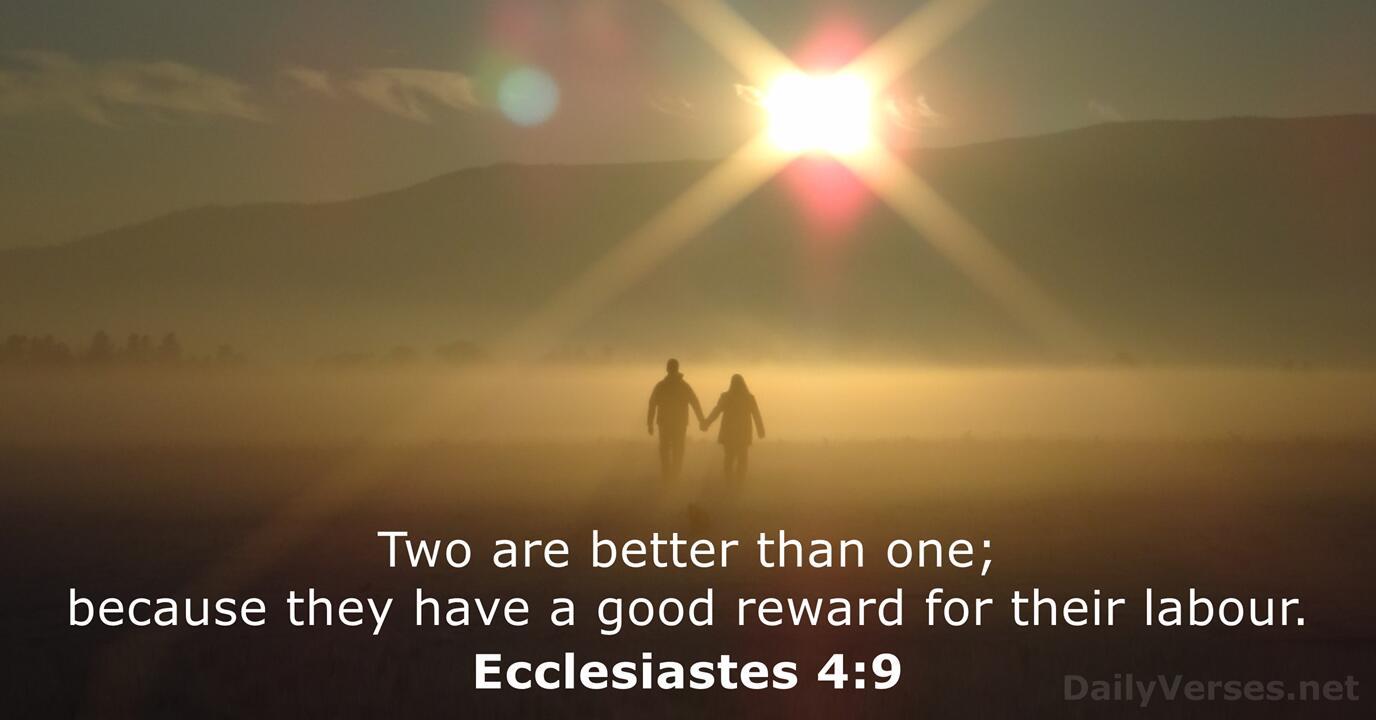
Jesus offers strength and comfort in godly relationships through His love12
A marriage bound together with Jesus is strengthened through love. Ecclesiastes 4:9 and 12 are often quoted during weddings. Jesus is argued to be the third cord that strengthens a marriage. Critics call this a forced interpretation. Some point to three cords in ancient Sumerian texts to argue that the author had something else in mind.13 But Jesus made clear that the Old Testament was written about Him. “You examine the Scriptures because you think that in them you have eternal life; and it is those very Scriptures that testify about Me;” (Jo. 5:39). The triune God created mankind in His image with a desire for godly fellowship and relationships. “ Then God said, ‘Let Us make mankind in Our image, according to Our likeness....”’ (Gen. 1:26a). The triune God created mankind as men and women to be joined together as one flesh and populate the Earth (Gen. 1:27-28). Jesus later affirmed that God meant for one man and one woman to become united as one. “5 and [He] said, ‘For this reason a man shall leave his father and mother and be joined to his wife, and the two shall become one flesh.’” (Matt. 19:5; Gen. 2:24). Along with all creation, God looked upon the unity of a man and a woman coming together as one in marriage and described it as “very good”. “And God saw all that He had made, and behold, it was very good. And there was evening and there was morning, the sixth day.” (Gen. 1:31). Not everyone is called to be married. But for those who are married, Jesus should be the head over the marriage. “But I want you to understand that Christ is the head of every man, and the man is the head of a woman, and God is the head of Christ.” (1 Cor. 11:3). When a faithful couple submits, Jesus acts as the third cord to bind the marriage in strength through love. “For God has not given us a spirit of timidity, but of power and love and discipline.” (2 Tim. 1:7).
When the Church is united for Jesus, members encourage and support each other. Jesus created believers with a desire for fellowship and community so that they can support, encourage, and uplift each other in times of need. “As iron sharpens iron, so one person sharpens another.” (Prov. 27:17). “Bear one another’s burdens, and thereby fulfill the law of Christ.” (Gal. 6:2). “Therefore, encourage one another and build one another up, just as you also are doing.” (1 Thess. 5:11). “But encourage one another every day, as long as it is still called “today,” so that none of you will be hardened by the deceitfulness of sin.” (Heb. 3:13). “Now may the God who gives perseverance and encouragement grant you to be of the same mind with one another, according to Christ Jesus, so that with one purpose and one voice you may glorify the God and Father of our Lord Jesus Christ.” (Ro. 15:5-6). “He made known to us the mystery of His will, according to His good pleasure which He set forth in Him, regarding His plan of the fullness of the times, to bring all things together in Christ, things in the heavens and things on the earth.” (Eph. 1:9-10). As an example for us to follow, Jesus also sends out the disciples in pairs to encourage, protect, and uplift each other during their trials (Mk. 6:7).
Church unity is good and pleasant to God when it is rooted in His love. How do you know if the Church is united for a godly purpose? If it is united for God, it is united through love for Him and others. “In addition to all these things put on love, which is the perfect bond of unity … So, as those who have been chosen of God, holy and beloved, put on a heart of compassion, kindness, humility, gentleness, and patience; bearing with one another, and forgiving each other, whoever has a complaint against anyone; just as the Lord forgave you, so must you do also. In addition to all these things put on love, which is the perfect bond of unity.” (Col. 3:4, 12-14). “Be devoted to one another in brotherly love; give preference to one another in honor,” (Ro. 12:10). “To sum up, all of you be harmonious, sympathetic, loving, compassionate, and humble;” (1 Pet. 3:8). “Therefore if there is any encouragement in Christ, if any consolation of love, if any fellowship of the Spirit, if any affection and compassion, make my joy complete by being of the same mind, maintaining the same love, united in spirit, intent on one purpose.” (Phil. 2:1-2). As our example, the early Church lived together in unity. They sought to attend to each other’s needs while also serving to build Jesus’ Church (Acts 2:42-47).
Love others just as Jesus loves you. When you love and support others the same way that Jesus loves you, He will bless your relationships. “Greater love has no one than this, that a person will lay down his life for his friends.” (Jo. 15:13). “We know love by this, that He laid down His life for us; and we ought to lay down our lives for the brothers and sisters.” (1 Jo. 3:16). “Beloved, let’s love one another; for love is from God, and everyone who loves has been born of God and knows God. The one who does not love does not know God, because God is love.” (1 Jo. 4:7-8). “Be devoted to one another in brotherly love; give preference to one another in honor,” (Ro. 12:10). “Bear one another’s burdens, and thereby fulfill the law of Christ.” (Gal. 6:2; 1 Pet. 4:8).
7. Justice and Righteousness: Instead of Trusting in Government Leaders, Turn to Jesus for Justice and Righteousness. Ecc. 4:13-16.
Jesus offers justice and righteousness that no human leader can provide. Many people place their hope in strong leaders. But this is ultimately futility because all people are sinful, and leaders will come and go. “13 A poor yet wise youth is better than an old and foolish king who no longer knows how to receive instruction— 14 for he has come out of prison to become king, even though he was born poor in his kingdom. 15 I have seen all those living under the sun move to the side of the second youth who replaces him. 16 There is no end to all the people, to all who were before them. Even the ones who will come later will not be happy with him; for this too is futility and striving after wind.” (Ecc. 4:13-16). “Here is basically what is happening: A poor but wise supplants an old, foolish king who will not listen to counsel. Usually youth is associated with folly and age with wisdom, but not so here because the king will not listen to advice, which is the mark of foolishness (Prov 12:15). Also, Solomon’s son Rehoboam was brought down as a young king because he would not listen to the counsel of elders. Here in Ecclesiastes, the old king is inflexible and forgets what it was like to be young and fiery … The youth becomes king instead. But then the youth is supplanted by a second youth, and the point is that the cycle never ends … the fulfillment of political ambitions is transitory, and the praise of the masses is vapid … The masses are fickle and flip-flop from one politician to the next. No matter how good the politician might be, nothing lasts forever.” (Daniel Akin and Jonathan Akin on Ecc. 4:13-16).14 “High places offer no assurance of security. A king's popularity is never permanent; he is supplanted by some clever young aspirant for a time, whose influence in turn soon evaporates, and the subject-people reap no benefit from the change. …” (Pulpit Commentary on Ecc. 4:13-16).15
Trust in God and not in government for your deliverance. “Though we cannot grasp the precise interpretation, the moral lesson is obvious. Political power is meaningless and like chasing wind,…” (Tremper Longman III on Ecc. 4:13-16).16 God repeatedly warned His people to put their trust in Him and not in human leaders for their deliverance. “Do not trust in princes, in mortal man, in whom there is no salvation.” (Ps. 146:3). “It is better to take refuge in the LORD than to trust in princes.” (Ps. 118:9). “O give us help against the adversary, for deliverance by man is in vain.” (Ps. 60:11). God is the one who strengthens and protects His people: “But the Lord is faithful, and He will strengthen and protect you from the evil one.” (2 Thess. 3:3). A God-fearing leader does not promise to deliver his or her people. Instead, a God-fearing leader guides people back to God.
Jesus will reign with justice and righteousness. Jesus is our righteous judge (2 Tim. 4:8). “I can do nothing on My own initiative. As I hear, I judge; and My judgment is just, because I do not seek My own will, but the will of Him who sent Me.” (Jo. 5:30). “But even if I do judge, My judgment is true; for I am not alone in it, but I and the Father who sent Me.” (Jo. 8:16). While David, Solomon, and Israel’s other kings sinned, Jesus never will. His reign will be perfect, just, and righteous. “1 Then a shoot will spring from the stem of Jesse, and a Branch from his roots will bear fruit. 2 The Spirit of the Lord will rest on Him, the spirit of wisdom and understanding . . . with righteousness He will judge the poor, and decide with fairness for the humble of the earth; . . . 5 Also righteousness will be the belt around His hips, and faithfulness the belt around His waist.” (Is. 11:1-5). “There will be no end to the increase of His government or of peace, on the throne of David and over his kingdom, to establish it and to uphold it with justice and righteousness from then on and forevermore.” (Is. 9:7; 16:5). “Behold, a king will reign righteously, and officials will rule justly.” (Is. 32:1). ‘“Behold, the days are coming,’ declares the LORD, ‘When I will raise up for David a righteous Branch; and He will reign as king and act wisely and do justice and righteousness in the land.”’ (Jer. 23:5; Is. 24:15; 42:4; Zech. 9:9-10). His righteous reign is another reason to praise Him.
Jesus is also the Prince of Peace. Jesus will also bring a peace that will never end: “And He will judge between the nations, and will mediate for many peoples; and they will beat their swords into plowshares, and their spears into pruning knives. Nation will not lift up a sword against nation, and never again will they learn war.” (Is. 2:4). “For a Child will be born to us, a Son will be given to us; and the government will rest on His shoulders; . . . Mighty God, Eternal Father, Prince of Peace.” (Is. 9:6). He is also the King of Peace (Heb. 7:1-3). “ . . . the LORD will bless His people with peace.” (Ps. 29:11). He again deserves your praise for offering to share His peace with you. “For as the earth produces its sprouts, and as a garden causes the things sown in it to spring up, so the Lord GOD will cause righteousness and praise to spring up before all the nations.” (Is. 61:11). He again deserves your praise for offering you His everlasting peace.
Jesus is sovereign over every nation and person on Earth. In reference to God, Daniel later explained: “It is He [God] who changes the times and the epochs; He removes kings and establishes kings; He gives wisdom to wise men and knowledge to men of understanding.” (Da. 2:21). “He makes the nations great, then destroys them; He enlarges the nations, then leads them away.” (Job 12:23). “Behold, the nations are like a drop from a bucket, and are regarded as a speck of dust on the scales; behold, He lifts up the islands like fine dust.” (Is. 40:15). “All the nations are as nothing before Him, they are regarded by Him as less than nothing and meaningless.” (Is. 40:17). “You shall multiply the nation, You shall increase their gladness; . . .” (Is. 9:3(a)). “All the inhabitants of the earth are accounted as nothing, but He does according to His will in the host of heaven and among the inhabitants of earth; and no one can ward off His hand or say to Him, ‘What have You done?’” (Dan. 4:35). Even when evil surrounds you or when you are ruled by evil leaders, Jesus is still in ultimate control.
Enduring Word Bible Commentary Ecclesiastes Chapter 4 (emphasis in original).↩︎
Image credit: An emotionally charged and realistic image of Jesus rescuing a drowning man, encapsulating themes of salvation, compassion, and divine intervention. The scene depicts Jesus reaching out with a strong, Stock Illustration | Adobe Stock↩︎
Olympiodorus, ‘Commentary on Ecclesiastes’, 3:21, in Proverbs, Ecclesiastes, Song of Solomon, ed. by J. Robert Wright, Ancient Christian Commentary on Scripture, OT 9 (Downers Grove, IL: InterVarsity, 2005), p. 233, Philip Ryken, Why Everything Matters: The Gospel in Ecclesiastes, (Glasgow, SCO, Crossway Bibles 2024) p. 83.↩︎
Image credit: 11 Top Bible Verses About Eternal Life - Encouraging Scripture | Bible Study Tools↩︎
Sidney Greidanus, Preaching Christ from Ecclesiastes, (Grand Rapids, MI, William B. Eerdman’s Publishing Company, 2010), pgs. 92-93.↩︎
Image credit: https://images.playground.com/7f82b6bd24574df386d8dec6fe1dbeb1.jpeg↩︎
David Gibson, Living Life Backward: How Ecclesiastes Teach Us To Live in Light of the End (Wheaton IL, Crossway Bibles, 2017), pgs. 71-72.↩︎
Image credit: Ecclesiastes 4.6 Poster - Better is a handful with quiet than two handfuls with toil, and a chasing after wind.↩︎
Image credit: Ecclesiastes Chapter 4 Bible Study↩︎
What does Ecclesiastes 4:9-12 really mean? - God's Blessing↩︎
Image credit: Ecclesiastes 4:9 - Bible verse (KJV) - DailyVerses.net↩︎
Aaron Shaffer, “The Mesopotamian Background of Qoh 4:9-12” (in Hebrew), El 8 (1967): 246-50; and “New Information on the Origin of the ‘Threefold Cord’” (in Hebrew), El 9 (1967): 159-60; Tremper Longman III, The Book of Ecclesiastes, (Grand Rapids, MI, William B. Eerdman’s Publishing Company, 1998) p. 143.↩︎
Daniel L. Akin and Jonathan Akin, Christ-Centered Exposition, Exalting Jesus in Ecclesiastes, (Brentwood, TN, B&H Publishing Group, 2016), pgs. 56-57.↩︎
Tremper Longman III, The Book of Ecclesiastes, (Grand Rapids, MI, William B. Eerdman’s Publishing Company, 1998) p. 147.↩︎