Ecclesiastes 9: Lessons For Finding Meaning Through Jesus During Your Limited Time on Earth
Introduction: Solomon previously warned that everything “under the sun” is (he·ḇel) “הֶ֙בֶל֙”, “futility,” “vanity,” or “meaningless” (e.g. Ecc. 1:3, 9, 14; 2:18-23; 3:16; 4:2-3, 8; 5:13-14; 6:1, 5). All worldly things will one day evaporate like smoke. Here, Solomon warned of the futility of trying to live life in the face of an inevitable death without Yahweh, another name for Jesus. Through Solomon’s warnings, the Bible reveals several lessons for finding meaning through Jesus with your limited time on Earth. These include: (1) faith, (2) hope, (3) grateful contentment, (4) serving Jesus, (5) diligence, (6) seeking Jesus’ wisdom, and (7) trusting Him.
First, Solomon warned that both the wicked and those who try to be moral will eventually die. Faith in Jesus is the only path to salvation. Second, Solomon warned that hope is available for as long as you live. But it ends at your death unless you place your hope in Jesus. Third, with the limited life that you are given Solomon urged believers to enjoy what Yahweh provides. At all times, be grateful and content with Jesus’ grace and provision. Fourth, Solomon urged believers to serve wherever Yahweh places them. Wherever Jesus places you, you can show your love for Him by faithfully serving Him. Fifth, Solomon warned that death stalks like a predator. It may come unexpectedly as part of Yahweh’s sovereign plans. Because death can come at any time, Jesus does not want you to wait to seek Him and serve Him. Sixth, Solomon urged believers not to waste the lives they are given. They should continually seek strength and protection through Yahweh’s wisdom. Jesus also wants you to find strength and protection through Him. Finally, Solomon warned that foolish worldly wisdom is frequently loud and popular. But it frequently leads to sorrow. Even when the wisdom of the world is popular, place your trust in Jesus.
1. Faith: Faith in Jesus is the Only Path to Eternal Salvation. Ecc. 9:1-3.
Both with the wicked and those who try to be righteous will one day die because of sin. Whether you live a wicked life or try to live a moral life, no person can change God’s sovereign will and prevent the death that comes to all because of original sin. “1 For I have taken all this to my heart and explain it that righteous men, wise men, and their deeds are in the hand of God. Man does not know whether it will be love or hatred; anything awaits him. 2 It is the same for all. There is one fate for the righteous and for the wicked; for the good, for the clean and for the unclean; for the man who offers a sacrifice and for the one who does not sacrifice. As the good man is, so is the sinner; as the swearer is, so is the one who is afraid to swear. 3 This is an evil in all that is done under the sun, that there is one fate for all men. Furthermore, the hearts of the sons of men are full of evil and insanity is in their hearts throughout their lives. Afterwards they go to the dead.” (Ecc. 9:1-3). “In Ecclesiastes 9:1-3, we are confronted with the stark reality that both the righteous and the wicked face the same fate of death. The passage emphasizes that the righteous and the wise, along with their deeds, are ultimately in the hand of God, highlighting the divine sovereignty over human actions and outcomes… Drawing parallels with other biblical passages such as Psalm 31:15, Hebrews 9:27, and Romans 3:23, we find a consistent theme of human frailty, divine sovereignty, and the universal need for redemption.” (Reverend Michael Johnson on Ecc. 9:1-3).1
All are appointed to die because of original sin. Some will try to live righteous lives on their own (Ecc. 9:1). But Solomon made clear that no one can be justified before God because all have sinned. “Indeed, there is not a righteous person on earth who always does good and does not ever sin.” (Ecc. 7:20). “for all have sinned and fall short of the glory of God,” (Rom. 3:23). Without Jesus, all will die. “For the wages of sin is death, but the gracious gift of God is eternal life in Christ Jesus our Lord.” (Rom. 6:23). Abel or Havel (הָ֑בֶל)2, Adam and Eve’s second son could not escape a physical death. (Gen. 4:1-2). His name translates as ‘vanity’ or ‘breath’.”3 His name is related to the word that Solomon used for futility hebel (הָ֫בֶל).4 God accepted Abel’s blood offering that he made in faith (Gen. 4:4). But his brother Cain then killed him out of jealousy (Gen. 4:8). Thus, Abel’s righteous acts could not save him from suffering a physical death.
No one can be righteous without Jesus. Without faith in Jesus Christ all will die regardless of their actions because of original sin. “For since by a man death came, by a man also came the resurrection of the dead. For as in Adam all die, so also in Christ all will be made alive.” (1 Cor. 15:21-22). “Therefore, just as through one man sin entered into the world, and death through sin, and so death spread to all mankind, because all sinned— for until the Law sin was in the world, but sin is not counted against anyone when there is no law. Nevertheless death reigned from Adam until Moses, even over those who had not sinned in the likeness of the violation committed by Adam, who is a type of Him who was to come. But the gracious gift is not like the offense. For if by the offense of the one the many died, much more did the grace of God and the gift by the grace of the one Man, Jesus Christ, overflow to the many.” (Ro. 5:12-15).

While death is certain for all, life after death is only certain for those with faith.5
No one can change the consequences of their sins without Jesus. Even if you live a moral life, you cannot redeem your own soul. “Regardless of how moral or religious we are, we all die …Solomon adds the reason we all die: Adam’s sons are full of evil and go to the dead. Solomon makes an explicit connection with the fall … Ecclesiastes 9 makes clear that all have sinned and fallen short of God’s glory, and the wages for that sin is death for all.” (Daniel Akin and Jonathan Akin on Ecc. 9:1-3).6 God determines the fate over every soul. “Behold, all souls are Mine; the soul of the father as well as the soul of the son is Mine. The soul who sins will die.” (Ezek. 18:4). “In whose hand is the life of every living thing, and the breath of all mankind?” (Job 12:10). “In whose hand is the life of every living thing, and the breath of all mankind?” (Jer. 10:23). “In whose hand is the life of every living thing, and the breath of all mankind?” (Prov. 20:24; Is. 46:10).
2. Hope: To Have Eternal Life, Place Your Hope in Jesus. Ecc. 9:4-6.
While hope exists for the living, hope without Jesus comes to an end at the time of death. Hope is universally available for the living. But hope dies at death without Jesus. “4 For whoever is joined with all the living, there is hope; surely a live dog is better than a dead lion. 5 For the living know they will die; but the dead do not know anything, nor have they any longer a reward, for their memory is forgotten. 6 Indeed their love, their hate and their zeal have already perished, and they will no longer have a share in all that is done under the sun.” (Ecc. 9:4-6). “[v. 4] As long as a man lives (is one of living beings) he has some hope, whatever it be …The dog in Palestine was not made a pet and companion, as it is among us, but was regarded as a loathsome and despicable object comp ... So the proverbial saying in the text means that the vilest and meanest creature possessed of life is better than the highest and mightiest which has succumbed to death. [v.5] The living have at least the consciousness that they will soon have to die, and this leads them to work while it is day, to employ their faculties worthily, to make use of opportunities, to enjoy and profit by the present. [v.6] Between the dead and the living an impassable gulf exists. The view of death here given, intensely gloomy and hopeless as it appears to be, is in conformity with other passages of the Old Testament (see Job 14:10-14; Psalm 6:5; Psalm 30:9; Isaiah 38:10-19;…), and that imperfect dispensation. Koheleth and his contemporaries were of those ‘who through fear of death were all their lifetime subject to bondage’ (Hebrews 2:15); it was Christ who brightened the dark valley, showing the blessedness of those who die in the Lord, bringing life and immortality to light through the gospel (2 Tim. 1:10).” (Pulpit Commentary, Ecc. 9:4-6).7
Every person faces a resurrection when they die. Without knowing, Job also had a dark view of death. “If I hope for Sheol as my home, I make my bed in the darkness; . . . Will it go down with me to Sheol? Shall we together go down into the dust?” (Job 17:13, 16). But God later corrected Job’s incorrect presumptions about the afterlife (Job 38:2; 17). When Jesus was incarnate, the Jews who believed in an afterlife referred to their place of rest as Abraham’s bosom. Jesus referred to this place in the context of the rich man and Lazarus (Lk. 16:19-31). When Jesus died, He brought the righteous in Abraham’s bosom to heaven (Acts 2:31). He also spoke of many sitting with Abraham at the feast in heaven (Matt. 8:11; Lk. 14:15). For those who died after Jesus’ resurrection, He taught that each dead person is “asleep” until His return. His believers will be the first to rise: “For the Lord Himself will descend from heaven with a shout, with the voice of the archangel and with the trumpet of God, and the dead in Christ will rise first.” (1 Thess. 4:16). According to the Bible, each person then faces judgement: “For we must all appear before the judgment seat of Christ, so that each one may be recompensed for his deeds in the body, according to what he has done, whether good or bad.” (2 Cor. 5:10; 1 Jo. 4:17). Jesus also taught that everyone would either live again in heaven (Jo 11:23-26; 1 Cor. 15:3-57) or a resurrected state of eternal suffering in outer darkness (Matt. 22:13). Thus, everyone needs Jesus to have the hope of an eternity in heaven.
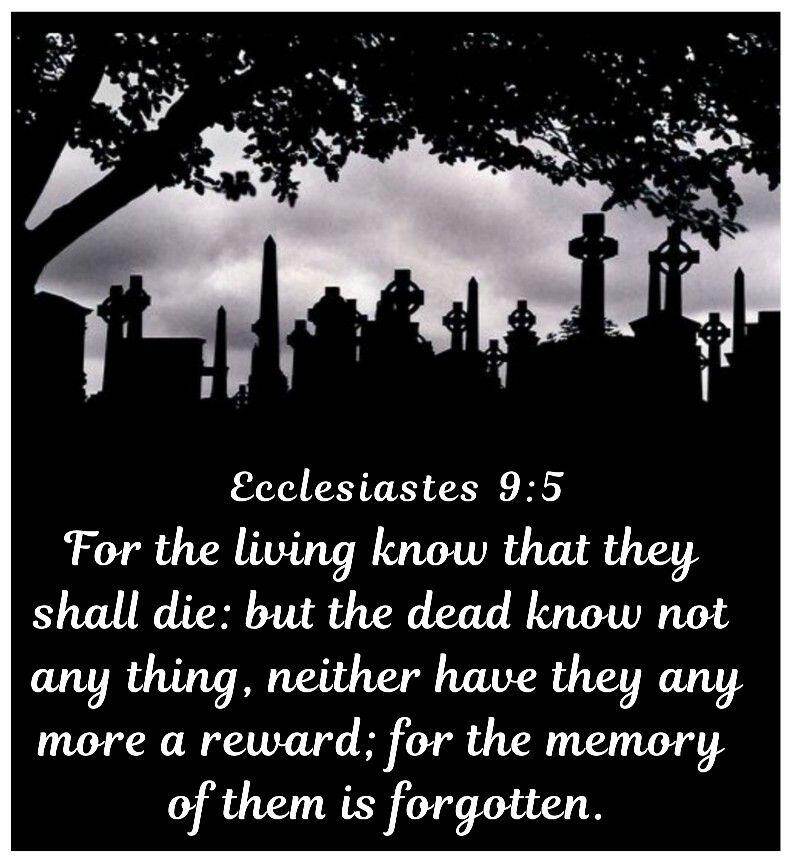
Because death comes to all, place your hope in Jesus for eternal life.8
David proclaimed that his hope rested in only God. In his darkness, David stated that he would place his hope in God alone: “5 My soul, wait in silence for God alone, for my hope is from Him.” (Ps. 62:5). “6 My soul waits in hope for the Lord more than the watchmen for the morning; yes, more than the watchmen for the morning.” (Ps. 130:6).
Put your hope in Jesus when you experience a trial. When you face a trial or darkness, Jesus also wants you to place your hope in Him alone for deliverance: “This hope we have as an anchor of the soul, a hope both sure and reliable and one which enters within the veil,” (Heb. 6:19). “And now, Lord, for what do I wait? My hope is in You.” (Ps. 39:7). “For I wait for You, LORD; You will answer, Lord my God.” (Ps. 38:15). “For You are my hope; Lord GOD, You are my confidence from my youth.” (Ps. 71:5). When you face a trial, do you place your hope in Jesus or in the things of this world?
3. Grateful Contentment: At All Times, Be Grateful and Content with Jesus’ Grace and Provision. Ecc. 9:7-9.
Be grateful and content for Jesus’ provision. Solomon again urged everyone to be content with Yahweh’s sovereign provision. His joy and provision will be even greater in heaven. “7 Go then, eat your bread in happiness and drink your wine with a cheerful heart; for God has already approved your works. 8 Let your clothes be white all the time, and let not oil be lacking on your head. 9 Enjoy life with the woman whom you love all the days of your fleeting life which He has given to you under the sun; for this is your reward in life and in your toil in which you have labored under the sun.” (Ecc. 9:7-9). [v. 7.] “eat thy bread with joy, and drink thy wine with a merry heart; … with moderation, not to excess; and with thankfulness to God; …The Targum interprets it figuratively of the joys of heaven; … ; for God now accepteth thy works; both the persons of righteous and good men are accepted of God in Christ …. [v.8] Let thy garments be always white … the Targum, ‘let thy garments be white (or washed) from all filth of sin;’ … the conversation garments of the saints are made white in the blood of Christ, and his righteousness is fine linen, and white; and even eternal glory and happiness is signified by walking with him in white, ...; and let thy head lack no ointment:.. we read of the oil of joy and gladness, … [9.] [T]his is all the outward happiness of a man in this life, and all the use, profit, and advantage of his labours, to eat and drink cheerfully, to clothe decently, to debar himself of nothing of lawful pleasure, particularly to live joyfully with his wife, and enjoy his friends; this is the utmost of outward felicity he can partake of, and this he should not deny himself.” (John Gill on Ecc. 9:7-9) (emphasis in original).9
Find joy and contentment in Jesus’ provision.10
Be grateful for Jesus’ provision. Solomon urged believers to be joyful and content with their God-given provision (Ecc. 9:7-9; 2:24; 3:12-13; 5:18-20; 8:15). Paul also stressed the importance of being content (Phil. 4:11-13). What God provides is enough to live a joyful life. “Instruct those who are rich in this present world not to be conceited or to set their hope on the uncertainty of riches, but on God, who richly supplies us with all things to enjoy.” (1 Tim. 6:17). But Paul made clear that God’s kingdom is more than just indulging in your God-given food and beverages. “for the kingdom of God is not eating and drinking, but righteousness and peace and joy in the Holy Spirit.” (Rom. 14:17). As you eat and drink, do so for Jesus’ glory by giving Him credit and expressing gratitude for His provision. “Therefore, whether you eat or drink, or whatever you do, do all things for the glory of God.” (1 Cor. 10:31). “Whatever you do in word or deed, do everything in the name of the Lord Jesus, giving thanks through Him to God the Father.” (Col. 3:17). “Then he said to them, “Go, eat the festival foods, drink the sweet drinks, and send portions to him who has nothing prepared; for this day is holy to our Lord. Do not be grieved, for the joy of the LORD is your refuge.” (Neh. 8:10; Dt. 12:7; Ps. 104:15).
Be grateful for your redemption by being holy. Solomon stated “God has already approved your works. 8 Let your clothes be white all the time, and let not oil be lacking on your head.” (Ecc. 9:7b-8). Jesus redeems believers and makes them righteous (Rom. 3:22; 2 Cor. 5:21). “I will rejoice greatly in the LORD, my soul will be joyful in my God; for He has clothed me with garments of salvation, He has wrapped me with a robe of righteousness, as a groom puts on a turban, and as a bride adorns herself with her jewels.” (Is. 61:10). He will provide fine linen cloths for His bride, the Church, in heaven. “Let’s rejoice and be glad and give the glory to Him, because the marriage of the Lamb has come, and His bride has prepared herself. It was given to her to clothe herself in fine linen, bright and clean; for the fine linen is the righteous acts of the saints.” (Rev. 19:7-8). Out of gratitude, you can respond by living a holy life (Rom. 12:1; 1 Pet. 1:16).
If you are married, be grateful and love the spouse Jesus has given you. After learning the dangers of lust, Solomon urged believers to love and support the spouse that God provides (Ecc. 9:9). “Let your fountain be blessed, and rejoice in the wife of your youth.” (Prov. 5:18). This message is repeated in the New Testament (Eph. 5:25-33; 1 Cor. 7:3-5; Heb. 13:4; 1 Pet. 3:7). Jesus will also love you as His bride (Rev. 19:7-8).
4. Service: Wherever Jesus Places You, Show Your Love for Him by Faithfully Serving Him. Ecc. 9:10.
Use your limited time on Earth to diligently serve Jesus. Because life is like a vapor and meaningless without Yahweh, Solomon urged every person to use their life to diligently serve Him. “10 Whatever your hand finds to do, do it with all your might; for there is no activity or planning or knowledge or wisdom in Sheol where you are going.” (Ecc. 9:10). “‘Whatsoever thy hand findeth to do’ … we are to approach these endeavors wholeheartedly. The next part, ‘do it with thy might,’ is a call to action … By committing to every task with diligence, we honor our capabilities and the grace bestowed upon us by God. The phrase ‘for in the grave, whither thou goest’ serves as a profound reminder of our mortality. It implies that our time is limited; death is a certainty and, therefore, a motivator to act now.” (Christianitypath.com on Ecc. 9:10).11
Whatever you do, honor Jesus with your works.12
Jesus has given you a ministry field for service wherever He has placed you. Like Solomon, Paul urged believers to diligently serve Jesus in whatever you do. “Whatever you do, do your work heartily, as for the Lord and not for people,” (Col. 3:23). “Therefore, my beloved brothers and sisters, be firm, immovable, always excelling in the work of the Lord, knowing that your labor is not in vain in the Lord.” (1 Cor. 15:58). “With goodwill render service, as to the Lord, and not to people,” (Eph. 6:7). “not lagging behind in diligence, fervent in spirit, serving the Lord;” (Rom. 12:11).
Although salvation is not based upon works, Jesus will reward you for your faithfulness. You should not be motivated by rewards. But Jesus will reward you if you faithfully serve Him. “For God is not unjust so as to forget your work and the love which you have shown toward His name, by having served and by still serving the saints.” (Heb. 6:10). “And whoever gives one of these little ones just a cup of cold water to drink in the name of a disciple, truly I say to you, he shall by no means lose his reward.” (Matt. 10:42). “Let’s not become discouraged in doing good, for in due time we will reap, if we do not become weary. So then, while we have opportunity, let’s do good to all people, and especially to those who are of the household of the faith.” (Gal. 6:9-10).
5. Diligence: Because Death Can Come at Any Time, Jesus Does Not Want You to Wait to Seek Him and Serve Him. Ecc. 9:11-12.
Because you cannot control the length of your life, do not delay in serving Jesus. Solomon warned that death stalks like a predator. Thus, no one should delay in serving Yahweh. “11 I again saw under the sun that the race is not to the swift and the battle is not to the warriors, and neither is bread to the wise nor wealth to the discerning nor favor to men of ability; for time and chance overtake them all. 12 Moreover, man does not know his time: like fish caught in a treacherous net and birds trapped in a snare, so the sons of men are ensnared at an evil time when it suddenly falls on them.” (Ecc. 9:11-12). “This passage continues the implications from death being the fate of all men, proclaiming that man does not know his time. Death is certain for all, but no one knows the day of their death. Solomon uses an analogy of fish that are caught in a net and birds that are trapped in a snare. Neither the fish nor the bird expected to be caught, but caught they are. So it is with death. Solomon calls the net treacherous. Humans were not created for death. Death is an interrupter and a usurper. Death is viewed throughout scripture as an enemy that Jesus vanquishes. … Solomon adds an element to the inevitability of death: time and chance. In the end, not everything will follow normal cause-and-effect. Someone who lives a healthy lifestyle might live longer. But they will still die. Time and chance happen to all. Sometimes people who live healthy lifestyles die prematurely, while people who abuse themselves live a long life … No matter what we do, we cannot prevent time and chance, events, from overriding the consequences of our own actions.” (TheBibleSays.com on Ecc. 9:11-12) (Italics in original).13
Jesus is sovereign over the duration of every person’s life. Solomon stated that no person can influence the length of time that they will live through their efforts (Ecc. 9:11-12). Jesus alone determines the length of time that every person will live. “The mind of a person plans his way, but the LORD directs his steps.” (Prov. 16:9). “Many plans are in a person’s heart, but the advice of the LORD will stand.” (Prov. 19:21). “In Him we also have obtained an inheritance, having been predestined according to the purpose of Him who works all things in accordance with the plan of His will,” (Eph. 1:11). “for it is God who is at work in you, both to desire and to work for His good pleasure.” (Phil. 2:13).
Out of grace, Jesus determines the length of each person’s life. Solomon’s revelation is also important because no one can prolong their life through their works. Instead, Jesus gives life and extends a person’s life as a gift of grace. “So then, it does not depend on the person who wants it nor the one who runs, but on God who has mercy.” (Rom. 9:16). “For by grace you have been saved through faith; and this is not of yourselves, it is the gift of God; not a result of works, so that no one may boast.” (Eph. 2:8-9).
Because life is short and beyond your control, don’t squander the time Jesus gives you. With your limited time on Earth, Jesus does not want you to delay in serving Him. “Yet you do not know what your life will be like tomorrow. For you are just a vapor that appears for a little while, and then vanishes away. Instead, you ought to say, ‘If the Lord wills, we will live and also do this or that.’ … So for one who knows the right thing to do and does not do it, for him it is sin.” (Jam. 4:14-15, 17). “not lagging behind in diligence, fervent in spirit, serving the Lord;” (Rom. 12:11; Prov. 10:4; 12:24; 13:4).
Because you cannot avoid death, diligently serve Jesus with the time He gives you.14
6. Seeking Jesus’ Wisdom: Find Strength and Protection Through Jesus’ Wisdom. Ecc. 9:13-15.
With the time available to you, continually seek out Jesus’ wisdom. Jesus’ wisdom is quickly forgotten in our fallen world. Even though worldly wisdom may appear strong, Solomon encouraged all to seek Yahweh’s wisdom. “13 Also this I came to see as wisdom under the sun, and it impressed me. 14 There was a small city with few men in it and a great king came to it, surrounded it and constructed large siegeworks against it. 15 But there was found in it a poor wise man and he delivered the city by his wisdom. Yet no one remembered that poor man.” (Ecc. 9:13-15). “Solomon tells a story about a poor wise man whose wisdom saved a city against the siege of a great king. This seemed great to Solomon; it was a wonderful and significant display of wisdom … Under the premise that death ends existence and consciousness for all, Solomon protested that the only lasting meaning this man might have – to be remembered – was taken away. The almost unbelievable fleetingness of fame added to the sense of meaninglessness of life. Men quickly forget, but God never does. He knows those who are His (2 Timothy 2:19). He has a book of remembrance before Him for those that fear the Lord (Malachi 3:16), and their names are written in heaven (Luke 10:20). (David Guzik on Ecc. 9:13-18).15
Jesus’ wisdom will allow you to bring down the enemy’s strongholds. Even the greatest worldly powers are no match against Jesus’ wisdom. “A wise person scales the city of the mighty and brings down the stronghold in which they trust.” (Prov. 21:22). Here, Solomon gave an example where Yahweh’s wisdom saved a city. (Ecc. 9:14-16).
Jesus’ wisdom will frequently appear foolish to worldly people. Jesus’ wisdom is more powerful than worldly wisdom. But His wisdom is quickly forgotten (Ecc. 9:15). “For the foolishness of God is wiser than mankind, and the weakness of God is stronger than mankind.” (1 Cor. 1:25). But obeying His wisdom can allow you to prevail in spiritual warfare and bring down the enemy’s spiritual strongholds in your life. “For though we walk in the flesh, we do not wage battle according to the flesh, for the weapons of our warfare are not of the flesh, but divinely powerful for the destruction of fortresses. We are destroying arguments and all arrogance raised against the knowledge of God, and we are taking every thought captive to the obedience of Christ,” (2 Cor. 10:3-5). “We have to remember today that the world will never applaud the basic truth of the Christian faith because Christianity judges the world, points out its error, and exposes its illusions; it humbles it. The world cannot take that. So we can expect that the wisdom that we are learning from God will not necessarily be popular. Nevertheless, it is that which can deliver, that which can free.” (Ray Stedman, Authentic Christianity, Ecc. 9:15).16
7. Trust: Even When Worldly Wisdom is Popular, Place Your Trust in Jesus’ Wisdom. Ecc. 9:16-18.
Trust in the quiet power of Jesus’ wisdom over the boasts of foolish worldly wisdom. The loudest voices frequently demand obedience to the views of the world. But those who follow worldly wisdom frequently find sorrow. Solomon instead urged believers to trust in the quiet wisdom of Yahweh. “16 So I said, ‘Wisdom is better than strength.’ But the wisdom of the poor man is despised and his words are not heeded. 17 The words of the wise heard in quietness are better than the shouting of a ruler among fools. 18 Wisdom is better than weapons of war, but one sinner destroys much good.” (Ecc. 9:16-18). [v.16] “The Teacher is probably quoting a familiar proverb: ‘Wisdom is better than might’ That’s like our proverb, ‘Brains are better than brawn.’ …[v. 17] The quiet words of the wise are ‘better than might’; they ought to be headed….[v. 18] It takes only one foolish bungler, only one person who ‘misses the mark,’ to destroy the many good things accomplished by wisdom …Think of King Rehoboam when he succeed his father Solomon. His counselors advised him to ‘lighten the hard service’ Solomon had placed on the people. But he disregarded their wise counsel and turned to his younger counselors …as a result he lost ten of the twelve tribes of Israel. It takes only one bungler to destroy much good.” (Sidney Greidanus on Ecc. 9:16-18).17
Don’t place your trust in worldly things for your deliverance. When you rely upon the things of the world to deliver you, you are telling God that you don’t need Him. The result is frequently disastrous. For example, when the Jews turned to Egypt for protection, their enemies defeated them: “Then they will be terrified and ashamed because of Cush their hope and Egypt their pride.” (Is. 20:5). “Therefore the safety of Pharaoh will be your shame, and the shelter in the shadow of Egypt, your humiliation.” (Is. 30:8). “Woe to those who go down to Egypt for help and rely on horses, and trust in chariots because they are many and in horsemen because they are very strong, but they do not look to the Holy One of Israel, nor seek the LORD!” (Is. 31:1).
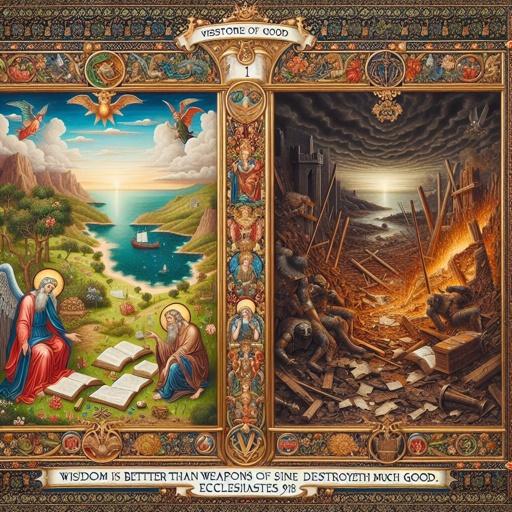
Place your trust in Jesus and not in the wisdom of the world.18
Have faith that God is stronger than any evil that you will ever face. In the Lord’s prayer, Jesus encouraged believers to pray: “And do not lead us into temptation, but deliver us from evil.” (Matt. 6:13). “But the Lord is faithful, and He will strengthen and protect you from the evil one.” (2 Thess. 3:3). God wants you to have faith that the Holy Spirit inside of you is greater than any spiritual adversary that you will ever face. “You are from God, little children, and have overcome them; because greater is He who is in you than he who is in the world.” (1 Jo. 4:4). “What then shall we say to these things? If God is for us, who is against us?” (Ro. 8:31; Ps. 118:6; Heb. 13:6). Jonathan also encouraged David that Saul would never capture or harm him: “ Thus he said to him, ‘Do not be afraid, because the hand of Saul my father will not find you, and you will be king over Israel and I will be next to you; and Saul my father knows that also.”’ (1 Sam. 23:17).
What does Ecclesiastes 9:1-3 really mean? - God's Blessing↩︎
Image credit: Ecclesiastes Archives -↩︎
Daniel L. Akin and Jonathan Akin, Christ-Centered Exposition, Exalting Jesus in Ecclesiastes, (Brentwood, TN, B&H Publishing Group, 2016), p. 102.↩︎
Image credit: Ecclesiastes 9:5↩︎
Ecclesiastes 9 Commentary - John Gill's Exposition of the Bible | Bible Study Tools↩︎
Image credit: Ecclesiastes 9:7 BSB - Go, eat your bread with joy, and drink your wine with a cheerful heart, for God has already approved your works:↩︎
Ecclesiastes 9:10 Meaning & Explanation (with Related Verses) - Christianity Path↩︎
Image credit: Ecclesiastes 9 10 Bible Verse Wall Art #1 Digital Art by Bible Verse - Fine Art America↩︎
Image credit: Ecclesiastes 9 11 Bible Verse Wall Art #1 Digital Art by Bible Verse - Fine Art America↩︎
Sidney Greidanus, Preaching Christ from Ecclesiastes, (Grand Rapids, MI, William B. Eerdman’s Publishing Company, 2010), p. 251.↩︎
Image credit: Ecclesiastes 9:7 Artwork | Bible Art↩︎