Proverbs 22: Lessons for Living Out Your Faith in Jesus
Introduction: Proverbs 22 marks a transition in Proverbs. The first 16 verses continue the single-verse proverb format. But, in verse 17, Solomon begins a different style with proverbs that vary in length, called the “Thirty Sayings of the Wise.” Just as people respond to different styles of worship music, Solomon gave witness to Yahweh’s wisdom through different styles. But the message remained the same. All people, both Jews and gentles, need to live out their faith by turning from their sins and find guidance through Yahweh’s wisdom. Yahweh, the great I AM, is revealed in the New Testament to be Jesus (Jo. 8:58; Ex. 3:14). Thus, in Proverbs 22, the Bible reveals seven lessons for living out your faith in Jesus. These include: (1) fearing Him, (2) stewardship, (3) purity, (4) trust, (5) righteousness, (6) obedience, and (7) faithful service.
First, in verses one through five, Solomon provides five examples of a person who lives out their faith by fearing the Lord. These examples include: integrity, submission to God, discernment, humility, and holiness. Second, in verses six through nine, Solomon provides examples regarding how believers should be good stewards with what Yahweh provides. These include: raising children in the Lord, avoiding excessive debt, being a source of justice, and being generous to others in need. Third, in verses 10 and 11, Solomon provides two examples for believers to live out their faith through purity. These include separation from sinners and having a pure heart for God. Fourth, in verses 12 and 13, Solomon provides two examples of believers who live out their faith by trusting Yahweh. This includes trusting that He is always watching over His people. It also includes trusting in His provision by being diligent and avoiding slothfulness. Fifth, in verses 14 through 16, Solomon provides examples for believers to live out their faith through righteous conduct. These include: fleeing from temptation and adultery, submitting to discipline, and being just and compassionate to people in need. Sixth, in verses 17 through 28, Solomon provides examples for believers to live out their faith through obedience. These include: seeking out and following Yahweh’s wisdom, following His laws, including the treatment of the poor, not being unequally yoked with sinners, avoiding economic bondage, and respecting God-given revelations to your forefathers when they do not conflict with His Word. Finally, in verse 29, Solomon explains how believers should live out their faith by faithfully serving wherever Yahweh has placed you. Jesus also desires your faithful service.
1. Fearing Jesus: Live Out Your Faith in Jesus By Fearing Him with Reverent Conduct and Avoiding What He Defines as Evil. Prov. 22:1-5.
When your fear of Jesus includes integrity, it leads to His blessing of a good reputation. The fear of the Lord is defined as hating evil (Prov. 8:13). When the fear of Jesus causes a person to shun evil and live out their faith with a life of integrity, Jesus will bless that person with a good name or reputation, something that is better than anything money can buy. “1 A good name is to be more desired than great wealth; favor is better than silver and gold.” (Prov. 22:1). In the original Hebrew, the word “good” does not exist as an adjective before the noun name. But it is implied. (Albert Barnes on Prov. 22:1).1 “One important lesson we learn from Proverbs 22:1 is that our reputation is our most valuable asset. It influences how others interact with us and the opportunities that come our way. When we strive to build a solid reputation through kindness, honesty, and treating others well, we create an environment where support and positive interactions flourish. A good reputation can open doors for us in ways that wealth simply cannot. Another essential lesson is the value of relationships. Loving favor invites people into our lives, and when we are known for our good character, we attract supportive friends and community. Investing in relationships with kindness leads to a more enriched life filled with love, support, and genuine connections.” (Christianitypath.com on Prov. 22:1).2

When you live out your faith with integrity, Jesus will bless your reputation3
Live out your faith with integrity, and Jesus will bless you. A person with faith-based integrity will be remembered forever. “For he will never be shaken; the righteous will be remembered forever.” (Ps. 112:6). Jesus will be faithful to remember and celebrate your righteous acts in heaven (Matt. 6:19-21). Thus, every person should seek the blessings that come from living a life of integrity. “7 The mentioning of the righteous is a blessing, but the name of the wicked will rot.” (Prov. 10:7). “A good name is better than good oil, and the day of one’s death is better than the day of one’s birth.” (Ecc. 7:1).
The fear of the Lord includes submitting to Jesus whether you are rich or poor. Jesus made the heavens, the Earth, and all people within it (Jo. 1:3; Col. 1:16). Thus, whether you are rich or poor, you should submit to Jesus with reverent fear as your Creator. “2 The rich and the poor have a common bond, the Lord is the Maker of them all.” (Prov. 22:2). “God has ordained that there shall be rich and poor in the world, and that they should meet in the intercourse of life. These social inequalities are ordered for wise purposes; the one helps the other. The labor of the poor makes the wealth of the rich; the wealth of the rich enables him to employ and aid the poor. Their common humanity, their fatherhood in God, should make them regard one another as brethren, without distinction of rank or position: the rich should not despise the poor (Proverbs 14:31; Proverbs 17:5; Job 31:15), the poor should not envy the rich (Proverbs 3:31), but all should live in love and harmony as one great family of God.” (Pulpit Commentary on Prov. 22:2).4
Jesus brought you into the world with nothing and you will leave it with nothing. Even when Job lost all his wealth, he still praised God, “He [Job] said, ‘Naked I came from my mother’s womb, and naked I shall return there. The LORD gave and the LORD has taken away. Blessed be the name of the LORD.”’ (Job 1:21). Your faith should not be impacted if Jesus makes you rich or poor. “For we have brought nothing into the world, so we cannot take anything out of it, either.” (1 Tim. 6:7). Jesus decides who receives wealth and who does not. Those who are poor are blessed because they are more likely to depend upon Him. “Listen, my beloved brothers and sisters: did God not choose the poor of this world to be rich in faith and heirs of the kingdom which He promised to those who love Him? But you have dishonored the poor man. Is it not the rich who oppress you and personally drag you into court?” (Jam. 2:5-6). “Who shows no partiality to the prominent, nor regards the rich as above the poor, since they are all the work of His hands?” (Job 34:19). “The LORD makes poor and rich; He humbles, He also exalts. He raises the poor from the dust, He lifts the needy from the garbage heap to seat them with nobles, and He gives them a seat of honor as an inheritance; for the pillars of the earth are the LORD’S, and He set the world on them.” (1 Sam. 2:7-8).
The fear of the Lord includes both discerning evil and avoiding it. If the fear of the Lord is hating evil (Prov. 8:13), believers should live out their faith and fear Jesus by first seeking to discern evil and then trying to avoid it. “3 A prudent person sees evil and hides himself, but the naive proceed, and pay the penalty.” (Prov. 22:3). “This powerful verse from Proverbs 22:3 highlights the importance of being wise and cautious in our decisions. It contrasts two types of people: the prudent and the simple. The prudent are those who possess wisdom, foresight, and discernment. They are able to recognize potential dangers or threats and take proactive steps to protect themselves. On the other hand, the simple are depicted as lacking in wisdom and awareness. They fail to see the warning signs and continue on their path without consideration of potential consequences. We are called to examine our own approach to life’s challenges as we reflect on this verse. Are we like the prudent, who are vigilant and make informed choices to safeguard themselves? Or do we resemble the simple, who overlook warning signs and face the consequences of their recklessness? This verse reminds us of the importance of being intentional, thoughtful, and prudent in our decision-making. It challenges us to cultivate wisdom, foresight, and discernment so that we may navigate life’s journey with care and avoid unnecessary pitfalls.” (Reverend Michael Johnson on Prov. 22:3).5
Jesus wants you to be wise and avoid evil. For emphasis, Solomon later repeated this proverb. “A prudent person sees evil and hides himself; but the naive proceed, and pay the penalty.” (Prov. 27:12). With the wisdom that Jesus offers, you will have the ability to discern when others try to deceive or cause you harm. “Behold, I am sending you out as sheep in the midst of wolves; so be as wary as serpents, and as innocent as doves.” (Matt. 10:16; Lk. 10:3). But you must follow Jesus’ wisdom to be protected. “Therefore, everyone who hears these words of Mine, and acts on them, will be like a wise man who built his house on the rock. And the rain fell and the floods came, and the winds blew and slammed against that house; and yet it did not fall, for it had been founded on the rock. And everyone who hears these words of Mine, and does not act on them, will be like a foolish man who built his house on the sand.” (Matt. 7:24-26).

Live out your faith by seeking Jesus’ help to discern and avoid evil6
The fear of the Lord includes humility. Here, Solomon expressly connects the fear of the Lord to humility because all have fallen short and sinned (Ecc. 7:22). When you live out your faith with humility and reverent fear for Jesus, He will bless you in heaven and possibly on Earth. “4 The reward of humility and the fear of the Lord are riches, honor, and life.” (Prov. 22:4). “We must so reverence God’s majesty and authority as to submit with all humility to the commands of his word and the disposals of his providence. We must have such low thoughts of ourselves as to behave humbly towards God and man. Where the fear of God is there will be humility … What is to be gotten by it—riches, and honor, and comfort, and long life, in this world, as far as God sees good, at least spiritual riches and honor in the favor of God, and the promises and privileges of the covenant of grace, and eternal life at last.” (Matthew Henry on Prov. 22:4).7
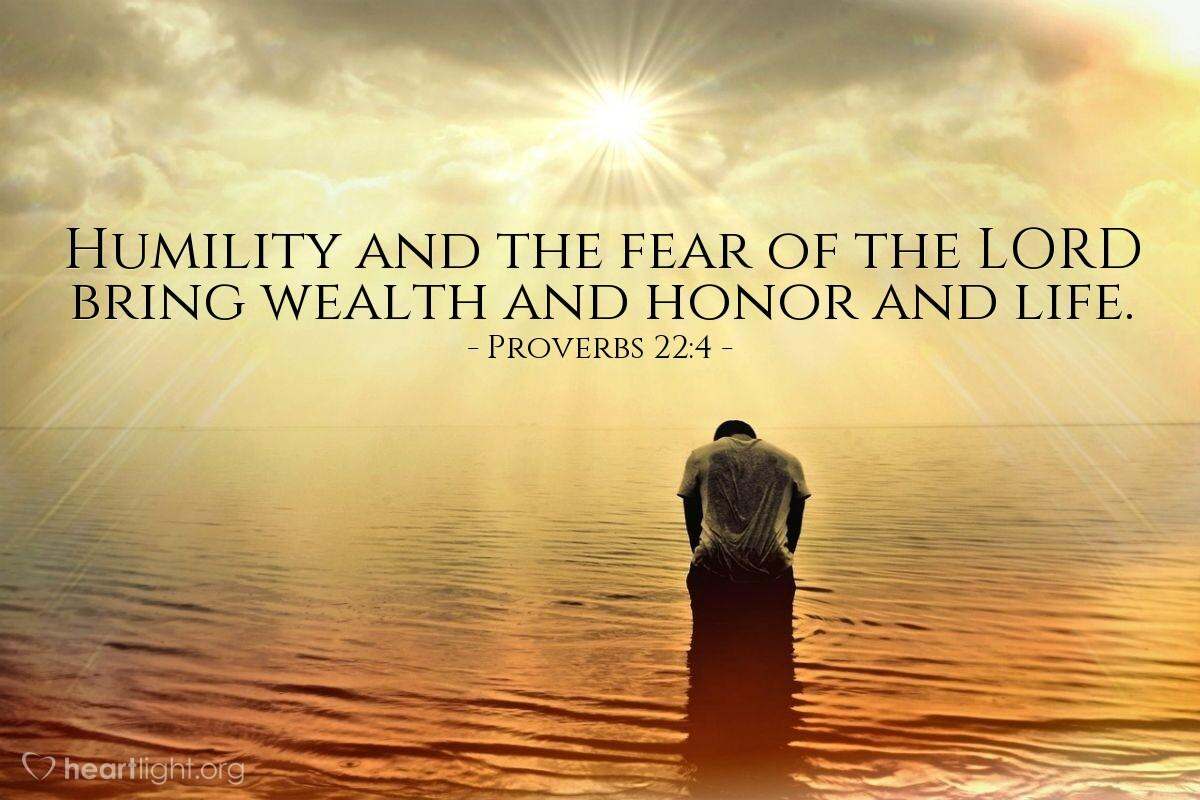
Live out your faith with humility and reverent fear, and He will honor you8
The fear of the Lord brings the blessings of wisdom and honor. When you live out your faith with humility and reverent fear, Jesus will honor and bless you in His perfect timing. “The fear of the LORD is the instruction for wisdom, and before honor comes humility.” (Prov. 15:33). “Whoever exalts himself shall be humbled, and whoever humbles himself shall be exalted.” (Matt. 23:12). “Humble yourselves in the presence of the Lord, and He will exalt you.” (Jam. 4:10). “A person’s pride will bring him low, but a humble spirit will obtain honor.” (Prov. 29:23). “Therefore humble yourselves under the mighty hand of God, so that He may exalt you at the proper time,” (1 Pet. 5:6).
When the fear of Lord prompts you to stay on Jesus’ holy path, He will protect you. When you fear Jesus by hating evil (Prov. 8:13) and remain on His narrow path of holiness, Jesus will protect you from the snares of evil. “5 Thorns and snares are in the way of the perverse; one who guards himself will be far from them.” (Prov. 22:5). “Proverbs 13:15 told us that the way of the unfaithful is hard. Thorns and snares symbolically describe the hard way of the perverse … The wise man or woman, keeping watch over their life (guards his soul) will stay far from the way of the perverse and the thorns and snares associated with that way.” (David Guzik on Prov. 22:5).9
Jesus’s narrow path provides protection from evil. Those who stay on the path of holiness find Jesus’ protection from evil. “A highway will be there, a roadway, and it will be called the Highway of Holiness. The unclean will not travel on it, but it will be for the one who walks that way, and fools will not wander on it. No lion will be there, nor will any vicious animal go up on it; they will not be found there. But the redeemed will walk there,” (Is. 35:8-9). This narrow path also leads to the blessing of eternal life through Jesus. “Enter through the narrow gate; for the gate is wide and the way is broad that leads to destruction, and there are many who enter through it. For the gate is narrow and the way is constricted that leads to life, and there are few who find it.” (Matt. 7:13-14). The path that seems right in your own eyes leads to death. “There is a way which seems right to a person, but its end is the way of death.” (Prov. 14:12; Jer. 17:9).
2. Stewardship: Live Out Your Faith by Being a Good Steward With What Jesus Gives You. Prov. 22:6-9.
Be a good steward with your children by making them disciples for Jesus. Jesus also wants you to live out your faith by being a good steward and raising up your children to be disciples for Him. “6 Train up a child in the way he should go, even when he grows older he will not abandon it.” (Prov. 22:6). “This is among the most quoted proverbs in the Bible. Here, Solomon (Proverbs 10:1) offers sound advice for parents. When a child is raised with the right values, and the right perspective, those lessons will last a lifetime (Ephesians 6:4). The literal wording here implies that the rightly trained child will not deviate from this path. Of course, Solomon’s proverbial counsel is not an iron-clad promise. Despite the direction in which godly parents point their child, he or she may choose to pursue the way of the crooked mentioned in verse 5. Yet a foundation of godliness gives the child something positive to ‘fall back on’ when they come to their senses (Luke 15:16–20) … Godly parents can only do their best to direct the steps of their children. They can trust that instructing their children about God and modeling what it looks like to have a relationship with God will most likely persuade each child to believe on the Lord and obey Him. If it does not, then those experiences will help to convict and change a stubborn heart later in life.” (BibleRef.com on Prov. 22:6).10
Any child of God within your circle of influence should be raised up in Jesus. Jesus’ desire is for every parent to teach their children to live according to His Word. “These words, which I am commanding you today, shall be on your heart. And you shall repeat them diligently to your sons and speak of them when you sit in your house, when you walk on the road, when you lie down, and when you get up.” (Dt. 6:6-7; 4:9-10; Ps. 78:4-5). “Fathers, do not provoke your children to anger, but bring them up in the discipline and instruction of the Lord.” (Eph. 6:4; Col. 3:21). “and that from childhood you have known the sacred writings which are able to give you the wisdom that leads to salvation through faith which is in Christ Jesus.” (2 Tim. 3:15). Jesus wants you to raise your children to be His disciples. But He also wants you to make disciples out of God’s children anywhere through the world where people are willing to listen to you. “Go, therefore, and make disciples of all the nations, baptizing them in the name of the Father and the Son and the Holy Spirit, teaching them to follow all that I commanded you; and behold, I am with you always, to the end of the age.”” (Matt. 28:19-20).
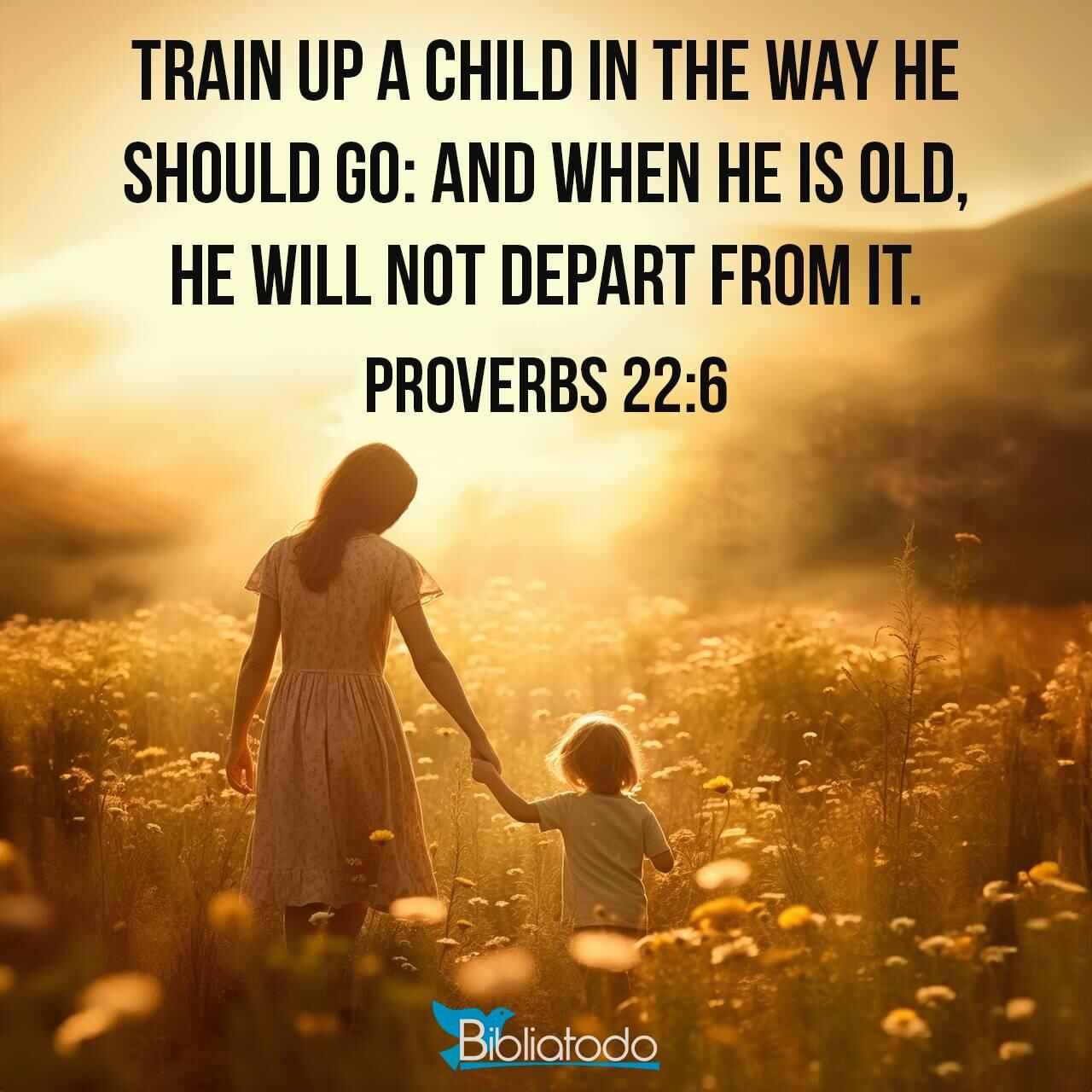
Be a good steward of Jesus’ children by raising them to believe and follow Him11
When possible, avoid making yourself a slave through your debts. Whether Jesus has blessed you with great resources or few resources, He wants you to be a good steward with His resources by avoiding excessive debt. “7 The rich rules over the poor, and the borrower becomes the lender’s slave.” (Prov. 22:7). “Money is power. Those who have it, rule. Those who do not have it, serve. Solomon saw this fact by observing human society (Ec 1:12-18). The proverb is an observation: … God wanted Israel to be a creditor nation – loaning money (Deut 28:12-13,43-44). Lenders are the head, and borrowers the tail. The creditor wags the debtor. If Israel obeyed Him, He promised to make them creditors; if they disobeyed Him, He promised to make them debtors. God has better things in store for His people than being servants through financial debt. You should work and save to avoid debt (Rom 13:8; I Cor 7:21). Godly ambition avoids foolish or unnecessary debt (I Cor 7:32).” (LetGodbeTrue on Prov. 22:7).12
Avoid placing yourself into economic bondage through unsustainable debts. Believers were warned against becoming enslaved though their debts. “For the LORD your God will have blessed you just as He has promised you, and you will lend to many nations, but you will not borrow; and you will rule over many nations, but they will not rule over you.” (Dt. 15:6; 28:12). “Owe nothing to anyone except to love one another; for the one who loves his neighbor has fulfilled the Law.” (Ro. 13:8). “You were bought for a price; do not become slaves of people.” (1 Cor. 7:23). “It was for freedom that Christ set us free; therefore keep standing firm and do not be subject again to a yoke of slavery.” (Gal. 5:1). “So if the Son sets you free, you really will be free.” (Jo. 8:36). But God does not want you to use the fear of financial bondage as an excuse to be miserly and ignore those around you who are in financial need (Prov. 19:17; Ex. 22:25; Matt. 5:42; 25:40; Lk. 6:34-35; Jam. 2:14-17). “[F]or God loves a cheerful giver.” (2 Cor. 9:7b).
Use your time, talent, and treasure to be a source for God’s justice. With whatever abilities and resources that Jesus has given you, He wants you to be a source of His justice. This includes helping the poor and others in need. “8 One who sows injustice will reap disaster, and the rod of his fury will perish.” (Prov. 22:8). “The ‘rod’ that is in this verse speaks of authority. A person that lives a wicked life will reap an empty harvest, and find that he has no authority over anyone.” (Ronald Young on Prov. 22:8).13
The unsaved will be repaid according to their deeds. In the book of Job, Eliphaz stated that “… those who plow iniquity and those who sow trouble harvest it” (Job 4:8). Although his attack on Job was meritless, it applies to all unsaved sinners. The Apostle Paul quoted repeated it in the New Testament: “ . . . for whatever a man sows, this he will also reap. For the one who sows to his own flesh will from the flesh reap corruption, but the one who sows to the Spirit will from the Spirit reap eternal life.” (Gal. 6:7-8). “Who will render to each person according to his deeds” (Ro. 2:6). The prophet Hosea also quoted a variation of this statement as well: “For they sow the wind and they reap the whirlwind. The standing grain has no heads; it yields no grain. Should it yield, strangers would swallow it up.” (Hos. 8:7). Even Jesus quoted a variation of Eliphaz’s statement: “For the Son of Man . . . will then repay every man according to his deeds.” (Matt. 16:27). Eliphaz’s error was in confusing the ultimate with the immediate. Even though God will one day judge all sin, He is patient and longsuffering. He withholds judgment to give every sinner a chance to repent. “The Lord is not slow about His promise, as some count slowness, but is patient toward you, not willing for any to perish, but for all to come to repentance.” (2 Pet. 3:9; 1 Tim. 2:4; Ezek. 18:23; 33:11).
Live with generosity, compassion, and love for others in need. Being a good steward and living out your faith should also include being generous to others in need. “9 One who is generous will be blessed, because he gives some of his food to the poor.” (Prov. 22:9). The person who gives to the poor without seeking public reward “shall be blessed with an increase of temporal good things, with spiritual blessings, and with eternal glory and happiness; when he does what he does from principles of grace, with a view to the glory of God, not depending on what he does, but upon the grace of God, and the righteousness of Christ; …” (John Gill’s Exposition of the Entire Bible, Prov. 22:9).14
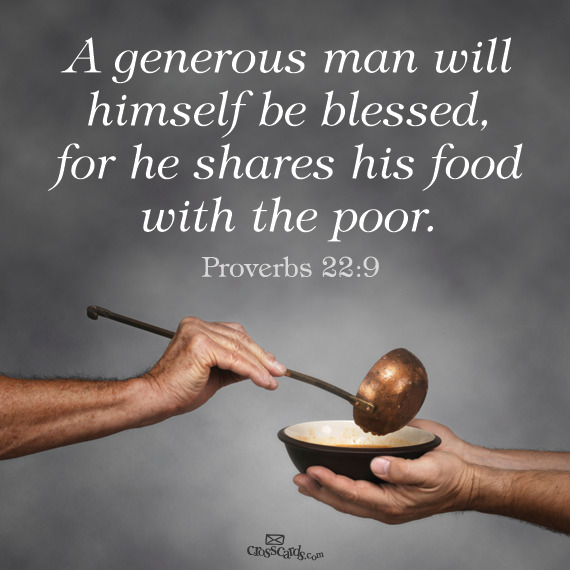
When the fruit of your faith includes generosity, Jesus will bless you15
Believers who are generous to the poor will reap Jesus’ blessings. Instead of reaping the consequences of sin, every believer should seek to reap Jesus’ blessings through selfless generosity to those who are in need. “There is one who scatters, and yet increases all the more, and there is one who withholds what is justly due, and yet it results only in poverty. A generous person will be prosperous, and one who gives others plenty of water will himself be given plenty.” (Prov. 11:24-25). “Give, and it will be given to you. They will pour into your lap a good measure—pressed down, shaken together, and running over. For by your standard of measure it will be measured to you in return.” (Lk. 6:38). “And whoever gives one of these little ones just a cup of cold water to drink in the name of a disciple, truly I say to you, he shall by no means lose his reward.” (Matt. 10:42). “Then the King will say to those on His right, ‘Come, you who are blessed of My Father, inherit the kingdom prepared for you from the foundation of the world. For I was hungry, and you gave Me something to eat; I was thirsty, and you gave Me something to drink; I was a stranger, and you invited Me in;”’ (Matt. 25:34-35; Heb. 6:10).
3. Purity: Live Out Your Faith With Pure Conduct and a Pure Heart for Jesus. Prov. 22:10-11.
Separate yourself from others who sow unnecessary discord. Jesus also desires that you live out your faith by staying pure. This includes separating yourself from scoffers and others who create unnecessary strife or quarreling. “10 Drive out the scoffer, and strife will leave, even quarreling and dishonor will cease.” (Prov. 22:10). “Cast out the scorner — Avoid all society and conversation with him who neither fears God nor reverences man, but scorns all admonitions, and minds only the pleasing of himself, and the gratifying of his own lusts, which is the chief cause of most contentions; and strife and reproach shall cease — The strife and reproach wherewith he is wont to load those that either oppose or admonish him.” (Joseph Benson Commentary on Prov. 22:10).16
Persons who fail to fear God and create unnecessary conflict can compromise your walk. Although believers are commanded to love one another, a person who sows unnecessary discord within a church must be driven out if they will not repent of their sinful actions. “Now I urge you, brothers and sisters, keep your eye on those who cause dissensions and hindrances contrary to the teaching which you learned, and turn away from them.” (Ro. 16:17). “Reject a divisive person after a first and second warning, knowing that such a person has deviated from what is right and is sinning, being self-condemned.” (Titus 3:10-11). “But if he does not listen to you, take one or two more with you, so that on the testimony of two or three witnesses every matter may be confirmed. And if he refuses to listen to them, tell it to the church; and if he refuses to listen even to the church, he is to be to you as a Gentile and a tax collector.” (Matt. 18:16-17).
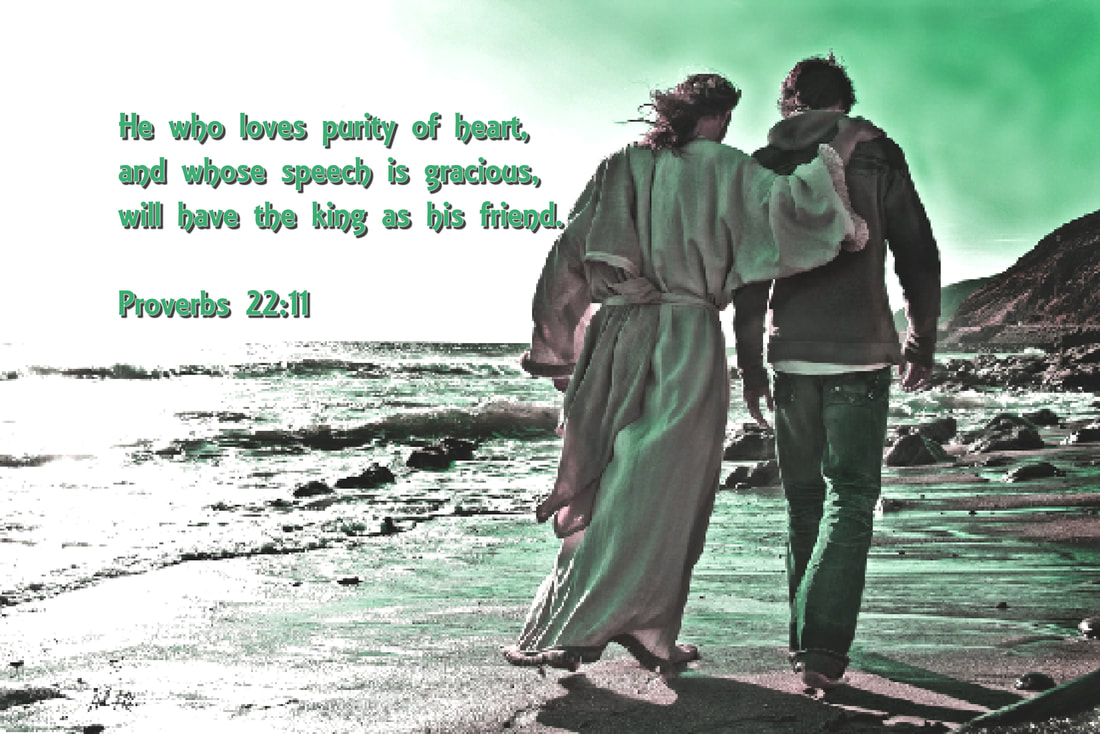
Live with a pure heart to the extent possible. Jesus is a friend to those who live out their faith by staying pure in their hearts, with gracious words. “11 One who loves purity of heart and whose speech is gracious, the king is his friend.” (Prov. 22:11). “He that loveth pureness of heart; he who strives to be pure in heart (Matthew 5:8), free from guile, lust, cupidity, vice of every kind. The next clause carries on the description of the perfect character, and is best translated. And hath grace of lips, the king is his friend. He who is not only virtuous and upright, but has the gift of graciousness of speech, winning manner in conversation, such a man wilt attach the king to him by the closest bonds of friendship. We have had something very similar at ch. 16:13. Some of the versions consider that by the king God is meant.” (Pulpit Commentary on Prov. 22:11).17
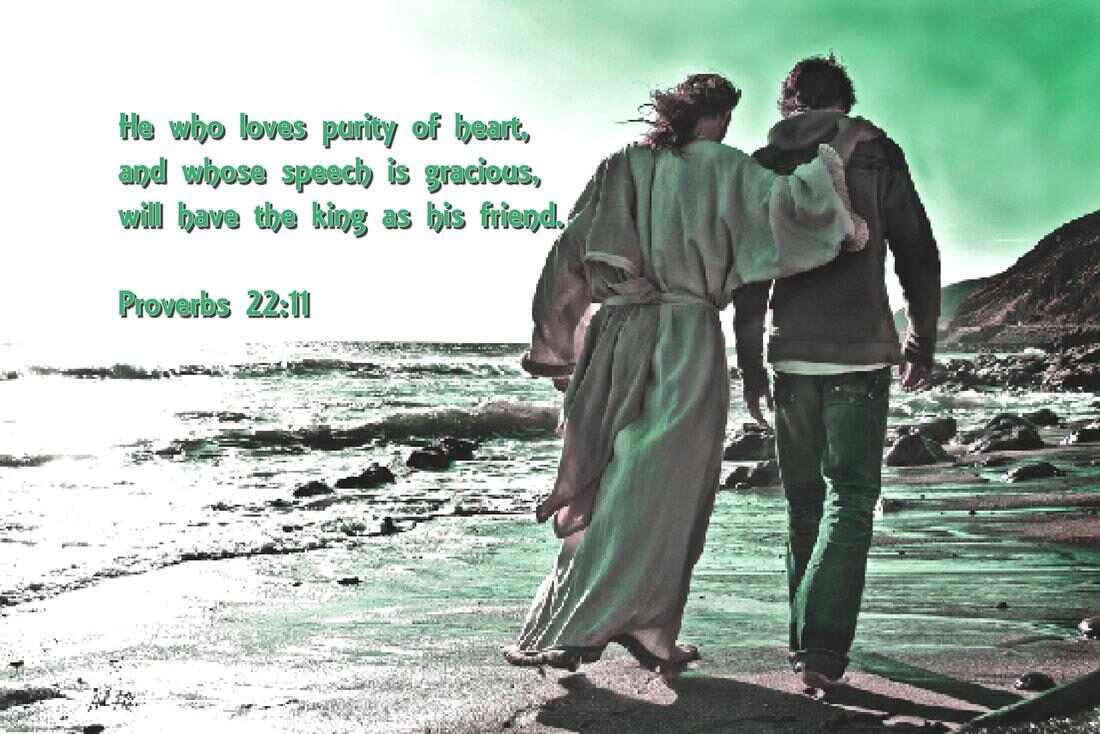
Those who seek to live out their faith with a pure heart will walk with Jesus18
Jesus will bless those who act with a pure heart and grace towards others. Those who repent of their sins and try to live a pure life will “see God” by living in fellowship with Him. “Blessed are the pure in heart, for they will see God.” (Matt. 5:8). “A Psalm of David. LORD, who may reside in Your tent? Who may settle on Your holy hill? One who walks with integrity, practices righteousness, and speaks truth in his heart.” (Ps. 15:1-2). Speaking righteous and gracious words are the fruit of a pure heart. “The mouth of the righteous utters wisdom, and his tongue speaks justice. The Law of his God is in his heart; His steps do not slip.” (Ps. 37:30-31). “There is one who speaks rashly like the thrusts of a sword, but the tongue of the wise brings healing.” (Prov. 12:18). “Let no unwholesome word come out of your mouth, but if there is any good word for edification according to the need of the moment, say that, so that it will give grace to those who hear.” (Eph. 4:29). “Your speech must always be with grace, as though seasoned with salt, so that you will know how you should respond to each person.” (Col. 4:6). These actions also stem from a desire to live out your faith by following Jesus’ holy example. “but like the Holy One who called you, be holy yourselves also in all your behavior; because it is written: ‘You shall be holy, for I am holy.”’ (1 Pet. 1:15-16).
3. Trust: Live Out Your Faith by Trusting Jesus. Prov. 22:12-13.
Trust in God’s faithfulness. Another important part of living out your faith includes trusting Jesus. He knows all things and can protect you. “12 The eyes of the Lord protect knowledge, but He overthrows the words of the treacherous person.” (Prov. 22:12). “In the context of this verse, the ‘eyes of the LORD’ symbolize His vigilant awareness over all moral matters. This verse reassures that God protects the words of those who stand firm in His truth. In contrast, He actively frustrates the deceptive counsel of those who turn away from His commandments, ensuring that nothing deceitful prevails against His ultimate truth. This dichotomy serves not only as a comfort to the faithful but also a warning against falsehood … The teaching reiterates that a life led by wisdom will secure both protection and purpose under the divine gaze, aligning with the greater theme of moral accountability found throughout scripture, including the principle of accountability in relationships.” (TheBibleSays.com on Prov. 22:12).19
Trust Jesus to faithfully watch over His sheep. You can trust Jesus to protect you because He knows all things, and no evil can escape His sight. “Behold, the eye of the LORD is on those who fear Him, on those who wait for His faithfulness,” (Ps. 33:18). “For the ways of everyone are before the eyes of the LORD, and He observes all his paths.” (Prov. 5:21). “The eyes of the LORD are in every place, watching the evil and the good.” (Prov. 15:3). “For His eyes are upon the ways of a person, and He sees all his steps.” (Job 34:21). “For My eyes are on all their ways; they are not hidden from My face, nor is their wrongdoing concealed from My eyes.” (Jer. 16:17). “And there is no creature hidden from His sight, but all things are open and laid bare to the eyes of Him to whom we must answer.” (Heb. 4:13). Because He sees all things, you should invite Jesus to examine your heart for hidden sin and then repent when He exposes it to you. “A Psalm of David. LORD, You have searched me and known me. You know when I sit down and when I get up; You understand my thought from far away. You scrutinize my path and my lying down, and are acquainted with all my ways. Even before there is a word on my tongue, behold, LORD, You know it all.” (Ps. 139:1-4).
Be diligent in serving Jesus. Another part of trusting Jesus includes being diligent in working or serving wherever He places you. Sometimes, work is not available. But when you make up excuses for failing to serve or work, you show a lack of trust in Jesus’ plans for you. “13 The lazy one says, ‘There is a lion outside; I will be killed in the streets!’” (Prov. 22:13). “In this verse, we find a striking example of how laziness can shape our thoughts and actions. When we read about the slothful man who perceives danger in every corner, it reflects a mindset that tends to focus on fears and excuses rather than taking action. It’s easy to see how such a perspective can prevent us from accomplishing our goals or even taking care of our responsibilities. No doubt we can relate to moments in our lives when we have avoided doing something important because we let fear hold us back. The imagery of a lion roaming outside evokes a strong sense of danger. While it’s true that there can be risks in stepping out into the unknown, especially in pursuit of new opportunities, we must not allow our fears to keep us paralyzed. This verse encourages us to assess our fears realistically and to challenge the negativity that may try to dominate our thoughts.” (Christianitypath.com on Prov. 22:13).20
Slothfulness is one of the seven deadly sins. For emphasis, Solomon later repeated this proverb. “A lazy one says, “There is a lion on the road! A lion is in the public square!” (Prov. 26:13). He also repeatedly condemned the sin of slothfulness. “Poor is one who works with a lazy hand, but the hand of the diligent makes rich.” (Prov. 10:4). “The soul of the lazy one craves and gets nothing, but the soul of the diligent is made prosperous.” (Prov. 13:4). “The lazy one does not plow after the autumn, so he begs during the harvest and has nothing.” (Prov. 20:4). “The desire of the lazy one puts him to death, for his hands refuse to work; all day long he is craving, while the righteous gives and does not hold back.” (Prov. 21:25-26). Jesus also condemned and will judge the unsaved who lack the faith to use the talents that He gave them for His Kingdom (Matt. 25:24-30).
5. Righteousness: Live Out Your Faith With Righteousness. Prov. 22:14-16.
Flee from temptation. The fruit of your faith should include righteousness. This includes staying pure from all forms of temptation, like adultery. “14 The mouth of an adulteress is a deep pit; he who is cursed of the Lord will fall into it.” (Prov. 22:14). “A common form of trap in the ancient world was the pit: a disguised hole used to capture or injure prey. Earlier in the book of Proverbs, ‘he forbidden woman’was used as a personification of temptation (Proverbs 2:16; 7:4–10). Sin seems attractive and welcoming, but what it draws us to is not what God intends for us. In fact, the result of following temptation is death and ruin (Proverbs 8:34–36). Moving towards sinful urges is as dangerous as walking unaware towards a deep trap. The comparison used here echoes the anger God expresses at sin as a type of spiritual adultery. After committing physical adultery with Bathsheba, King David felt the disastrous effects of his sin. He suffered mental, spiritual, and physical anguish. Until he confessed his sin and received forgiveness, his bones wasted away, he groaned all day long.” (BibleRef.com on Prov. 22:14).21
Adultery is a serious sin that causes pain for entire families. God’s Seventh Commandment prohibits adultery (Ex. 20:14; Dt. 5:18). For this reason and because of the pain that adultery inflicted upon David’s royal family, Solomon repeatedly warned of the temptations leading to adultery. “For the lips of an adulteress drip honey, and her speech is smoother than oil; but in the end she is bitter as wormwood, sharp as a two-edged sword.” (Prov. 5:3-4). “To keep you from the evil woman, from the smooth tongue of the foreign woman. Do not desire her beauty in your heart, nor let her capture you with her eyelids.” (Prov. 6:24-25). From his own moral failings, Solomon also warned of the dangers of sexual temptation. “And I discovered as more bitter than death the woman whose heart is snares and nets, whose hands are chains. One who is pleasing to God will escape from her, but the sinner will be captured by her.” (Ecc. 7:26). Those who commit adultery harm themselves. “One who commits adultery with a woman is lacking sense; he who would destroy himself commits it.” (Prov. 6:32). In addition to shame, unsaved adulterers are disqualified from eternal salvation (1 Cor. 6:9-10). Jesus came to raise the standards of moral conduct. Thus, a person who merely looks lustfully upon someone else’s spouse has committed an act of adultery in His eyes (Matt. 5:27-28).
Submit to Spirit-led discipline and correction. Living out your faith also requires that you submit to godly discipline and correction when you sin. Without discipline and correction, you will likely stray from Jesus’ righteous path. “15 Foolishness is bound up in the heart of a child; the rod of discipline will remove it far from him.” (Prov. 22:15). “The phrase “Foolishness is bound in the heart of a child” encapsulates the innate inclination towards imprudence that children possess. It serves as a cautionary note, highlighting the vulnerability of youth to making unwise choices in the absence of proper direction. Without the guiding hand of discipline, children may struggle to discern between right and wrong, potentially leading to detrimental consequences. On the other hand, “The rod of correction shall drive it far from him” underscores the significance of discipline in rectifying foolish behavior. This imagery of the rod symbolizes not only correction but also instruction and guidance. Discipline, when administered with love and intentionality, serves as a compass that steers children away from folly and towards the path of wisdom.” (Reverend Michael Johnson on Prov. 22:15).22

Live out your faith by submitting to Spirit-led discipline23
Jesus disciplines His sheep out of love. Just as a loving parent disciplines a wayward child, Jesus disciplines wayward believers out of love to restore their walk with Him. “My son, do not reject the discipline of the LORD or loathe His rebuke, for whom the LORD loves He disciplines, just as a father disciplines the son in whom he delights.” (Prov. 3:11-12). “He who withholds his rod hates his son, but he who loves him disciplines him diligently.” (Prov. 13:24). “Do not withhold discipline from a child; though you strike him with the rod, he will not die. You shall strike him with the rod and rescue his soul from Sheol.” (Prov. 23:13-14). “The rod and a rebuke give wisdom, but a child who gets his own way brings shame to his mother.” (Prov. 29:15). “For the moment, all discipline seems not to be pleasant, but painful; yet to those who have been trained by it, afterward it yields the peaceful fruit of righteousness.” (Heb. 12:11).
Be just and compassionate to those in need. Another important part of living out your faith according to Jesus’ righteous example includes being generous to persons in need. “16 One who oppresses the poor to make more for himself, or gives to the rich, will only come to poverty.” (Prov. 22:16). “God is an advocate for the oppressed and needy people in the world. The Bible says that God hears the cries of the needy. He is also aware of those who take advantage of them. It will not turn out well for those who oppress the poor and needy people. Jesus told the people that when He returns to the Earth, He will separate the people as one would separate goats and sheep. The sheep He will gather to himself. The goats He will cast away … Therefore, we should treat those who are needy with dignity, respect and care. Our eternal destination may well be determined by how we have treated the poor people in this world.” (Bibleinsights.com on Prov. 22:16).24
The unsaved who oppress or ignore the people in need will be judged. God’s law prohibits oppression against the poor, widows, orphans, immigrants, or others in need. “and do not oppress the widow or the orphan, the stranger or the poor; and do not devise evil in your hearts against one another.’” (Zech. 7:10). Those who ignore people in need have a worthless faith. “If a brother or sister is without clothing and in need of daily food, and one of you says to them, ‘Go in peace, be warmed and be filled,” yet you do not give them what is necessary for their body, what use is that?”’ (Jam. 2:15-16). Those who ignore persons in need also cannot claim to have Jesus’ love within them. “But whoever has worldly goods and sees his brother or sister in need, and closes his heart against him, how does the love of God remain in him?” (1 Jo. 3:17). For the unsaved, Jesus will judge and condemn those who ignore persons in need. “Then He will also say to those on His left, ‘Depart from Me, you accursed people, into the eternal fire which has been prepared for the devil and his angels; for I was hungry, and you gave Me nothing to eat; I was thirsty, and you gave Me nothing to drink; I was a stranger, and you did not invite Me in; naked, and you did not clothe Me; sick, and in prison, and you did not visit Me.’ Then they themselves also will answer, ‘Lord, when did we see You hungry, or thirsty, or as a stranger, or naked, or sick, or in prison, and did not take care of You?’ Then He will answer them, ‘Truly I say to you, to the extent that you did not do it for one of the least of these, you did not do it for Me, either.’ These will go away into eternal punishment, but the righteous into eternal life.’” (Matt. 25:41-46).
6. Obedience: Live Out Your Faith With Obedience. Prov. 22:17-28.
Seek out and obey Jesus’ wisdom. Jesus also wants you to live out your faith by constantly seeking and obeying His wisdom. “17 Extend your ear and hear the words of the wise, and apply your mind to my knowledge; 18 For it will be pleasant if you keep them within you, so that they may be ready on your lips. 19 So that your trust may be in the Lord, I have taught you today, you indeed. 20 Have I not written to you excellent things of counsels and knowledge, 21 to make you know the certainty of the words of truth, so that you may correctly answer him who sent you?” (Prov. 22:17-21). This section begins a collection of proverbs “commonly referred to as the ‘Thirty Sayings of the Wise.’ Its own preamble (22:17-21) debatably refers to thirty sayings (22:20). Its preamble and especially its first ten sayings have striking similarities with the sayings of the Egyptian Instruction of Amenemope (ca. 1186-1069 B.C.) … Solomon adopted from pagan cultures the wise sayings informed by God’s common grace and adapted them to Israel’s faith in I AM.” (Bruce Waltke and Ivan De Silva on Proverbs Prov. 22:17-21).25 Solomon learned Egyptian culture after he married an Egyptian princess (1 Kgs. 3:1). Just as Paul witnessed to the Greeks about their “Unknown God” (Acts 17:23), Solomon used the structure of Egyptian wisdom sayings as a witnessing tool to reveal that true wisdom comes from I AM. “For the LORD gives wisdom; from His mouth come knowledge and understanding.” (Prov. 2:6). The New Testament reveals that I AM is Jesus (Jo. 8:58; Ex. 3:14). Believers are called upon to “Extend your ear and hear the words of the wise (Prov. 22:17), to hear His wisdom. He is the carnation of true wisdom. “But it is due to Him that you are in Christ Jesus, who became to us wisdom from God, and righteousness and sanctification, and redemption,” (1 Cor. 1:30). “[I]n whom are hidden all the treasures of wisdom and knowledge.” (Col. 2:3). His wisdom is a gift that comes from faith. “that the God of our Lord Jesus Christ, the Father of glory, may give you a spirit of wisdom and of revelation in the knowledge of Him.” (Eph. 1:17).
Constantly seek out and follow Jesus’ free gift of wisdom. With your eyes, ears, and mind, you must first actively seek out the wisdom that Jesus freely offers. “But if any of you lacks wisdom, let him ask of God, who gives to all generously and without reproach, and it will be given to him.” (Jam. 1:15). Faith comes by hearing the Word (Ro. 10:17). You must then meditate on and internalize the wisdom of Jesus’ Word so that the Holy Spirit can apply it to your life through prayer. “Let the word of Christ richly dwell within you, with all wisdom teaching and admonishing one another with psalms, hymns, and spiritual songs, singing with thankfulness in your hearts to God.” (Col. 3:16; Ps. 1:2; 119:11; Josh. 1:8). You must then trust Jesus (Prov. 22:19). You can show your trust in His Wisdom by obeying His Word (Matt. 7:24-27; Lk. 6:47-49; Jo. 8:31-32; 14:23).
Obey God’s law and avoid evil. Living out your faith should include obeying God’s laws that protect the poor. “22 Do not rob the poor because he is poor, nor crush the needy at the gate; 23 for the Lord will plead their case and take the life of those who rob them.” (Prov. 22:22-23). “Thus, after the preceding solemn preface, among the principal rules of life which he was about to lay down, he first commends this, not to be injurious to poor people; especially by oppressing them in a form of justice: as if he had said, never abuse thy power to the spoiling of him who is in a mean condition; because he is poor… Neither oppress the afflicted in the gate — In the place of judgment, or under pretense of justice; and much less in other ways, where there is no color of justice. For the Lord will plead their cause … [He] Will take away not only their goods, but their lives too. So fully will he recompense their wickedness to them.” (Joseph Benson on Prov. 22:22-23).26
A believer cannot claim to obey God’s law when they ignore injustice in the world. God commanded His people to defend the poor from injustice. “Open your mouth for the people who cannot speak, for the rights of all the unfortunate. Open your mouth, judge righteously, and defend the rights of the poor and needy.” (Prov. 31:8-9). “Vindicate the weak and fatherless; do justice to the afflicted and destitute. Rescue the weak and needy; save them from the hand of the wicked.” (Ps. 82:3-4). True religion includes helping the poor out of love (Jam. 1:27; 1 Jo. 3:17). Jesus came to deliver the poor and the oppressed. “The Spirit of the Lord GOD is upon me, Because the LORD anointed me to bring good news to the humble; He has sent me to bind up the brokenhearted, to proclaim release to captives and freedom to prisoners;” (Is. 61:1; Lk. 4:18-19). He will also judge those who take advantage of others in need. “All my bones will say, ‘LORD, who is like You, who rescues the afflicted from one who is too strong for him, and the afflicted and the poor from one who robs him?’ Malicious witnesses rise up; they ask me things that I do not know.” (Ps. 35:10-11; Ps. 140:12). “Therefore because you impose heavy rent on the poor and take a tribute of grain from them, though you have built houses of cut stone, yet you will not live in them; you have planted beautiful vineyards, yet you will not drink their wine. For I know your offenses are many and your sins are great, you who are hostile to the righteous and accept bribes, and turn away the poor from justice at the gate.” (Amos 5:11-12; Is. 3:14-15; 10:1-2; Jer. 51:36; Ezek. 22:29; Mal. 3:5).
Separate yourself from people of the flesh to remain obedient. Living out your faith also should include obedience to God’s law that you separate yourself from hot-tempered persons of the flesh. “24 Do not make friends with a person given to anger, or go with a hot-tempered person, 25 or you will learn his ways and find a snare for yourself.” (Prov. 22:24-25). “Here is, 1. A good caution against being intimate with a passionate man. It is the law of friendship that we accommodate ourselves to our friends and be ready to serve them, and therefore we ought to be wise and wary in the choice of a friend, that we come not under the sacred tie to any one whom it would be our folly to accommodate ourselves to … 2. Good cause given for this caution: Lest thou learn his way. Those we go with we are apt to grow like. Our corrupt hearts have so much tinder in them that it is dangerous conversing with those that throw about the sparks of their passion. We shall thereby get a snare to our souls, for a disposition to anger is a great snare to any man, and an occasion of much sin.” (Matthew Henry on Prov. 22:24-25).27
Do not be unequally yoked in your walk. Believers are warned against being quick to anger (Jam. 1:19-20; Eph. 4:31; Col. 3:8). To avoid falling into this and other sins, believers are further warned to avoid the company of people who reject Yahweh’s wisdom. “One who walks with wise people will be wise, but a companion of fools will suffer harm.” (Prov. 13:20). This includes avoiding the company of those who are verbally abusive or quick to anger. “But actually, I wrote to you not to associate with any so-called brother if he is a … verbally abusive … —not even to eat with such a person.” (1 Cor. 5:11). “Do not be deceived: ‘Bad company corrupts good morals.”’ (1 Cor. 15:33). “Now we command you, brothers and sisters, in the name of our Lord Jesus Christ, that you keep away from every brother or sister who leads a disorderly life and not one in accordance with the tradition which you received from us.” (2 Thess. 3:6). “Do not be mismatched with unbelievers; for what do righteousness and lawlessness share together, or what does light have in common with darkness?” (2 Cor. 6:14).
Avoid economic bondage to stay on your walk. Living out your faith should also include obeying Jesus’ laws that were meant to protect you from being placed into economic bondage. “26 Do not be among those who shake hands, among those who become guarantors for debts. 27 If you have nothing with which to repay, why should he take your bed from under you?” (Prov. 22:26-27). “As with other such warnings, the point is not that God’s people ought to never lend money, at all. Rather, the danger is in making foolish choices about such things. Putting oneself at financial risk, for the sake of others, should only be done with careful consideration. Hebrews 7:22 identifies Jesus as the guarantor of a better covenant. He served as the ‘security’ or ‘surety’ for sin debt. He took upon Himself responsibility to do all that the covenant demanded for the salvation of those who would receive its provisions.” (BibleRef.com on Prov. 22:26-27).28
Avoid placing yourself into financial bondage. Solomon frequently warned about the dangers of becoming a surety or guarantor of another person’s unknown future debts. “1 My son, if you have become a guarantor for your neighbor, or have given a handshake for a stranger, 2 if you have been ensnared by the words of your mouth, or caught by the words of your mouth,” (Prov. 6:1-2). “One who is a guarantor for a stranger will certainly suffer for it, but one who hates being a guarantor is secure.” (Prov. 11:15). “A person lacking in sense shakes hands and becomes guarantor in the presence of his neighbor.” (Prov. 17:18). Paul also warned against unknown debts. “Owe nothing to anyone except to love one another; for the one who loves his neighbor has fulfilled the Law.” (Ro. 13:8). Jesus was born as a human to be a kinsman redeemer for us all. It is only through faith in His blood that your debts are forgiven (Heb. 9:22; 10:14; Lev. 17:11). On the first day of His public ministry, He entered the synagogue and read from Isaiah 61:1-2 and declared that He came to free those who are in bondage. (Lk. 4:14-21). But the devil will always try to enslave you. Taking on unknown, future debt obligations is one of many ways for the devil to do that. Jesus wants you to be free from all kinds of bondage. Thus, you should never place yourself in bondage through debts that are beyond what you can afford: “It was for freedom that Christ set us free; therefore keep standing firm and do not be subject again to a yoke of slavery.” (Gal. 5:1). “For you were called to freedom, . . .” (Gal. 5:13). “For you tolerate it if anyone enslaves you, anyone devours you, anyone takes advantage of you, anyone exalts himself, anyone hits you in the face.” (2 Cor. 11:2). “For you have not received a spirit of slavery ...” (Rom. 8:15). “So if the Son makes you free, you will be free indeed.” (Jo. 8:36).
Obey your spiritual heritage when it does not conflict with God’s Word. Believers should always follow the Word over the worldly traditions of mankind. But this does not mean that believers should ignore the wisdom of their forefathers when that wisdom comes directly from God. “28 Do not move the ancient boundary which your fathers have set.” (Prov. 22:28). “Focusing on the verse’s main components sheds light on its deeper meaning. The terms ‘remove’ and ‘ancient’ hold notable significance. “Remove” suggests taking something away, while ‘ancient’ speaks of the deep-rooted history of these landmarks. When we think about the implications of ‘removing’ such historical markers, we see that it equates to erasing essential parts of our identity. It suggests a disregard for the past and the wisdom that has been handed down to us. Another aspect to consider is who the ‘fathers’ represent. They embody the past generations who have established these landmarks and passed on their wisdom, teachings, and values. We owe it to them, and to ourselves, to honor their legacy by maintaining the boundaries they set. Lastly, the ‘landmark’ itself symbolizes more than just physical property. It represents our values, beliefs, and heritage. When we safeguard these landmarks, we are not just protecting land but our identities, cultures, and history. This verse reminds us that when we face challenges or feel lost, we should look back to our heritage and seek guidance from the legacies left for us.” (Christianitypath.com on Prov. 22:28).
Obey both God-given civil laws and God-given revelations to your forefathers. The Jews could not seek to expand their land by moving their neighbor’s landmarks. “You shall not move your neighbor’s boundary mark, which the ancestors have set, in your inheritance which you will inherit in the land that the Lord your God gives you to possess.” (Dt. 19:14; 27:17; Prov. 23:10-11). The practice of secretly moving stone markers was a form of theft, which is prohibited under the Eighth Commandment (Ex. 20:15; Dt. 5:19). God can expand your boundaries when you act in faith. But if you ever feel tempted to expand your boundaries by taking from another, your desires are from the devil and not from God. There is also another spiritual meaning for this law. You should always be open to helping others. But you must also maintain your boundaries. God does not want us to become yoked to non-believers and the things of the world (2 Cor. 6:14). Finally, tradition should not take precedence over the final authority of God’s Word (Matt. 15:3-6). But you should still look for God’s wisdom in the paths that God set for your forefathers. “This is what the LORD says: ‘Stand by the ways and see and ask for the ancient paths, Where the good way is, and walk in it; then you will find a resting place for your souls. But they said, ‘We will not walk in it.’” (Jer. 6:16).
7. Faithful Service: Live Out Your Faith with Faithful Service. Prov. 22:29.
Serve faithfully wherever Jesus has placed you. Finally, living out your faith should include diligently laboring wherever Jesus places you. “29 Do you see a person skilled in his work? He will stand before kings; He will not stand before obscure people.” (Prov. 22:29). “God says that He intended to reward the diligent man. You remember that the Lord Jesus said that in eternity His commendation would be ‘…Well done, though good and faithful servant…’ (Matt. 25:21). His commendation will not be based on the amount of work you have done, or on the number of people to whom you have witnessed, or how hard you have worked, but on how faithful you have been to the task He has given you. He may have given you the task of being a mother to a little one in the home. Moses’ mother was faithful in that way, and her name is recorded in the Word of God. The reward will be for faithfulness.” (J. Vernon McGee on Prov. 22:29).29
Jesus will reward those who faithfully serve Him. As long as your service is done out of a love for Jesus and not for any public reward, He will reward your faithful service in heaven. “Therefore, my beloved brothers and sisters, be firm, immovable, always excelling in the work of the Lord, knowing that your labor is not in vain in the Lord.” (1 Cor. 15:58). “Whatever you do, do your work heartily, as for the Lord and not for people, knowing that it is from the Lord that you will receive the reward of the inheritance. It is the Lord Christ whom you serve.” (Col. 3:23-24). “With goodwill render service, as to the Lord, and not to people, knowing that whatever good thing each one does, he will receive this back from the Lord, whether slave or free.” (Eph. 6:7-8). “Let’s not become discouraged in doing good, for in due time we will reap, if we do not become weary.” (Gal. 6:9). “And he said to him, ‘Well done, good slave; since you have been faithful in a very little thing, you are to have authority over ten cities.’” (Lk. 19:17).
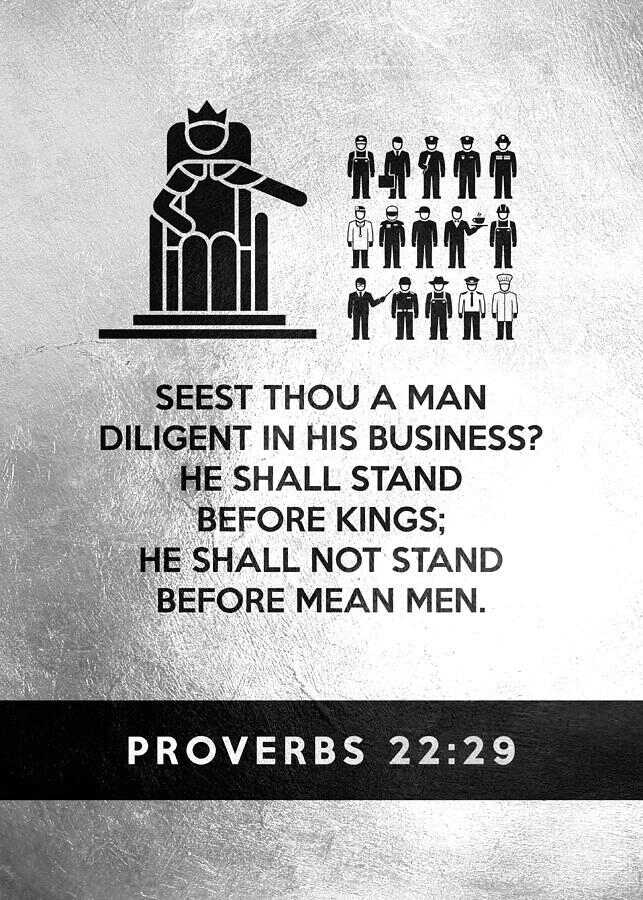
Jesus, the King of Kings, will reward His faithful servants in heaven30
Proverbs 22:1 Meaning & Explanation (with Related Verses) - Christianity Path↩︎
Image credit: Proverbs 22:1 - Bible verse - DailyVerses.net↩︎
Image credit: Weekend Wisdom – Proverbs 22:3 – In God's Image↩︎
Proverbs 22 Commentary - Matthew Henry Commentary on the Whole Bible (Complete) | Bible Study Tools (italics in original)↩︎
Image credit: Proverbs 22:4 — Daily Wisdom for Monday, January 21, 1946↩︎
Image credit: motosdidac.es/step-tracker-ankle-bracelet/awana-sunday-train-up-your-child-proverbs-22-6-zz-xNneobs0↩︎
R. Young, Proverbs, A Commentary on the Book of Proverbs (SureWord Publications, Baltimore, MD, 2005), p. 297.↩︎
Image credit: Master's Hand Ministry: Let Us Bring Our Offerings to the Storehouse↩︎
Image credit: https://glicuk.com/wp-content/uploads/2025/02/proverbs-22-11_orig.jpg↩︎
Proverbs 22:13 Meaning & Explanation (with Related Verses) - Christianity Path↩︎
Image credit: Proverbs 22 Scripture Pictures↩︎
B. Waltke and I. De Silva, Proverbs, A Shorter Commentary, (Grand Rapids, MI: Wm. B. Eerdmans Publishing Co., 2021), p. 4 (italics in original).↩︎
Proverbs 22 Commentary - Matthew Henry Commentary on the Whole Bible (Complete) | Bible Study Tools↩︎
J. Vernon McGee, Thru the Bible, Commentary Series, Proverbs (Thomas Nelson, Inc., Nashville TN 1991), p. 193.↩︎
Image credit: Page Removed | Fine Art America↩︎