Proverbs 23: Lessons For Turning to Jesus to Avoid Worldly Sins
Introduction: Proverbs 23 continues the “Thirty Sayings of the Wise”, which began at Proverbs 22:17. Proverbs 23 contains 12 of these 30 sayings, numbers seven through 19. These proverbs contain a style similar to an Egyptian wisdom style found in the Instruction of Amenemope (ca. 1186-1069 B.C.). Solomon sought to show that true wisdom comes from Yahweh, not from any worldly source (Bruce Waltke and Ivan De Silva on Proverbs Prov. 23).1 Here, he used a worldly style of literature to condemn worldly sins. Adopting a foreign style to witness to a gentile audience about Yahweh was similar to Paul’s attempt to witness to the Greeks by referencing their “Unknown God” (Acts 17:23). Yahweh, the great I AM, is Jesus Christ (Jo. 8:58; Ex. 3:14). In Proverbs 23, the Bible reveals lessons for turning to Jesus’ wisdom to help avoid several deadly, worldly sins in your walk. When you turn to Jesus’ wisdom, He will help you avoid the sins of: (1) covetousness, including gluttony and greed, (2) doublemindedness, (3) faithlessness, (4) theft, (5) a hardened heart, (6) loving evil, and (7) debauchery / drunkenness.
First, in verses one through five (sayings seven and eight), Solomon warned about the sin of covetousness, including gluttony and greed. Covetousness violates God’s Tenth Commandment. When you turn to Jesus’ wisdom, He will help you to recognize and avoid this sin. Second, in verses six through eight (saying nine), Solomon warns against keeping company with stingy, doubleminded persons. Jesus wants you to turn to Him for the wisdom to avoid keeping company with people who might make you double minded in your walk. Third, in verse nine (saying 10), Solomon warns about speaking with a fool, a person with no faith. While believers should witness to non-believers, they should turn to Jesus for wisdom to avoid being unequally yoked with nonbelievers. Fourth, in verses 10 through 11 (saying 11), Solomon warns of the sin of theft. Theft violates God’s Eighth Commandment. When you embrace Jesus’ wisdom, He will give you the strength to avoid the temptation of this sin. Fifth, in verses 12 through 16 (sayings 12 through 14), Solomon warned against the sin of a hardened heart and the wisdom of discipline to avoid it. Jesus wants you to accept His discipline. If you fail to do so, your heart will likely become hardened to sin. Sixth, in verses 17 through 25 (sayings 15 through 17), Solomon warned of the sins that stem from loving evil and how to avoid it. If you reject evil, Jesus offers the light to guide you out of darkness. Finally, in verses 26 through 35 (sayings 18 through 19) Solomon warned of the sins of debauchery, which includes drunkenness. When you turn to Jesus’ wisdom, He will also give you the discernment and strength to avoid these sins.
1. Covetousness: Turn to Jesus’ Wisdom to Avoid the Sin of Covetousness, Which Can Include Gluttony and Greed. Prov. 23:1-5.
Turn to Jesus to avoid the sin of gluttony. Solomon used an example of a person being tested by a king to be mindful of the sin of gluttony. (Saying 7). “1 When you sit down to dine with a ruler, consider carefully what is before you, 2 and put a knife to your throat if you are a person of great appetite. 3 Do not desire his delicacies, for it is deceptive food.” (Prov. 23:1-3). In this verse (Prov. 23:1) he [Solomon] counsels his student to carefully consider what is before him when he dines with a ruler. The overall warning is about complacency and greed. One should not embarrass themselves by abusing someone's hospitality. At the same time, one should be careful that a powerful person's generosity does not turn into a bribe. The distinction between rich and poor was much greater in the ancient world than it is in most modern cultures. For someone used to working for ‘daily bread,’ being invited to a feast of luxurious food might tempt them to eat too quickly or too much. Instead, Solomon advises self-discipline. The ruler may be watching the guest's table manners, but God also watches. The following verse (Proverbs 23:2) uses deliberate exaggeration (Matthew 5:30) about the importance of avoiding excess.” (BibleRef.com on Prov. 23:1-2).2 In Proverbs 23:4, “another reason for cautious skepticism is given. It's possible that a host might use lavish generosity to lull someone into a false sense of security. They might be offering a subtle bribe or attempting to sway a guest's opinions. Solomon warns his student not to be deceived by whatever luxuries are offered. Instead, one should be grateful for generous hospitality without being gullible or easily swayed. Like the dinner host of this proverb, the Devil often tempts victims with what appears to be highly desirable.” (Id. at Prov. 23:3).3
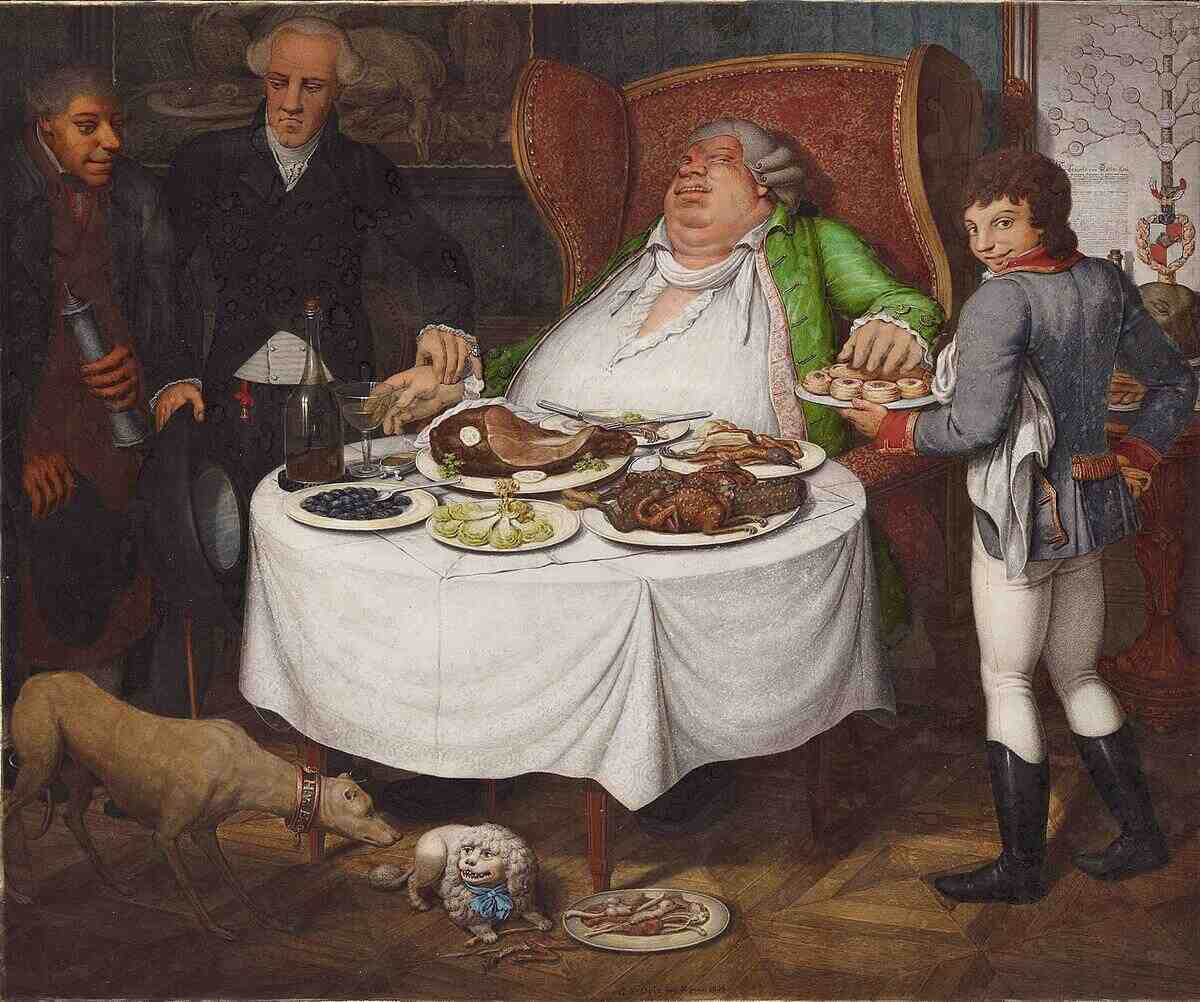
Turn to Jesus to avoid the sin of gluttony4
Gluttony is a form of covetousness that stems from a lack of discipline. The sin of coveting violates God’s Tenth Commandment (Ex. 20:17; Dt. 5:21). Gluttony is one type coveting. Solomon urged believers turn to Yahweh for the wisdom and strength to control a person’s desires and avoid overconsumption. “Woe to you, land whose king is a boy, and whose princes feast in the morning. Blessed are you, land whose king is of nobility, and whose princes eat at the appropriate time—for strength and not for drunkenness.” (Ecc. 10:16-17). “Have you found honey? Eat only what you need, so that you do not have it in excess and vomit it.” (Prov. 25:16). Paul also warned against the sin of gluttony. “whose end is destruction, whose god is their appetite, and whose glory is in their shame, who have their minds on earthly things.” (Phil. 3:19). “For those who are in accord with the flesh set their minds on the things of the flesh, but those who are in accord with the Spirit, the things of the Spirit.” (Ro. 8:5). “But I say, walk by the Spirit, and you will not carry out the desire of the flesh. For the desire of the flesh is against the Spirit, and the Spirit against the flesh; for these are in opposition to one another, in order to keep you from doing whatever you want…Now those who belong to Christ Jesus crucified the flesh with its passions and desires.” (Gal. 5:16-17, 24). Paul controlled his bodily desires. “but I strictly discipline my body and make it my slave, so that, after I have preached to others, I myself will not be disqualified.” (1 Cor. 9:27). Daniel also disciplined himself in front of the king, even though he risked offending the king through his faith. “But Daniel made up his mind that he would not defile himself with the king’s choice food or with the wine which he drank; so he sought permission from the commander of the officials that he might not defile himself.” (Dan. 1:8). Believers should always pray for the strength to resist temptation. “‘And do not lead us into temptation, but deliver us from evil.’” (Matt. 6:13; 1 Cor. 10:13; 2 Thess. 3:3).
Turn to Jesus to avoid greed. Solomon also warned against the sin of greed. (Saying 8). “4 Do not weary yourself to gain wealth; stop dwelling on it. 5 When you set your eyes on it, it is gone. For wealth certainly makes itself wings like an eagle that flies toward the heavens.” (Prov. 23:4-5). “Proverbs 23:4 holds a significant lesson for all of us regarding the pursuit of wealth. The verse reminds us that we should not wear ourselves out in the relentless pursuit of riches. This is so important because many people today seem to measure their success by their financial status. We often find ourselves in a money-driven culture that idolizes wealth, making it very easy to lose sight of what really matters in life. However, this verse encourages us to take a step back and evaluate our priorities. Are we striving hard to accumulate wealth at the expense of our health, relationships, and our connection with God? We must ask ourselves if the stress and effort involved in seeking material wealth is worth it.” (Christianitypath.com on Prov. 23:4).5 “In Proverbs 23:5, we are presented with a profound truth about wealth and our pursuit of it. The verse warns us against the danger of placing too much value on riches and earthly possessions. It paints a vivid picture of wealth as something that can vanish quickly, likening it to an eagle that flies away.” (Id. at Prov. 23:5).6

Turn to Jesus to avoid the deadly sin of greed7
Greed is another form of covetousness. People who love money will frequently never feel satisfied that they have enough money. “One who loves money will not be satisfied with money, nor one who loves abundance with its income. This too is futility. When good things increase, those who consume them increase. So what is the advantage to their owners except to look at them?” (Ecc. 5:10-11). Jesus specifically warned against the sin of greed. “But He said to them, ‘Beware, and be on your guard against every form of greed; for not even when one is affluent does his life consist of his possessions.”’ (Lk. 12:15). If you embrace greed, it will eventually pull you off your walk with Jesus. “No one can serve two masters; for either he will hate the one and love the other, or he will be devoted to one and despise the other. You cannot serve God and wealth.” (Matt. 6:24). “Come now, you rich people, weep and howl for your miseries which are coming upon you. Your riches have rotted and your garments have become moth-eaten. Your gold and your silver have corroded, and their corrosion will serve as a testimony against you and will consume your flesh like fire. It is in the last days that you have stored up your treasure!” (Jam. 5:1-3). “But those who want to get rich fall into temptation and a trap, and many foolish and harmful desires which plunge people into ruin and destruction. For the love of money is a root of all sorts of evil, and some by longing for it have wandered away from the faith and pierced themselves with many griefs.” (1 Tim. 6:9-10). To avoid the sin of greed, Jesus encourages believers to focus on storing up their treasures in heaven. “Do not store up for yourselves treasures on earth, where moth and rust destroy, and where thieves break in and steal. But store up for yourselves treasures in heaven, where neither moth nor rust destroys, and where thieves do not break in or steal; for where your treasure is, there your heart will be also.” (Matt. 6:19-21).
2. Doublemindedness: Turn to Jesus to Avoid Selfish, Double-minded People and the Sins of Being Selfish and Double-minded in Your Faith. Prov. 23:6-8.
Jesus offers you the wisdom to discern and avoid selfish, doubleminded people. If you embrace the fellowship of selfish, double-minded people, you may be pulled off your walk and become like them (Saying 9). “6 Do not eat the bread of a selfish person; or desire his delicacies; 7 For as he thinks within himself, so he is. He says to you, ‘Eat and drink!’ But his heart is not with you. 8 You will vomit up the morsel you have eaten and waste your compliments.” (Prov. 23:6-8). “Proverbs 23:6-7 offers a poignant warning against partaking in the hospitality of a stingy individual, shedding light on the duplicity that can reside within their heart …The phrase ‘Do not eat the bread of a man who is stingy’ serves as a cautionary tale, advising against accepting sustenance from those who are unwilling to give generously. Here, the bread symbolizes not just physical nourishment but also the essence of provision and care. The stingy individual embodies reluctance in giving, showcasing a scarcity mindset that contrasts with the spirit of abundance. ‘For he is like one who is inwardly calculating’ unveils the true nature of the stingy person. While they may outwardly display gestures of generosity, internally, they are tallying the costs and harboring resentment towards the act of giving. This dichotomy between outward appearance and inner disposition serves as a stark reminder of the importance of authenticity in our interactions. The verse further emphasizes the insincerity of the stingy individual by highlighting how they may extend invitations with words of welcome, yet their heart remains distant and disengaged.” (Reverend Michael Johnson on Prov. 23:6-7).8 “Proverbs 23:8 is about warning against pursuing material possessions with excessive eagerness, as they may appear appealing at first but can lead to negative consequences and harm in the end.” (Id. at Prov. 23:8).9
People who are double-minded are unstable and likely to fall off their walk with Jesus. One psalmist remarked that he hated and therefore avoided people who are double-minded in their faith. “I hate those who are double-minded, but I love Your Law.” (Ps. 119:113). Those who are double-minded in their faith are unstable and may not have their prayers answered because their faith is lacking. “For that person ought not to expect that he will receive anything from the Lord, being a double-minded man, unstable in all his ways.” (Jam. 1:7-8). Solomon also warns against being miserly. “There is one who scatters, and yet increases all the more, and there is one who withholds what is justly due, and yet it results only in poverty. A generous person will be prosperous, and one who gives others plenty of water will himself be given plenty.” (Prov. 11:24-25). Jesus advises that you will know whether a person is miserly and double-minded based upon their actions. “The good person out of the good treasure of his heart brings forth what is good; and the evil person out of the evil treasure brings forth what is evil; for his mouth speaks from that which fills his heart.” (Lk. 6:45). When a person is miserly or double minded, believers are warned against becoming unequally yoked with such persons. “Do not be mismatched with unbelievers; for what do righteousness and lawlessness share together, or what does light have in common with darkness? Or what harmony does Christ have with Belial, or what does a believer share with an unbeliever?” (2 Cor. 6:14-15). Those who are double-minded also likely have a lukewarm faith. “So because you are lukewarm, and neither hot nor cold, I will vomit you out of My mouth.” (Rev. 3:16).

Turn to Jesus for the wisdom to avoid stingy, double-minded people10
3. Faithlessness: Turn to Jesus’ Wisdom to Avoid Those Who Reject Him and to Remain Steadfast in Your Faith. Prov. 23:9.
Jesus offers to guide your relationships to help you avoid people who scoff at Him. As another worldly sin to avoid, Solomon cautioned against forming relationships with people who scoff at the wisdom found in Yahweh’s word. (Saying 10). “9 Do not speak to be heard by a fool, for he will despise the wisdom of your words.” (Prov. 23:9). “To seek to instruct those that have set their hearts on the folly and waywardness of this world is wasting your time and breath. It is like ‘casting your pearls before swine.’ When there is no desire for wisdom, and knowledge and understanding have been deliberately trampled underfoot, it is useless to waste your words.” (Ronald Young on Prov. 23:9).11
Jesus’ wisdom is foolishness to the world. Believers are called upon to witness to the lost with Jesus’ wisdom (Matt. 28:18-20). But many worldly people will reject the wisdom Jesus offers. “But a natural person does not accept the things of the Spirit of God, for they are foolishness to him; and he cannot understand them, because they are spiritually discerned.” (1 Cor. 2:14). “in whose case the god of this world has blinded the minds of the unbelieving so that they will not see the light of the gospel of the glory of Christ, who is the image of God.” (2 Cor. 4:4). “because the mind set on the flesh is hostile toward God; for it does not subject itself to the law of God, for it is not even able to do so,” (Ro. 8:7). If someone rejects the wisdom Jesus offers, Jesus wants you to invest in helping to save others who are willing to hear His wisdom. “Do not give what is holy to dogs, and do not throw your pearls before pigs, or they will trample them under their feet, and turn and tear you to pieces.” (Matt. 7:6). “One who corrects a scoffer gets dishonor for himself, and one who rebukes a wicked person gets insults for himself. Do not rebuke a scoffer, or he will hate you; rebuke a wise person and he will love you.” (Prov. 9:7-8). “A scoffer seeks wisdom and finds none, ...” (Prov. 14:6a). If you become unequally yoked with a nonbeliever, you risk having your faith compromised (2 Cor. 6:14-15).

Don’t be unequally yoked with scoffers who reject Jesus’ wisdom12
4. Theft: Turn to Jesus’ Wisdom to Avoid the Temptations of Theft and Oppression. Prov. 23:10-11.
Turn to Jesus to avoid the temptations of theft. Solomon also warned against the sins of theft and oppression through the ancient evil practice of stealing lands by moving stone territorial boundary markers. (Saying 11). “10 Do not move the ancient boundary or go into the fields of the fatherless, 11 for their Redeemer is strong; He will plead their case against you.” (Prov. 23:10-11). “Literally, the ancient landmark was normally a stone marker for a property line. Moving the landmark was a way to make your field bigger and to steal from your neighbor. Symbolically, the ancient landmark was a tradition or custom from ancestors … The field of the orphan needed special care and protection. It was evil to enter the fields of the fatherless to take some of the harvest from those who had trouble protecting it … The orphan and all who are vulnerable have a special protector, a Redeemer. He has vowed to plead their cause against all who would come to take what they have.” (David Guzik on Prov. 23:10-11).13

Jesus will discipline or judge those who oppress the poor and powerless14
Jesus will discipline or judge those who steal and reject His wisdom. The practice of secretly moving stone markers was a form of theft, which is prohibited under the Eighth Commandment (Ex. 20:15; Dt. 5:19). Thus, God condemned this type of theft through deception. “You shall not displace your neighbor’s boundary marker, which the ancestors have set, in your inheritance which you will inherit in the land that the LORD your God is giving you to possess.” (Dt. 19:14). “Do not move the ancient boundary which your fathers have set.” (Prov. 22:28). God also warned that He will curse and will judge those who engage in this type of theft. “‘Cursed is one who displaces his neighbor’s boundary marker.’ And all the people shall say, ‘Amen.’” (Dt. 27:17). “The leaders of Judah have become like those who displace a boundary marker; on them I will pour out My anger like water.” (Hosea 5:10). The warning against going “into the fields of the fatherless,” (Prov. 23:10) was a warning against oppressing the poor, widows, orphans, and the defenseless. Jesus, our Redeemer, who avenge the wrongs against them (Ex. 22:22-24; Dt. 10:18; Ps. 68:5; 146:9; Jer. 22:3; Mal. 3:5). “Their Redeemer is strong, the LORD of armies is His name; He will vigorously plead their case so that He may bring rest to their land, but turmoil to the inhabitants of Babylon.” (Jer. 50:34). “And they will call them, ‘The holy people, the redeemed of the LORD’; and you will be called, “sought out, a city not abandoned.” (Is. 62:12). An ancient stone barrier also represented Jesus’ wisdom revealed to Church forefathers. As long as a Church tradition is supported by the Word, like the Nicaean Creed as one example, it should be respected.
5. A Hardened Heart: Accept the Wisdom of Jesus’ Discipline to Avoid the Sin of a Hardened Heart. Prov. 23:12-16.
Accept Spirit-led discipline to avoid developing a hardened heart. Because all will sin, Solomon urged believers to accept the wisdom of Yahweh’s discipline. (Saying 12) “12 Apply your heart to discipline, and your ears to words of knowledge.” (Prov. 23:12). “The essence of Proverbs 23:12 lies in its call to action, urging us to actively seek wisdom and understanding. The phrase ‘apply your heart to instruction’ emphasizes the necessity of commitment and passion in the learning process. It suggests that wisdom is not merely an accumulation of facts but a heartfelt engagement with knowledge that transforms our lives. The second part, ‘and your ear to words of knowledge,’ reinforces the idea that attentive listening is crucial for gaining insight. In biblical terms, knowledge is often associated with reverence for God and a moral compass, guiding us in making righteous choices. This verse encapsulates a holistic approach to learning—one that integrates emotional, intellectual, and spiritual dimensions—reminding us that true wisdom is a transformative journey.” (Bibleverseexplained.com on Prov. 23:12).15

Accept discipline so that your heart is not hardened to Jesus’ wisdom16
Have a receptive heart for Jesus’ wisdom and the discipline to then obey it. Because many will hear without hearing, Solomon urged his son and other believers to have a receptive heart for Yahweh’s wisdom. “My son, if you will receive my words and treasure my commandments within you, make your ear attentive to wisdom; incline your heart to understanding.” (Prov. 2:1-2). “My son, pay attention to my words; incline your ear to my sayings. They are not to escape from your sight; keep them in the midst of your heart.” (Prov. 4:20-21). Those with the discipline to internalize and follow Jesus’ wisdom, will be blessed when they face a trial. “Therefore, everyone who hears these words of Mine, and acts on them, will be like a wise man who built his house on the rock. And the rain fell and the floods came, and the winds blew and slammed against that house; and yet it did not fall, for it had been founded on the rock. And everyone who hears these words of Mine, and does not act on them, will be like a foolish man who built his house on the sand. And the rain fell and the floods came, and the winds blew and slammed against that house; and it fell—and its collapse was great.” (Matt. 7:24-27).
Parents and others in authority must administer Spirit-led discipline to correct sinners. In addition to being receptive to Yahweh’s discipline, parents and others in authority must be prepared to administer to correct a wayward child or believer. (Saying 13). “13 Do not withhold discipline from a child; though you strike him with the rod, he will not die. 14 You shall strike him with the rod and rescue his soul from Sheol.” (Prov. 23:13-14). “A parent correcting his child. A tender parent can scarcely find in his heart to do this; it goes much against the grain. But he finds it is necessary; it is his duty, and therefore he dares not withhold correction when there is occasion for it (spare the rod and spoil the child); he beats him with the rod, gives him a gentle correction, the stripes of the sons of men, not such as we give to beasts. Beat him with the rod and he shall not die. The rod will not kill him; nay, it will prevent his killing himself by those vicious courses which the rod will be necessary to restrain him from.” (Matthew Henry on Prov. 23:13-14).17
Just as Jesus disciplines those who He loves, so must parents and others in authority. When done with the right motives and as directed by the Holy Spirit, discipline is an act of love when it is designed to restore a sinner on his or her walk with Jesus. “He who withholds his rod hates his son, but he who loves him disciplines him diligently.” (Prov. 13:24). “Discipline your son while there is hope, and do not desire his death.” (Prov. 19:18; 3:11-12). Jesus disciplines believers out of love. “So you are to know in your heart that the LORD your God was disciplining you just as a man disciplines his son.” (Dt. 8:5). If you accept Jesus’ discipline and turn back to Him, He will bless you. “Blessed is the man whom You discipline, LORD, and whom You teach from Your Law,” (Ps. 94:12). “For whom the Lord loves He disciplines, and He punishes every son whom He accepts.” (Heb. 12:6). “But when we are judged, we are disciplined by the Lord so that we will not be condemned along with the world.” (1 Cor. 11:32). “Those whom I love, I rebuke and discipline; therefore be zealous and repent.” (Rev. 3:19).
Be joyful and encouraging when any sinner repents and turns back to Jesus. To help a believer stay on the path following Spirit-led discipline, parents, persons in authority, and every member of Jesus’ Church, should rejoice when a sinner repents (Saying 14): (verses 15-16) “15 My son, if your heart is wise, my own heart also will be glad, 16 and my innermost being will rejoice when your lips speak what is right.” (Prov. 23:15-16). “The paternal tone characteristic of the Book of Proverbs is most probably regarded as that of a teacher addressing his disciples as his children. But the glimpse of the teacher’s heart here given may well apply to parents too, and ought to be true of all who can influence other and especially young hearts. Little power attends advices which are not sweetened by manifest love.” (Alexander MacLaren’s Expositions on the Bible, Prov. 23:15-15).18
Celebrate every sinner’s transformation. In multiple proverbs, Solomon stated that parents should rejoice when a child heeds Yahweh’s wisdom and walks with Him. “The proverbs of Solomon. A wise son makes a father glad, but a foolish son is a grief to his mother.” (Prov. 10:1). “A wise son makes a father glad, but a foolish man despises his mother.” (Prov. 15:20). “A man who loves wisdom makes his father glad, but he who involves himself with prostitutes wastes his wealth.” (Prov. 29:3). Believers should also celebrate when any sinner repents and walks in Jesus’ truth. “I have no greater joy than this, to hear of my children walking in the truth.” (3 Jo. 1:4). God the Father celebrated Jesus’ faithful example. “and behold, a voice from the heavens said, ‘This is My beloved Son, with whom I am well pleased.”’ (Matt. 3:17). Whenever a sinner repents, there is great rejoicing in heaven. “I tell you that in the same way, there will be more joy in heaven over one sinner who repents than over ninety-nine righteous people who have no need of repentance.” (Lk. 15:7). When a sinner repents, you should also celebrate the sinner’s transformation and encourage the person in their walk with Jesus (Heb. 3:13).
6. Loving Evil: Turn to Jesus’ Wisdom to Avoid The Temptations and False Allure of Evil. Prov. 23:17-25.
Turn to Jesus to avoid the sin of envy. Because of our fallen state and the temptations that Satan offers, Solomon also warned against the sin of envying sinners (Saying 15). “17 Do not let your heart envy sinners, but live in the fear of the Lord always. 18 Certainly there is a future, and your hope will not be cut off.” (Prov. 23:17-18). “Envying the success of the unrighteous can lead one down a treacherous path, as the prosperity of the wicked is often fleeting. This verse cautions against allowing your heart to be swayed by the allure of sinful lifestyles and the temporary triumphs that sometimes accompany them. Instead, it promotes a mindset anchored in reverence towards God, which should be a constant throughout our daily lives. The wisdom encapsulated here emphasizes that true fulfillment does not come from mimicking the ways of sinners, but from striving to live according to the principles of the Lord. The scripture further reassures us that adhering to the fear of the Lord carries with it the promise of hope and a secure future. As this verse notes, “for surely there is an end; and thine expectation shall not be cut off.” Maintaining our focus on God should cultivate patience and resilience, ensuring we are not led astray by envy, but instead encouraged by the assurance that righteousness ultimately leads to a rewarding outcome.” (TheBibleSays.com on Prov. 23:17-18).19

Be content with Jesus’ provision and do not envy sinners20
Do not envy a sinner’s success because that success is fleeting. In His wisdom, Jesus allows rain to fall on the righteous and the unrighteous (Matt. 5:45). When Jesus’ grace allows a sinner to temporarily succeed, believers must be careful to avoid becoming envious of the sinner’s success. “Do not be envious of evil people, nor desire to be with them; for their minds plot violence, and their lips talk of trouble.” (Prov. 24:1-2). Whatever success a sinner enjoys, it is temporary. “A Psalm of David. Do not get upset because of evildoers, do not be envious of wrongdoers. For they will wither quickly like the grass, and decay like the green plants.” (Ps. 37:1-2). True wisdom begins with fearing Jesus. “The fear of the LORD is the instruction for wisdom, and before honor comes humility.” (Prov. 15:33). The fear of the Lord is defined as hating evil (Prov. 8:13). If you “hate” evil, you will not envy it. Instead of envying evil, seek first to serve Jesus, and you can trust Him to provide all that you need. “But seek first His kingdom and His righteousness, and all these things will be provided to you.” (Matt. 6:33).
To avoid the enticement of sinners, guard your heart and avoid the company of sinners. Because of our fallen nature and the temporary allurement of sin, Solomon warned against keeping company with drunkards, those who are gluttonous, greedy, and other types of sinners (Saying 16) “19 Listen, my son, and be wise, and direct your heart in the way. 20 Do not be with heavy drinkers of wine, or with gluttonous eaters of meat; 21 for the heavy drinker and the glutton will come to poverty, and drowsiness will clothe one with rags.” (Prov. 23:19-21). “Be very careful of the company you keep, young man. Birds of feather flock together. Evil companions produce evil manners. This is a special warning to the young people.” (J. Vernon McGee on Prov. 23:19-21).21
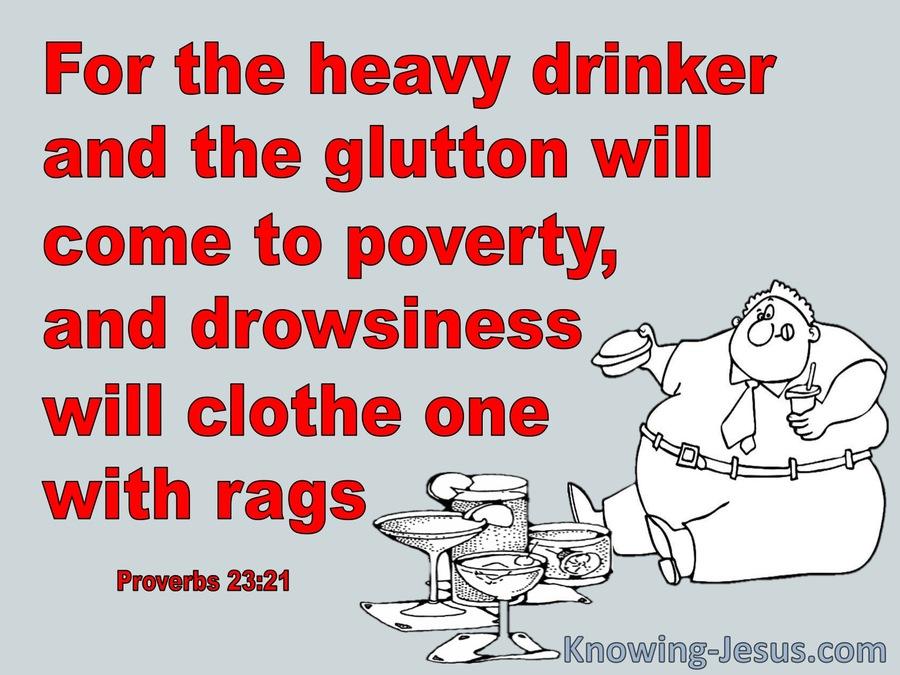
Avoid the company of gluttons, heavy drinkers, and other sinners to stay on your walk22
Those who fail to guard their hearts may be ensnared by the temptations of evil. Believers are warned to guard their hearts. “Watch over your heart with all diligence, for from it flow the springs of life.” (Prov. 4:23). This includes watching who becomes your friend, business partner, or spouse. “One who walks with wise people will be wise, but a companion of fools will suffer harm.” (Prov. 13:20). You should avoid the company of those who regularly get drunk, are greedy, or embrace other kinds of sin. “But actually, I wrote to you not to associate with any so-called brother if he is a sexually immoral person, or a greedy person, or an idolater, or is verbally abusive, or habitually drunk, or a swindler—not even to eat with such a person.” (1 Cor. 5:11). “And do not get drunk with wine, in which there is debauchery, but be filled with the Spirit,” (Eph. 5:18). “But be on your guard, so that your hearts will not be weighed down with dissipation and drunkenness and the worries of life, and that this day will not come on you suddenly, like a trap;” (Lk. 21:34). “Do not be deceived: ‘Bad company corrupts good morals.”’ (1 Cor. 15:33). “Now we command you, brothers and sisters, in the name of our Lord Jesus Christ, that you keep away from every brother or sister who leads a disorderly life and not one in accordance with the tradition which you received from us.” (2 Thess. 3:6). “Do not be mismatched with unbelievers; for what do righteousness and lawlessness share together, or what does light have in common with darkness?” (2 Cor. 6:14).
To guard your heart against the allure of evil, listen to the wisdom of godly parents. Because the family was meant to be the foundation for Yahweh’s wisdom to be transmitted from one generation to the next, Solomon urged believers to listen to the counsel of godly parents to avoid the false allure and temptations of sin (Saying 17). “22 Listen to your father, who fathered you, and do not despise your mother when she is old. 23 Buy truth, and do not sell it, get wisdom, instruction, and understanding. 24 The father of the righteous will greatly rejoice, and he who fathers a wise son will be glad in him. 25 Let your father and your mother be glad, and let her rejoice who gave birth to you.” (Prov. 23:22-25). “This saying remarkably escalates saying 14 (vv. 15-16) and, in similar logic to it, presents the admonition to accept the parents’ teaching in the first half (vv.22-23) and the motivation to give the parents exuberant joy in the second half (vv. 24-25). The two couplets are framed by ‘your father who begot you’ (v. 22a) and ‘the one/mother who bore you’ (v. 25b). That notion also unifies the second (vv. 24b, 25b). The saying uniquely stresses the role of the mother in birthing and raising the son (cf. 1:8), evincing the home, not a school, as the locus for transmitting the Thirty Sayings of the Wise.” (Bruce Waltke and Ivan De Silva on Proverbs Prov. 23:22-25).23

Seek out Jesus’ wisdom to gain knowledge and avoid the sins of the world24
Honor your parents by heeding Spirit-led parenting. The Fourth Commandment requires children to honor their parents (Ex. 20:20; Dt. 5:16; Eph. 6:1-3; Col. 3:20). Thus, Solomon urged children to listen to the godly counsel of his parents. “8 Listen, my son, to your father’s instruction, and do not ignore your mother’s teaching; 9 for they are a graceful wreath for your head and necklaces for your neck.” (Prov. 1:8-9). Believers should actively seek out godly wisdom through reading the Word, prayer, and godly counsel. “The beginning of wisdom is: Acquire wisdom; and with all your possessions, acquire understanding.” (Prov. 4:7). A child who heeds godly wisdom brings joy to the parents. “The proverbs of Solomon. A wise son makes a father glad, but a foolish son is a grief to his mother.” (Prov. 10:1). “A wise son makes a father glad, but a foolish man despises his mother.” (Prov. 15:20). “A man who loves wisdom makes his father glad, but he who involves himself with prostitutes wastes his wealth.” (Prov. 29:3). A parent is a steward of God’s children. Thus, they must use the honor and blessing God gives them to raise their children to honor and love God. “You shall teach them to your sons, talking of them when you sit in your house and when you walk along the road and when you lie down and when you rise up.” (Dt. 11:19). “You shall teach them diligently to your sons and shall talk of them when you sit in your house and when you walk by the way and when you lie down and when you rise up.” (Dt. 6:7). “. . . but make them known to your sons and your grandsons.” (Dt. 4:9). “ . . . and that they may teach their children.’” (Dt. 4:10; Prov. 22:6; Ps. 78:4-6). In case any Christian feels freed of this requirement, Paul is clear that it still applies: “Fathers, do not provoke your children to anger, but bring them up in the discipline and instruction of the Lord.” (Eph. 6:4).
7. Debauchery / Drunkenness: Turn to Jesus’ Wisdom for the Discernment and Strength to Avoid the Sins of Debauchery and Drunkenness. Prov. 23:26-35.
Turn to Jesus to avoid the false allure or sexual and spiritual temptation. Also because of mankind’s fallen nature and his many personal failures, Solomon warned about the consequences of sexual and spiritual sins against Yahweh (Saying 18). “26 Give me your heart, my son, and let your eyes delight in my ways. 27 For a prostitute is a deep pit, and a strange woman is a narrow well. 28 Certainly she lurks as a robber, and increases the treacherous among mankind.” (Prov. 23:26-28). “The need of the emphatic injunction in ver. 26 is exemplified by the dangers of impurity … A strange woman is a narrow pit. (For ‘strange woman,’ equivalent to ‘harlot,’ see on Proverbs 2:16.) A narrow pit is one with a narrow month, from which, if one falls into it, it is difficult to extricate one's self. The verse indicates the seductive nature of the vice of unchastity: how easy it is to be led into it! how difficult to rise from it! … The special transgression indicated is treachery or faithlessness. The harlot leads her victim to be faithless to his God, his wife, his parents, his tutor, his master. ” (Pulpit Commentary on Prov. 23:26-28).25

Guard your body and your mind from the devil’s seduction and destruction26
Keep your body and your heart pure to remain on your walk with Jesus. Moses called upon God’s people to give their hearts to Him. “And you shall love the LORD your God with all your heart and with all your soul and with all your strength.” (Dt. 6:5). Jesus called this the greatest Commandment. (Matt. 22:37; Mk. 12:30; Lk. 10:27). When you have a heart for God, you will have a relationship with Him. “I will also give them a heart to know Me, for I am the LORD; and they will be My people, and I will be their God, for they will return to Me wholeheartedly.” (Jer. 24:7). Conversely, Solomon repeatedly warned about believers seduced and drawn off their walk with God (Prov. 2:16-19; 5:3-5; 6:24-26; 7:24-27; Ecc. 7:26). As an example of this, Delilah used her looks to seduce Samson and deceive him (Jdgs. 16:4-21). Solomon also fell victim to his own lusts. He married foreign women who worshipped pagan idols. Solomon’s actions caused him to stop walking with God and commit idolatry (1 Kgs. 11:1-4). These warnings apply to both a perso’s physical and spiritual actions. God called Israel spiritually unfaithful to Him (Jer. 3:6-10). Those who follow the path of physical or spiritual adultery find that the path leads to a pit of sorrow. “The mouth of an adulteress is a deep pit; He who is cursed of the LORD will fall into it.” (Prov. 22:14). Today, the great spiritual harlot leads many astray to their sorrow and destruction (Rev. 17:1-15).
Turn to Jesus to avoid the false allure of drunkenness. Especially for young people, there are social pressures to be heavy drinkers when in the company of friends. But Solomon warns that this can lead to sorrow when people lift their guard and embrace sin (Saying 19). “29 Who has woe? Who has sorrow? Who has contentions? Who has complaining? Who has wounds without cause? Who has red eyes? 30 Those who linger long over wine, those who go to taste mixed wine. 31 Do not look at wine when it is red, when it sparkles in the cup, when it goes down smoothly; 32 in the end it bites like a snake and stings like a viper. 33 Your eyes will see strange things and your mind will say perverse things. 34 And you will be like one who lies down in the middle of the sea, or like one who lies down on the top of a mast. 35 ‘They struck me, but I did not become ill; they beat me, but I did not know it. When will I awake? I will seek another drink.” (Prov. 23:29-35). “This vivid picture of the effects of drunkenness leaves its sinfulness and its wider consequences out of sight, and fixes attention on the sorry spectacle which a man makes of himself in body and mind when he ‘puts an enemy into his mouth to steal away his brains.’ Disgust and ridicule are both expressed. The writer would warn his ‘son’ by impressing the ugliness and ludicrousness of drunkenness. The argument is legitimate, though not the highest.” (Alexander MacLaren’s Expositions on the Bible, Prov. 23:29-35).27

Guard your heart for Jesus by avoiding the sin of drunkenness28
The wise will heed Jesus’ wisdom and avoid the sin of drunkenness. The Bible does not condemn the drinking of alcohol under any circumstances. But it does condemn those who choose to become drunk from alcohol. “Woe to those who rise early in the morning so that they may pursue intoxicating drink, who stay up late in the evening so that wine may inflame them! Their banquets are accompanied by lyre and harp, by tambourine and flute, and by wine; but they do not pay attention to the deeds of the LORD, nor do they consider the work of His hands.” (Is. 5:11-12). “Woe to him who makes his neighbor drink; to you who mix in your venom even to make your neighbors drunk, so as to look at their genitalia!” (Hab. 2:15). These warnings are repeated in the New Testament. “And do not get drunk with wine, in which there is debauchery, but be filled with the Spirit,” (Eph. 5:18). “For the time already past is sufficient for you to have carried out the desire of the Gentiles, having pursued a course of indecent behavior, lusts, drunkenness, carousing, drinking parties, and wanton idolatries.” (1 Pet. 4:3). “Let’s behave properly as in the day, not in carousing and drunkenness, not in sexual promiscuity and debauchery, not in strife and jealousy.” (Rom. 13:13; Gal. 5:19-21). “Or do you not know that the unrighteous will not inherit the kingdom of God? Do not be deceived; … nor those habitually drunk … will inherit the kingdom of God.” (1 Cor. 6:9-10). Jesus also warns believers to guard their hearts by staying sober. “But be on your guard, so that your hearts will not be weighed down with dissipation and drunkenness and the worries of life, and that this day will not come on you suddenly, like a trap;” (Lk. 21:34).
B. Waltke and I. De Silva, Proverbs, A Shorter Commentary, (Grand Rapids, MI: Wm. B. Eerdmans Publishing Co., 2021), pgs. 330-341.↩︎
Image credit: Georg Emanuel Opiz (1741–1812) Painting; Georg Emanuel Opiz - Wikipedia↩︎
Proverbs 23:4 Meaning & Explanation (with Related Verses) - Christianity Path↩︎
Proverbs 23:5 Meaning & Explanation (with Related Verses) - Christianity Path↩︎
Image credit: Bankruptcy and loss concept businessman person went bankrupt | Premium AI-generated image↩︎
Image credit: Sunday Morning Message: "The Double Minded Person finds No Peace"↩︎
R. Young, Proverbs, A Commentary on the Book of Proverbs (SureWord Publications, Baltimore, MD, 2005), p. 306-307.↩︎
Image credit: Who Are the Scoffers? - by Allan Bevere↩︎
Image credit: Proverbs 23 10-11 Bible Verse Wall Art Digital Art by Bible Verse - Fine Art America↩︎
Proverbs 23:12 - Meaning, Context, and Spiritual Reflection↩︎
Image credit: HARD Hearts – Seek Grow Love↩︎
Proverbs 23 Commentary - Matthew Henry Commentary on the Whole Bible (Complete) | Bible Study Tools↩︎
Image credit: 53+ Bible Verses About Jealousy and Envy↩︎
J. Vernon McGee, Thru the Bible, Commentary Series, Proverbs (Thomas Nelson, Inc., Nashville TN 1991), p. 197.↩︎
Image credit: 26 Bible verses about Sloth↩︎
B. Waltke and I. De Silva, Proverbs, A Shorter Commentary, (Grand Rapids, MI: Wm. B. Eerdmans Publishing Co., 2021), pgs. 337-338.↩︎
Image credit: Proverbs 23 23 Bible Verse Wall Art Digital Art by Bible Verse - Fine Art America↩︎
Image credit: (16) Facebook↩︎
Image credit: What Does the Bible Say about Drunkenness? | Crosswalk.com↩︎