Proverbs 25: Lessons For Seeking and Living Out Jesus’ Wisdom
Introduction: Proverbs 25 marks a transition in Proverbs. According to verse one, “1 These also are proverbs of Solomon which the men of Hezekiah, king of Judah, transcribed.” (Prov. 25:1). King Hezekiah (circa 715 B.C. – 687 B.C.) was the 13th King of Judah and one of its great reformers (2 Kgs. 18:3).1 Solomon wrote over 3,000 proverbs (1 Kgs. 4:32). But not all of them are found within the Book of Proverbs. After finding a then lost collection of Solomon’s proverbs, King Hezekiah’s priests added Proverbs 25 through 29 to Solomon’s then published collection. Jesus confirmed their inspiration by quoting Proverbs 25:6-7 (Lk. 14:7-11), and Paul did likewise with Proverbs 25:21-22 (Rom. 12:20). In Proverbs 25, the Bible reveals seven lessons for seeking and living out Jesus’ wisdom. These include: (1) faith, (2) being peaceable, (3) being encouraging, (4) humility, (5) moderation, (6) loving kindness, and (7) purity.
First, in verses two through seven, Solomon established the importance of seeking out Yahweh’s hidden wisdom over worldly wisdom. Jesus’ wisdom is hidden from the world but freely available to those who search it out with faith. Second, in verses eight through 10, Solomon stressed the importance of living at peace with those around you. Jesus revealed that loving your neighbor as yourself is the second greatest commandment. Third, in verses 11 through 13, urged believers to be encouraging to one another. This is also part of the calling that Jesus has for every believer. Fourth, in verses 14 through 15, Solomon stressed the importance of humility. Walking in humility is also critical to living out Jesus’ wisdom in your life. Fifth, in verses 16 through 17, Solomon encouraged believers to live a life of moderation and discipline. Spirit-led moderation is an important part of living out Jesus’ wisdom rather than worldly wisdom. Sixth, in verses 18 through 25, Solomon urged believers to live in loving kindness toward others. Jesus commands believers to love even their enemies. Finally, in verses 26 through 28, stressed the importance of purity. Living a pure life is also important for properly living out Jesus’ wisdom.
1. Faith: Faith is Necessary to Seek and Live Out Jesus’ Wisdom. Prov. 25:2-7.
With faith, search out Jesus’ hidden wisdom over the hearts of worldly leaders. God gave Solomon wisdom that was greater than any other human, and leaders from across the then known world came to hear his wisdom (1 Kgs. 4:29-24). Because he knew the limits of his sinful heart, he urged all to focus on uncovering God’s hidden wisdom over seeking to discern the hearts of any human leader. “2 It is the glory of God to conceal a matter, but the glory of kings is to search out a matter. 3 As the heavens for height and the earth for depth, so the heart of kings is unsearchable.” (Prov. 25:1-3). “It is the glory of God to conceal a thing. That which is the chief glory of God is his mysteriousness, the unfathomable character of his nature and attributes and doings. The more we search into these matters, the more complete we find our ignorance to be; finite faculties are utterly unable to comprehend the infinite; they can embrace merely what God chooses to reveal … But the honour of kings is to search out a matter. The same word is used for ‘glory’ and ‘honour’ in both clauses, and ought to have been rendered similarly. It is the king's glory to execute justice and to defend the rights and safety of his people. To do this effectually he must investigate matters brought before him, look keenly into political difficulties, get to the bottom of all complications, and watch against possible dangers. The contrast between the glory of God and that of the king lies in this - that whereas both God and the king desire man’s welfare, the former promotes this by making him feel his ignorance and littleness and entire dependence upon this mysterious Being whose nature and designs mortals cannot understand; the latter advances the good of his subjects by giving them confidence in his zeal and power to discover truth, and using his knowledge for their benefit.” (Pulpit Commentary on Prov. 25:2).2 In verse three, the “proverb is connected with the preceding by the idea of ‘searching’ (chakar) common to both. Such emblematic proverbs are common in this second collection (see Ver. 11). Three subjects are stated, of which is predicated the term unsearchable, viz. The heaven for height, and the earth for depth, and the heart of kings. As you can never rise to the illimitable height of the heavens, as you can never penetrate to the immeasurable depth of the earth, so you can never fathom the heart of a king, can never find out what he really thinks and intends (comp. Job 11:8). (Pulpit Commentary on Prov. 25:3).3

With a childlike faith, Jesus wants you to search out His hidden wisdom and knowledge4
Jesus wants you to search out His hidden wisdom with a childlike faith. Solomon, Moses, David, Isaiah, and Paul proclaimed how mankind cannot fully comprehend the mind of the Creator of the universe. “He has made everything appropriate in its time. He has also set eternity in their heart, without the possibility that mankind will find out the work which God has done from the beginning even to the end.” (Ecc. 3:11). “The secret things belong to the LORD our God, ...” (Dt. 29:29a). “Such knowledge is too wonderful for me; it is too high, I cannot comprehend it.” (Ps. 139:6). “Great is the LORD, and highly to be praised; and His greatness is unsearchable.” (Ps. 145:3). “His understanding is unsearchable.” (Is. 40:28b). “For as the heavens are higher than the earth, so are My ways higher than your ways and My thoughts than your thoughts.” (Is. 55:9). “Oh, the depth of the riches, both of the wisdom and knowledge of God! How unsearchable are His judgments and unfathomable His ways!” (Rom. 11:30). God, however, still wants believers to search out His wisdom, knowledge, and His marvelous fingerprints over creation. “It is He who reveals the profound and hidden things; He knows what is in the darkness, and the light dwells with Him.” (Dan. 2:22). But Jesus warns that you need a childlike faith to see His hidden mysteries. “At that time Jesus said, ‘I praise You, Father, Lord of heaven and earth, that You have hidden these things from the wise and intelligent, and have revealed them to infants.”’ (Matt. 11:25). Jesus came to fulfill God’s Word, including the Law, all prophecy, and offer salvation (Matt. 5:17). To save the lost, Jesus shared His wisdom (Mk. 1:21-22, 6:6). His wisdom teachings included His parables (e.g., Matt. 13:13). The Greek word “parable” (παραβολή) is a translation of the Hebrew word “mashal” (מָשָׁל) or “proverb”.5 He taught wisdom parables to the crowds (Matt 13:10-17). But he revealed their hidden meanings to His disciples (Matt. 13:11). Jesus also wants you to become His disciple (Lk. 9:23). If you will search out what He offers, He will share His wisdom with you. “It is the glory of God to conceal a matter, but the glory of kings is to search out a matter.” (Prov. 25:2).
Unlike the heart of Jesus, the hearts of mankind are wicked and cannot be fully trusted. In verse two, Jesus establishes that He as the King of Kings (Rev. 19:16) is superior to any human leader. The heart of any person is wicked and unknowable. “The heart is more deceitful than all else and is desperately sick; who can understand it?” (Jer. 17:9). “For out of the heart come evil thoughts, murders, acts of adultery, other immoral sexual acts, thefts, false testimonies, and slanderous statements.” (Matt. 15:19). Thus, while believers should invest great efforts to learn Jesus’ wisdom, there is a limit to what they can learn, know, and trust when it comes to the hearts of their leaders on Earth.
Have the faith to trust Jesus, the King of Kings, as He removes sin from His bride. As a wise and perfect King of Kings, Jesus will in His perfect timing all remove wickedness from His throne and His bride, the Church. “4 Take away the impurities from the silver, and there comes out a vessel for the smith; 5 take away the wicked before the king, and his throne will be established in righteousness.” (Prov. 25:4-5). “This proverb pair advances the wise king’s activity from his investigating matters of state (v. 2) to his elimination of corrupt officials. The comment about purifying silver (v. 4) illustrates the real topic of purifying the king’s officials in v. 5. As a silversmith can only produce a vessel with silver purified of dross, so the king’s throne (his dynasty) can endure only when wicked officials are eliminated (cf. 20:8, 26). A solid building cannot be built of marred material.” (Bruce Waltke and Ivan De Silva on Proverbs 25:4-5).6

Trust Jesus to purify you to prepare you for His use7
Let Jesus purify and then keep yourself pure by focusing of the things of the Holy Spirit. Jesus uses afflictions to remove the impure desires of the flesh the same way impurities are removed from precious metals. “Behold, I have refined you, but not as silver; I have tested you in the furnace of affliction.” (Is. 48:10). “For You have put us to the test, God; You have refined us as silver is refined.” (Ps. 66:10). “And He will sit as a smelter and purifier of silver, and He will purify the sons of Levi and refine them like gold and silver, so that they may present to the LORD offerings in righteousness.” (Mal. 3:3). “And I will bring the third part through the fire, refine them as silver is refined, and test them as gold is tested. They will call on My name, and I will answer them; I will say, ‘They are My people,’ and they will say, ‘The LORD is my God.’” (Zech. 13:9). Just as a leader should focus on removing corrupt officials who can compromise a government, believers should keep themselves pure by focus on the things of the Holy Spirit over the flesh. “For those who are in accord with the flesh set their minds on the things of the flesh, but those who are in accord with the Spirit, the things of the Spirit.” (Ro. 8:5).
With faith, humble yourself before Jesus and human authorities. Unless required to engage in evil, believers must submit to authority because all such authority exists through Jesus’ sovereign will (Ro. 13:1; 1 Pet. 2:13-17). Thus, believers should humble themselves before both Jesus and any human authorities that is not seeking to force you to sin. “6 Do not boast in the presence of the king, and do not stand in the same place as great people; 7 for it is better that it be said to you, ‘Come up here,’ than for you to be placed lower in the presence of the prince, whom your eyes have seen.” (Prov. 25:6-7). “This verse advises readers not to barge into the presence of a king or pretend to be great. The imagery is someone overstating their importance, only to be ‘put in their place.’ This teaching indicates that it's better to be overly humble, then lifted up, rather than be embarrassed when overreaching and being put down. The danger is expressed in the second half of the proverb (Proverbs 25:7). Jesus used nearly this exact scenario in His parable of the wedding feast (Luke 14:8–11). The book of Esther shows how Esther humbly presented herself to King Ahasuerus. At significant risk she presented herself to the king on behalf of her people who faced genocide. The king extended his golden scepter toward Esther as a sign of his favor, but Esther did not rush to make her request known. Instead, she touched the tip of the scepter and waited for him to ask (Esther 5:2–3). In contrast to Esther's humble approach to King Ahasuerus, wicked Haman boldly asked to destroy the Jews (Esther 3:1–11; 6:4). Later, when the king asked for Haman's input on how to honor the man in whom he delighted, Haman foolishly shared his elaborate ideas, thinking this meant his own benefit (Esther 6:6–9). As it happened, those honors went to the very Jewish man Haman hoped to destroy, and Haman was embarrassed (Esther 6:10–13).” (BibleRef.com on Prov. 25:6).8
Humble yourself before Jesus. Although believers should submit to human authority, they must submit to Jesus, the King of Kings, as the highest authority. In heaven or on Earth, He will exalt in His perfect timing those who humble themselves before Him. “Whenever you are invited by someone to a wedding feast, do not take the place of honor, for someone more distinguished than you may have been invited by him, and the one who invited you both will come and say to you, ‘Give your place to this person,’ and then in disgrace you will proceed to occupy the last place. But whenever you are invited, go and take the last place, so that when the one who has invited you comes, he will say to you, ‘Friend, move up higher’; then you will have honor in the sight of all who are dining at the table with you. For everyone who exalts himself will be humbled, and the one who humbles himself will be exalted.” (Lk. 14:8-11). “Whoever exalts himself shall be humbled, and whoever humbles himself shall be exalted.” (Matt. 23:12). “So the last shall be first, and the first, last.” (Matt. 20:16). “Humble yourselves in the presence of the Lord, and He will exalt you.” (Jam. 4:10). “Therefore humble yourselves under the mighty hand of God, so that He may exalt you at the proper time,” (1 Pet. 5:6). “The reward of humility and the fear of the LORD are riches, honor, and life.” (Prov. 22:4).
2. Being Peaceable: When It is Possible, Live Out Jesus’ By Seeking Peace With Your Brothers, Sisters, Neighbors, and Even Your Enemies. Prov. 25:8-10.
Seek to quickly resolve conflicts with others. Instead of rushing to court or publicly airing your grievances with someone who has wronged you, God’s wisdom is found in seeking to privately resolve your dispute with the person who has wronged you. “8 Do not go out hastily to argue your case; otherwise, what will you do in the end, when your neighbor humiliates you? 9 Argue your case with your neighbor, and do not reveal the secret of another, 10 or one who hears it will put you to shame, and the evil report about you will not pass away.” (Prov. 25:8-9). “Proverbs 25:8-10 provides insightful guidance on navigating disputes and conflicts with others. The passage underscores the significance of humility, discretion, and the pursuit of peaceful resolutions. ‘Do not hastily bring into court’ cautions against impulsively engaging in legal battles or public confrontations, urging thoughtful consideration and exploration of alternative solutions. The warning, ‘What will you do in the end, when your neighbor puts you to shame?’ highlights the potential consequences of rash actions, including embarrassment and harm to one’s reputation. ‘Argue your case with your neighbor himself’ advocates for resolving disagreements privately and directly, emphasizing the importance of personal communication over public confrontation. Additionally, ‘Do not reveal another’s secret’ serves as a reminder to uphold trust and avoid betraying confidences, which can escalate conflicts and erode relationships.” (Reverend Micheal Johnson on Prov. 25:8-9).9
Quickly resolve your differences through forgiveness and compassion. Jesus referenced the wisdom He gave Solomon when he urged believers to quickly resolve their grievances outside of court, where the believer might lose and face judgment. “Come to good terms with your accuser quickly, while you are with him on the way to court, so that your accuser will not hand you over to the judge, and the judge to the officer, and you will not be thrown into prison. Truly I say to you, you will not come out of there until you have paid up the last quadrans .” (Matt. 5:25-26; Lk. 12:58-59). Believers should first seek to resolve disputes with another privately. “Now if your brother sins, go and show him his fault in private; if he listens to you, you have gained your brother.” (Matt. 18:15). The goal of dispute resolution should be peace, not victory. “If possible, so far as it depends on you, be at peace with all people.” (Rom. 12:18). “But if you bite and devour one another, take care that you are not consumed by one another.” (Gal. 5:15). If you want God’s forgiveness, you must forgive those who have wronged you. “For if you forgive other people for their offenses, your heavenly Father will also forgive you. But if you do not forgive other people, then your Father will not forgive your offenses.” (Matt. 6:14-15). Being kind, compassionate, and forgiving will help to resolve many conflicts. “Be kind to one another, compassionate, forgiving each other, just as God in Christ also has forgiven you.” (Eph. 4:32). If you cannot informally resolve a conflict, you must avoid hating your adversary. “Everyone who hates his brother or sister is a murderer, and you know that no murderer has eternal life remaining in him.” (1 Jo. 3:15).

Avoid bringing hasty charges in Court where God may expose false allegations10
3. Encouragement: Live Out Jesus’ Wisdom by Seeking to Encourage and Edify Others In Need With His Wisdom. Prov. 25:11-13.
Help resolve problems by offering godly wisdom to others in need. Because the power of life and death is in the tongue (Prov. 18:21), Solomon advised that believers can offer pearls of God-given wisdom to others in need when they pray and offer the wisdom at the right time. “11 Like apples of gold in settings of silver, is a word spoken at the proper time.” “The meaning of Proverbs 25:11 speaks deeply to the significance of our words. Just as apples of gold represent beauty and rarity, the verse highlights how important it is to choose our words carefully. When we speak wisely and thoughtfully, our words can have a powerful impact on others. This verse implies that the right words can uplift, encourage, and bring joy just like a beautifully crafted piece of art. It challenges us to think before we speak and to consider how our words can influence those around us. Additionally, this verse can also be reflected upon in terms of relationships. When we speak a kind word or provide wise counsel at an appropriate moment, we create a bond of trust and respect. It encourages us to aim for excellence in our communication. This is vital not just in our spiritual growth but also in our daily lives. It is essential to recognize that our words can solidify connections with others or create divisions. As we take time to ponder the meaning of Proverbs 25:11, we can strive to make our conversations meaningful and constructive.” (Christianitypath.com on Prov. 25:11).
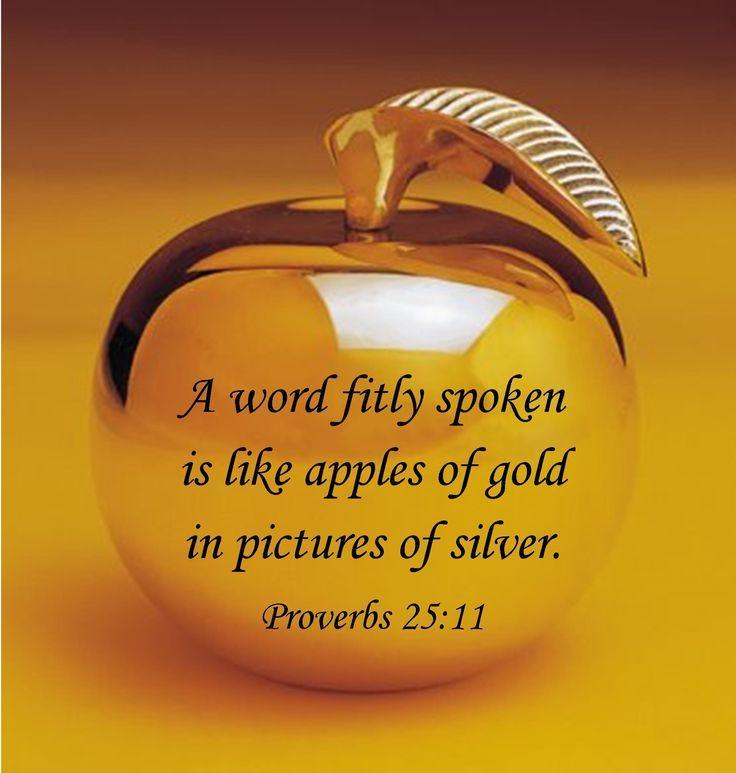
Use your words to encourage and give hope through Jesus11
Use your words to bring life, healing, grace, and encouragement. Godly wisdom offered at the right time can bring healing. “… [T]he tongue of the wise brings healing.” (Prov. 12:18b). “A soothing tongue is a tree of life, …” (Prov. 15:4a). “Pleasant words are a honeycomb, sweet to the soul and healing to the bones.” (Prov. 16:24). You must first pray and ask for God’s wisdom (Jam. 1:5). To ensure that your wisdom is from God, it must be based on the Word, truthful, loving, gentle, merciful, impartial, and free from hypocrisy. “But the wisdom from above is first pure, then peace-loving, gentle, reasonable, full of mercy and good fruits, impartial, free of hypocrisy.” (Jam. 3:17). “Your speech must always be with grace, as though seasoned with salt, so that you will know how you should respond to each person.” (Col. 4:6). “Let no unwholesome word come out of your mouth, but if there is any good word for edification according to the need of the moment, say that, so that it will give grace to those who hear.” (Eph. 4:29).
Treat godly discipline as being of greater value than fine jewelry. In addition controlling their tongues to offer only godly words of wisdom, believers must open their ears and their hearts to place great value in godly discipline. “12 Like an earring of gold and a jewelry piece of fine gold, is a wise person who offers rebukes to a listening ear.” (Prov. 25:12). “A person that is trying to live for God with all his heart will be thankful to a person that will love him or her enough to rebuke them when they are wrong. The value of a person that will stand up and tell you what you need to do to get right with God can’t be measured with this earth’s goods.” (Ronald Young on Prov. 25:12).12
Those who accept godly discipline will grow in wisdom. When believers accept Spirit-led discipline, they allow the Holy Spirit to redirect their paths back towards Jesus and grow in His wisdom. “… rebuke a wise person and he will love you.” (Prov. 9:8b). “One who loves discipline loves knowledge, ....” (Prov. 12:1a). “Poverty and shame will come to one who neglects discipline, but one who complies with rebuke will be honored.” (Prov. 13:18). “One whose ear listens to a life-giving rebuke will stay among the wise. One who neglects discipline rejects himself, but one who listens to a rebuke acquires understanding.” (Prov. 15:31-32). “Listen to advice and accept discipline, so that you may be wise the rest of your days.” (Prov. 19:20). “It is better to listen to the rebuke of a wise person than for one to listen to the song of fools.” (Ecc. 7:5). “For the moment, all discipline seems not to be pleasant, but painful; yet to those who have been trained by it, afterward it yields the peaceful fruit of righteousness.” (Heb. 12:11).
Offer hope in Jesus. Jesus is the light of the world, and His light shines in you (Jo. 8:12; Matt. 5:14-16). Thus, you can offer hope through Him. “13 Like the cold of snow in the time of harvest is a faithful messenger to those who send him, for he refreshes the soul of his masters.” (Prov. 25:13). A “faithful messenger” “does not just refer to someone who carries messages; it emphasizes reliability, trustworthiness, and the ability to connect deeply with those receiving the message. A faithful messenger is someone who acts with integrity and respect for the person sending the message … When we think about a hot summer day, nothing compares to the thrill of cold snow. The joy and comfort felt in our hearts when we receive a message that lifts our spirits are just as refreshing. This imagery highlights the importance of timing and context in delivering messages effectively.” “[R]efreshes the soul” “speaks to the deep emotional impact that a good messenger can have on someone. It demonstrates how a simple act of kindness can change the course of a day or even a life. We all experience times when we feel downhearted or in need of encouragement, and faithful messengers have the unique ability to make us feel valued, loved, and motivated once again. We should strive to be that type of presence in the lives of those around us.” (Christinanitypath.com on Prov. 25:13).13
Be a messenger for Jesus. When you let Jesus work through you, you can bring healing to another person’s mind and soul. “A wicked messenger falls into adversity, but a faithful messenger brings healing.” (Prov. 13:17). “How delightful on the mountains are the feet of one who brings good news, who announces peace and brings good news of happiness, who announces salvation, and says to Zion, ‘Your God reigns!”’ (Is. 52:7). In the New Testament, we find many examples where faithful believers conveyed messages that brought hope and encouragement through Jesus. “I rejoice over the coming of Stephanas, Fortunatus, and Achaicus, because they have supplied what was lacking on your part. For they have refreshed my spirit and yours. Therefore acknowledge such men.” (1 Cor. 16:17-18). “But God, who comforts the discouraged, comforted us by the arrival of Titus;” (2 Cor. 7:6). “For I have had great joy and comfort in your love, because the hearts of the saints have been refreshed through you, brother.” (Phil. 1:7).
4. Humility: To Live Out Jesus’ Wisdom, Be Humble. Prov. 25:14-15.
Serve with humility and truth. Those who boast or make false promises do not walk in God’s true wisdom. “14 Like clouds and wind without rain is a person who boasts of his gifts falsely.” (Prov. 25:14). “Whoever falsely boasts of giving: There are some who give nothing but want to be known as people who give; others give small gifts and want to be known as those who give great gifts (such as Ananias and Sapphira in Acts 5:1-11). They want the reputation of generosity without actually being generous … Is like clouds and wind without rain: When the clouds and wind of a storm come, we expect life-giving rain. When the clouds and wind are without rain, it is a disappointment – just like he who falsely boasts of giving.” (David Guzik on Prov. 25:14).14

Live humble and avoid making false boasts about your generosity15
Be wary of those who boast or fail to serve only themselves. In Jude, Solomon’s proverb is used to warn against those who boast and seek public attention while serving only themselves. “These are the ones who are hidden reefs in your love feasts when they feast with you without fear, like shepherds caring only for themselves; clouds without water, carried along by winds; autumn trees without fruit, doubly dead, uprooted; wild waves of the sea, churning up their own shameful deeds like dirty foam; wandering stars, for whom the gloom of darkness has been reserved forever.” (Jude 1:12-13). Your faith should be evidenced through love and truth, not just your words. “Little children, let’s not love with word or with tongue, but in deed and truth.” (1 Jo. 3:18). A faith that does not motivate you to act out of love for Jesus to serve is dead (Jam. 2:15-17).
With patience and gentleness, God’s wisdom can transform a leader’s hardened heart. Believers will frequently encounter persons in authority who do not accept God’s wisdom. When this happens, trust God and use prayer, patience, and gentleness to reach the ruler. “15 Through patience a ruler may be persuaded, and a gentle tongue breaks bone.” (Prov. 25:15). “We have an illustration of this proverb in the effect of the ‘long forbearing’ of David during his persecution by Saul, and of his ‘soft tongue’ at Engedi (1 Samuel 24), and in the wilderness of Ziph (Ib. Proverbs 26:7 ff.): ‘And it came to pass, when David had made an end of speaking these words unto Saul, that Saul said, is this thy voice, my son David? And Saul lifted up his voice and wept: ‘Return, my son David; for I will no more do thee harm, because my soul was precious in thine eyes this day.”’’ (Thomas Thomason Perowne, Cambridge Bible for Schools and Colleges, Prov. 25:15).16
Use patience and kindness when seeking to resolve conflict. Believers live in a fallen world where conflict is pervasive. To help prevent conflicts and resolve them when they happen, believers should be patient and gentle. “Do not be quick with your mouth or impulsive in thought to bring up a matter in the presence of God. For God is in heaven and you are on the earth; therefore let your words be few.” (Ecc. 5:2). “If the ruler’s temper rises against you, do not abandon your place, because composure puts great offenses to rest.” (Ecc. 10:4). “When there are many words, wrongdoing is unavoidable, but one who restrains his lips is wise.” (Prov. 10:19). “The heart of the righteous ponders how to answer, but the mouth of the wicked pours out evil things.” (Prov. 15:28). “One who withholds his words has knowledge, And one who has a cool spirit is a person of understanding.” (Prov. 17:27). “You know this, my beloved brothers and sisters. Now everyone must be quick to hear, slow to speak, and slow to anger;” (Jam. 1:19).
5. Moderation: To Live Out Jesus’ Wisdom, Live in Moderation. Prov. 25:16-17.
Live life enjoying God’s provision in moderation. Jesus the Creator has provided mankind with many types of blessings in nature (Jam. 1:17). Believers are free to enjoy what He provides. But they should do so in moderation and without coveting, hoarding or greed. “16 Have you found honey? Eat only what you need, so that you do not have it in excess and vomit it.” (Prov. 25:16). “We are cautioned to take heed of excess. We must use all pleasures as we do honey, with a check upon our appetite, lest we take more than does us good and make ourselves sick with it. We are most in danger of surfeiting upon that which is most sweet, and therefore those that fare sumptuously every day have need to watch over themselves, lest their hearts be at any time overcharged. The pleasures of sense lose their sweetness by the excessive use of them and become nauseous, as honey, which turns sour in the stomach; it is therefore our interest, as well as our duty, to use them with sobriety.” (Matthew Henry on Prov. 25:16).17

Live modestly and avoid the sin of gluttony18
Live contently with what Jesus provides and avoid overindulgence. Jesus deserves for believers to be content with His provision. “But godliness actually is a means of great gain when accompanied by contentment. For we have brought nothing into the world, so we cannot take anything out of it, either. If we have food and covering, with these we shall be content.” (1 Tim. 6:6-7). "But even when Jesus blesses you with something, it is a sin to overindulge. This type of behavior stems from greed, covetousness, and a lack of self-control over the desires of your flesh. “All things are permitted for me, but not all things are of benefit. All things are permitted for me, but I will not be mastered by anything.” (1 Cor. 6:12; 10:23). “But He said to them, ‘Beware, and be on your guard against every form of greed; for not even when one is affluent does his life consist of his possessions.”’ (Lk. 12:15). “You have lived for pleasure on the earth and lived luxuriously; you have fattened your hearts in a day of slaughter.” (Jam. 5:5).
Practice moderation and respect social boundaries in your relationships. Just as you can harm yourself by overindulging in food, you can also cause conflict by overindulging in relationships. “17 Let your foot rarely be in your neighbor’s house, or he will become weary of you and hate you.” (Prov. 25:17). “The essence of Proverbs 25:17 lies in its practical wisdom regarding social interactions. The verse warns against overstaying one's welcome, suggesting that excessive visitation can lead to strain on relationships. This principle extends beyond the physical act of visiting; it encapsulates the idea of respecting personal boundaries in all interactions. In a broader spiritual context, this verse teaches us the importance of balance in our relationships. It encourages us to be considerate of others’ time and space, promoting a healthy exchange that fosters goodwill rather than resentment.” (Bibleverseexplained.com on Prov. 25:17).19
Do misuse your freedoms in a way that causes others to stumble. Even though you may be free to visit your neighbors, friends, and acquaintances, you should respect their boundaries and avoid excessive visits or contacts that might cause them to stumble. “But take care that this freedom of yours does not somehow become a stumbling block to the weak.” (1 Cor. 8:9). “No one is to seek his own advantage, but rather that of his neighbor … Do not offend Jews or Greeks, or the church of God; just as I also please everyone in all things, not seeking my own benefit but the benefit of the many, so that they may be saved.” (1 Cor. 10:24, 32). “It [love] does not act disgracefully, it does not seek its own benefit; it is not provoked, does not keep an account of a wrong suffered,” (1 Cor. 13:5). “Each of us is to please his neighbor for his good, to his edification.” (Rom. 15:2). “and to make it your ambition to lead a quiet life and attend to your own business and work with your hands, just as we instructed you, so that you will behave properly toward outsiders and not be in any need.” (1 Thess. 4:11-12).
6. Loving Kindness: To Live Out Jesus’ Wisdom, Show Loving Kindness to All, Even Your Enemies. Prov. 25:18-25.
Respond to evil with love and kindness. When your enemies hurt you, your flesh may seek to inflict pain on your enemies. But God calls upon you to respond to your enemies with love and kindness. “18 Like a club, a sword, and a sharp arrow is a person who gives false testimony against his neighbor. 19 Like a bad tooth and an unsteady foot is confidence in a treacherous person in time of trouble. 20 Like one who takes off a garment on a cold day, or like vinegar on soda, is one who sings songs to a troubled heart. 21 If your enemy is hungry, give him food to eat; and if he is thirsty, give him water to drink; 22 for you will heap burning coals on his head, and the Lord will reward you.” (Prov. 25:18-22). “Proverbs 25:18-23 is about exercising self-control in responding to anger and conflicts, using gentle words to calm situations and demonstrating kindness and patience toward others … When facing anger, it is important to respond with kindness and understanding. We can calm the situation and potentially bring about a resolution by responding to anger with gentleness and compassion. Kindness can help defuse the anger and pave the way for a more constructive conversation. Practice empathy and try to see the situation from the other person’s perspective in moments of conflict or anger. We can demonstrate respect for the other person’s feelings and create a space for open communication by showing understanding and patience. Responding with kindness can help build bridges and strengthen relationships, even in the face of strong emotions.” (Reverend Michael Johnson on Prov. 25:18-22).20
When an enemies fail to respond to your love, they bring judgment on themselves. Jesus warns that all will be held to account for their words. “But I tell you that for every careless word that people speak, they will give an account of it on the day of judgment. For by your words you will be justified, and by your words you will be condemned.” (Matt. 12:36-37). Jesus will commend some for offering words of life and judge others for their words of death. “Death and life are in the power of the tongue, and those who love it will eat its fruit.” (Prov. 18:21). His warning includes judging those who tell lies and slandering others (Prov. 25:18-19; Ex. 20:16; Dt. 5:20; Eph. 4:25; Jam. 4:11). Jesus instead calls upon believers to forgive and love their enemies. “But I say to you, love your enemies and pray for those who persecute you,” (Matt. 5:44; Lk. 6:27-28). Saul, for example, felt convicted because of David’s kind and forgiving heart towards him in face of his unjustified persecution of David (1 Sam. 24:17). The Apostle Paul also quoted from Solomon’s Proverbs 25:21-22 to encourage believers to respond to an enemy’s acts of hatred with love. If they respond to acts of love with further hatred, they bring judgment on themselves. “But if your enemy is hungry, feed him; if he is thirsty, give him a drink; for in so doing you will heap coals on his head.” (Ro. 12:20).

Show loving kindness to your enemies and help them in their time of need21
Show love by avoiding gossip. Gossip is another form of evil that many struggle to avoid. “23 The north wind brings rain, and a gossiping tongue brings an angry face.” (Prov. 25:23). “This proverb highlights how harmful speech, akin to an unexpected harsh wind, can stir up animosity and discord. The metaphor describes how gossip and slander can catch individuals off guard, leaving them as bewildered as a farmer surprised by rain that threatens his crops. Such treacherous words undermine relationships and yield unforeseen turmoil. The essence of this teaching underscores the need for restraint and mindfulness in communication. Just as one must be prepared for weather changes, we should anticipate how our words can affect others. Therefore, it is crucial to engage in thoughtful dialogue rather than unfiltered chatter. The wisdom of Proverbs advocates for guarding our tongues to foster peace and mitigate conflict, providing a timeless lesson applicable to modern discourse as well. This wisdom is encapsulated in Proverbs 25:23, which reminds us of the significant consequences of our spoken words in maintaining harmony among our connections.” (TheBiblesays.com on Prov. 25:23).22
The momentary pleasures of gossip quickly fade. Gossip brings momentary pleasure but ultimately causes great harm to relationships. “8 The words of a gossiper are like dainty morsels, and they go down into the innermost parts of the body.” (Prov. 18:8; 26:22). Gossip also divides friends. “A perverse person spreads strife, and a slanderer separates close friends.” (Prov. 16:28). Even worse, gossip frequently involves slander. “One who goes about as a slanderer reveals secrets, but one who is trustworthy conceals a matter.” (Prov. 11:13). Thus, believers are warned to not associate with gossipers (Prov. 20:19). In the Old Testament, God promises to judge those who “secretly slander,” another phrase for gossip (Ps. 101:5; 1 Tim. 5:13; Ro. 16:17-18; 2 Thess. 3:11). God further considers the religion of a person who fails to control their tongue of gossip or slander to be “worthless”. “If anyone thinks himself to be religious, yet does not bridle his tongue but deceives his own heart, this person’s religion is worthless.” (Jam. 1:26).
Love your spouse the way Jesus loves His Church. Just as Jesus loves and supports His Church, each believer should also practice love by living in harmony with his or her spouse. “24 It is better to live on a corner of the roof, than in a house shared with a contentious woman.” (Prov. 25:24). This verse obviously speaks to the importance of marital harmony between both sexes. But it also has a spiritual application. “Let every believer in Jesus Christ make sure he is a gentle, tender, and virtuous bride for the Lord of glory, without contending, questioning, or whining against Him, His word, or His ministers. He married you for His pleasure, so do all you can every day to be a cheerful, doting, loving spouse for the King.” (LetGodbeTrue.com on Prov. 25:24).23
Loving your spouse is important for maintaining your God-given family. Because the family is part of God’s plan for companionship, support, encouragement, and raising children, many proverbs are devoted to encouraging spouses to live in loving harmony with each other. “It is better to live on a corner of a roof than in a house shared with a contentious woman…It is better to live in a desert land than with a contentious and irritating woman.” (Prov. 21:9, 19). “An excellent wife is the crown of her husband, but she who shames him is like rottenness in his bones.” (Prov. 12:4). “House and wealth are an inheritance from fathers, but a prudent wife is from the LORD.” (Prov. 19:14). Jesus wants spouses to submit in love to each other the same way He submitted for His bride the Church. “But I want you to understand that Christ is the head of every man, and the man is the head of a woman, and God is the head of Christ.” (1 Cor. 11:3).

Show loving kindness to your spouse, just as Jesus loves His Church24
Out of love, share Jesus’ good news. Jesus is looking for believers to share His love and promise of eternal life in the land of heaven that can only be seen with faith. “25 Like cold water to a weary soul, so is good news from a distant land.” (Prov. 25:25). “Our natural it is to us to desire to hear good news from our friends, and concerning our affairs at a distance. It is sometimes with impatience that we expect to hear from abroad; our souls thirst after it … Heaven is a country afar off; how refreshing is it to hear good news thence, both in the everlasting gospel, which signified glad tidings, and in the witness of the Spirit with our spirits that we are God's children.” (Matthew Henry on Prov. 25:25).25
Jesus wants you to invite nonbelievers to His wedding banquet. When you accept Jesus, His light shines within you as a beacon for nonbelievers to seek out the eternal promised land: “14 You are the light of the world. A city set on a hill cannot be hidden; 15 nor do people light a lamp and put it under a basket, but on the lampstand, and it gives light to all who are in the house. 16 Your light must shine before people in such a way that they may see your good works, and glorify your Father who is in heaven.” (Matt. 5:14-16). In Jesus’ parable of the wedding feast, He calls upon every believer to share His invitation. “So go to the main roads, and invite whomever you find there to the wedding feast.” (Matt. 22:9). “and at the dinner hour he sent his slave to tell those who had been invited, ‘Come, because everything is ready now.”’ (Lk. 14:17). This is also Jesus’ Great Commission. “18 And Jesus came up and spoke to them, saying, ‘All authority in heaven and on earth has been given to Me. 19 Go, therefore, and make disciples of all the nations, baptizing them in the name of the Father and the Son and the Holy Spirit, 20 teaching them to follow all that I commanded you; and behold, I am with you always, to the end of the age.”’ (Matt. 28:18-20). When you plant the seeds of faith, the Spirit will speak to nonbelievers and cause them to find refreshment in Jesus. “The Spirit and the bride say, ‘Come.’ And let the one who hears say, ‘Come.’ And let the one who is thirsty come; let the one who desires, take the water of life without cost.” (Rev. 22:17).
7. Purity: To Live Out, Jesus’ Wisdom, Stay Pure for His Use. Prov. 25:26-28.
Stay pure so that Jesus can use you for His glory. Because you are meant to reflect Jesus’ light to the lost, He wants you to remain pure and unpolluted from worldly sins. “26 Like a trampled spring and a polluted well, so is a righteous person who gives way before the wicked.” (Prov. 25:26). “The mouth of the righteous was described (Proverbs 10:11) as a “well of life,” from the comfort and refreshment it brings to the weary- through the just and kindly counsel it offers. But if the righteous man yields to the pressure put upon him by the wicked, and through fear or favor gives up his principles, then he can no longer give forth counsel out of a pure heart; he becomes like a fountain which has been fouled by the feet of cattle drinking at it (Ezekiel 34:18), and like a corrupted spring.” (Charles Ellicott’s Commentary for English Readers on Prov. 25:26).26
When sin pollutes you, it becomes less likely that Jesus will use you for His purposes. Jesus referred to believers as “salt”. Salt stings in the wound of sin, and it was used to preserve food. Thus, believers whose saltiness are compromised by sin are of little value to Him. “You are the salt of the earth; but if the salt has become tasteless, how can it be made salty again? It is no longer good for anything, except to be thrown out and trampled underfoot by people.” (Matt. 5:13; Mk. 9:50; Lk. 14:34-35). “Your silver has become waste matter, your drink diluted with water.” (Is. 1:22). Believers compromised by sin can spread that their sin to others. “Is it too little a thing for you to feed in the good pasture, that you must trample with your feet the rest of your pastures? Or too little for you to drink the clear waters, that you must muddy the rest with your feet? But as for My flock, they must eat what you trample with your feet, and drink what you muddy with your feet!’” (Ezek. 34:18-19). Thus, believers are called upon to cleanse themselves of sin. “Therefore, if anyone cleanses himself from these things, he will be an implement for honor, sanctified, useful to the Master, prepared for every good work.” (2 Tim. 2:21). “Or do you not know that your body is a temple of the Holy Spirit within you, whom you have from God, and that you are not your own? For you have been bought for a price: therefore glorify God in your body.” (1 Cor. 6:19-20). “Therefore I urge you, brothers and sisters, by the mercies of God, to present your bodies as a living and holy sacrifice, acceptable to God, which is your spiritual service of worship.” (Rom. 12:1).

Remain pure from sin so that Jesus can reflect His light through you27
Remain pure of covetousness and pride. Being pure for Jesus’ use also requires that you live in humble moderation and avoid the sins of overindulgence and pride. “27 It is not good to eat much honey, nor is it glory to search out one’s own glory.” (Prov. 25:27). “A little honey is good, but a lot of honey makes you sick. For a man to be ambitious for self-glory, especially in the ministry of God, make you sick. We see this around us in the church – there is an inordinate ambition among some Christians today. It makes you sick to your tummy to see that type of thing.” (J. Vernon McGee on Prov. 25:27).28
Remove all forms of covetousness, greed, selfish ambition, and pride from your walk. To walk in Jesus’ wisdom, you must also avoid overindulging in worldly desires (Prov. 25:16). “For all that is in the world, the lust of the flesh and the lust of the eyes and the boastful pride of life, is not from the Father, but is from the world.” (1 Jo. 2:16). “Do not be with heavy drinkers of wine, or with gluttonous eaters of meat; for the heavy drinker and the glutton will come to poverty, and drowsiness will clothe one with rags.” (Prov. 23:20-21). “whose end is destruction, whose god is their appetite, and whose glory is in their shame, who have their minds on earthly things.” (Phil. 3:19). To walk in Jesus’ wisdom, you must also avoid acting out of selfish ambition or pride. “Do nothing from selfishness or empty conceit, but with humility consider one another as more important than yourselves;” (Phil. 2:3). “Love is patient, love is kind, it is not jealous; love does not brag, it is not arrogant.” (1 Cor. 13:4). “Let’s not become boastful, challenging one another, envying one another.” (Gal. 5:26). “Whoever exalts himself shall be humbled, and whoever humbles himself shall be exalted.” (Matt. 23:12).
Remaining pure for Jesus requires self-control. Without discipline and self-control, a believer’s purity will be quickly compromised through sin. “28 Like a city that is broken into and without walls so is a person who has no self-control over his spirit.” (Prov. 25:28). “He that hath no rule over his own spirit,.... His affections and passions, puts no restraint, unto them, as the word signifies; no guard against them, no fence about them, to curb his curiosity, to check his pride and vanity, to restrain his wrath and anger and revenge, and keep within due bounds his ambition and itch of vainglory; is like a city that broken down and without walls; into which the may go with pleasure, and which is exposed to the rapine and violence of everyone; and so a man that has no command of himself and passions, but gives the reins to them, is exposed to the enemy of souls, Satan and is liable to every sin, snare and temptation.” (John Gill on Prov. 25:28).29

Exercise self-control to remain pure for Jesus’ use30
The Holy Spirit offers you the fruit of “self-control” to remain pure for Jesus’ use. Many aspire to do what is right but fail when tempted. To develop the strength to exercise self-control, believers can pray for the Holy Spirit to strengthen them with that gift. “But the fruit of the Spirit is love, joy, peace, patience, kindness, goodness, faithfulness, gentleness, self-control; against such things there is no law.” (Gal. 5:22-23). “For God has not given us a spirit of timidity, but of power and love and discipline.” (2 Tim. 1:7). “Now for this very reason also, applying all diligence, in your faith supply moral excellence, and in your moral excellence, knowledge, and in your knowledge, self-control, and in your self-control, perseverance, and in your perseverance, godliness,” (2 Pet. 1:5-6). When you fail, repent and pray for Jesus to renew your mind (Ro. 12:2).

Find self-control through the power of the Holy Spirit31
Image credit: Proverbs 25:2 The Mysteries of God (devotional)08:18 (brown)↩︎
Strong's Greek: 3850. παραβολή (parabole) -- Parable, comparison, illustration, allegory; Strong's Hebrew: 4912. מָשָׁל (mashal) -- Proverb, parable, byword, taunt; Mashal: Telling Stories through PARABLES & PROVERBS – Hebrew Word Lessons↩︎
B. Waltke and I. De Silva, Proverbs, A Shorter Commentary, (Grand Rapids, MI: Wm. B. Eerdmans Publishing Co., 2021), p. 359.↩︎
Image credit: https://bible.art/meaning/proverbs-25:4↩︎
Image credit: To Kill a Mockingbird Original R1967 U.S. Silver Gelatin Single-Weight Photo - Posteritati Movie Poster Gallery↩︎
Image credit: (145) Pinterest↩︎
R. Young, Proverbs, A Commentary on the Book of Proverbs (SureWord Publications, Baltimore, MD, 2005), p. 330.↩︎
Proverbs 25:13 Meaning & Explanation (with Related Verses) - Christianity Path↩︎
Image credit: Proverbs 25:14↩︎
Proverbs 25 Commentary - Matthew Henry Commentary on the Whole Bible (Complete) | Bible Study Tools↩︎
Image credit: What does Proverbs 25:16 mean? | Bible Art↩︎
Proverbs 25:17 - Meaning, Context, and Spiritual Reflection↩︎
Image credit: 46 Bible verses about Feeding The Poor↩︎
Image credit: 'Proverbs 25 24' Poster, picture, metal print, paint by ABConcepts | Displate↩︎
Proverbs 25 Commentary - Matthew Henry Commentary on the Whole Bible (Complete) | Bible Study Tools↩︎
Image credit: Proverbs 25:26 - Wellspring Christian Ministries↩︎
J. Vernon McGee, Thru the Bible, Commentary Series, Proverbs (Thomas Nelson, Inc., Nashville TN 1991), p. 217.↩︎
Image credit: Weekend Wisdom – Proverbs 25:28 – In God's Image↩︎
Image credit: Self-Control In The Bible - 6 Truths To Help You Overcome Temptation - Gentle Christian Parenting↩︎