Proverbs 29: Solomon’s Final Lessons for Walking Jesus’ Wisdom
Introduction: Proverbs 29 is the conclusion of Solomon’s proverbs. The final two chapters are attributed to Agur and King Lemuel. Here, Solomon provides several lessons for walking in the wisdom of Yahweh, later revealed to be Jesus (Jo. 8:58; Ex. 3:14). These include: (1) humility, (2) justice, (3) love, (4) restraint, (5) righteousness, (6) trusting God, and (7) fearing Him.
First, in verse one, Solomon restated the importance of being willing to accept godly correction and instruction. To walk in Jesus’ wisdom, you must have the humility to accept godly correction and instruction. Second, in verses two through six, Solomon stressed the importance of being a source of Yahweh’s justice. Jesus also wants you to be a source of His justice in the world. Third, in verse seven, Solomon reminded believers of their obligation to help the poor. Jesus also wants you to show His love to people in need. Fourth, from verse eight through 11, Solomon urged believers to restrain their mouth and their hearts from committing evil. Jesus also wants you to restrain your flesh and walk in the Spirit. Fifth, in verses 12 through 15, Solomon stressed the importance of believers following Yahweh’s righteous example. Jesus also wants you to follow His example of righteousness. Sixth, in verses 16 through 19, Solomon urged believers to place their trust in Yahweh and not in people. Jesus also wants you to place your trust in Him alone. Finally, in verses 20 through 27, Solomon returned to the theme of Proverbs to give different examples regarding how a believer can fear the Lord. The fear of the Lord is defined as hating evil. Jesus wants you to hate evil and be His light to the lost.
1. Humility: To Walk in Jesus’ Wisdom, Have the Humility to Accept Godly Correction and Instruction. Prov. 29:1.
Have the humility to accept and learn from correction. A person who repeatedly refuses to accept correction risks becoming numb to the calling of the Holy Spirit to repent. “1 A person often rebuked who becomes obstinate will suddenly be broken beyond remedy.” (Prov. 29:1). “Christ calls his yoke easy, and bids his followers to bear it bravely (Matthew 11:29. etc.). The reproofs may arise from the Holy Spirit and the conscience, from the teaching of the past, or from the counsel of friends …The incorrigible and self-deluding sinners shall come to a fearful and sudden end, though retribution be delayed (comp. Job 34:20; Psalm 2:9; Jeremiah 19:11). And there is no hope in their end; despising all correction, they can have no possibility of restoration. We may refer, as an illustration, to that terrible passage in the Epistle to the Hebrews (Hebrews 6:4, etc.), and to the fate of the Jews unto the present day.” (Pulpit Commentary on Prov. 29:1).1
Believers should learn from the Jews and avoid becoming stiff-necked to correction. God repeatedly lamented that His people were stiff-necked because they refused to change in the face of His discipline (Ex. 32:9; Nu. 14:22-23; Dt. 9:6-7; Jer. 7:26; Is. 48:4). God’s prophets also publicly confessed that the Jews were stiff-necked in refusing to accept correction in the face of God’s mercy and grace (2 Kgs. 17:14; Neh. 9:16-17; Ps. 78:8; 95:8-11; 106:6-7; Acts 7:39-41; Ro. 10:21). Because the Jews were unwilling to accept God’s correction, He was forced to discipline them (Ezek. 20:8). Believers are warned to not harden their hearts like the Jews did with God. “Therefore, just as the Holy Spirit says, “Today if you hear His voice, do not harden your hearts as when they provoked Me, as on the day of trial in the wilderness,” (Heb. 3:7-8). Disobedience grieves the Holy Spirit (Eph. 4:30). Ongoing disobedience also risks “searing” a person’s conscience. “But the Spirit explicitly says that in later times some will fall away from the faith, paying attention to deceitful spirits and teachings of demons, by means of the hypocrisy of liars seared in their own conscience as with a branding iron,” (1 Tim. 4:1-2).
2. Justice: To Walk in Jesus’ Wisdom, be a Source of His Justice. Prov. 29:2-6.
Pray for your leaders and practice justice, mercy, and grace. Godly leadership can bless people in need. In contrast, unrestrained wickedness causes sorrow. “2 When the righteous increase, the people rejoice, but when a wicked person rules, people groan.” (Prov. 29:2). “Earlier proverbs in this collection (Proverbs 25:1) noted a similar idea (Proverbs 28: 12, 15, 28). Godly leadership in a nation generally leads to good outcomes (Proverbs 11:10; 14:34; 20:26; 25:5). Oppressive rulers who ignore godly wisdom (Proverbs 8:12–17; 28:16) make their subjects miserable. Paul encouraged Timothy to instruct believers to pray for all government authorities. The goal of that prayer was "that we may lead a peaceful and quiet life, godly and dignified in every way" (1 Timothy 2:2). Prayer can influence whether a government contributes to believers’ ability to worship, serve God effectively, and evangelize freely.” (BibleRef.com on Prov. 29:2).2
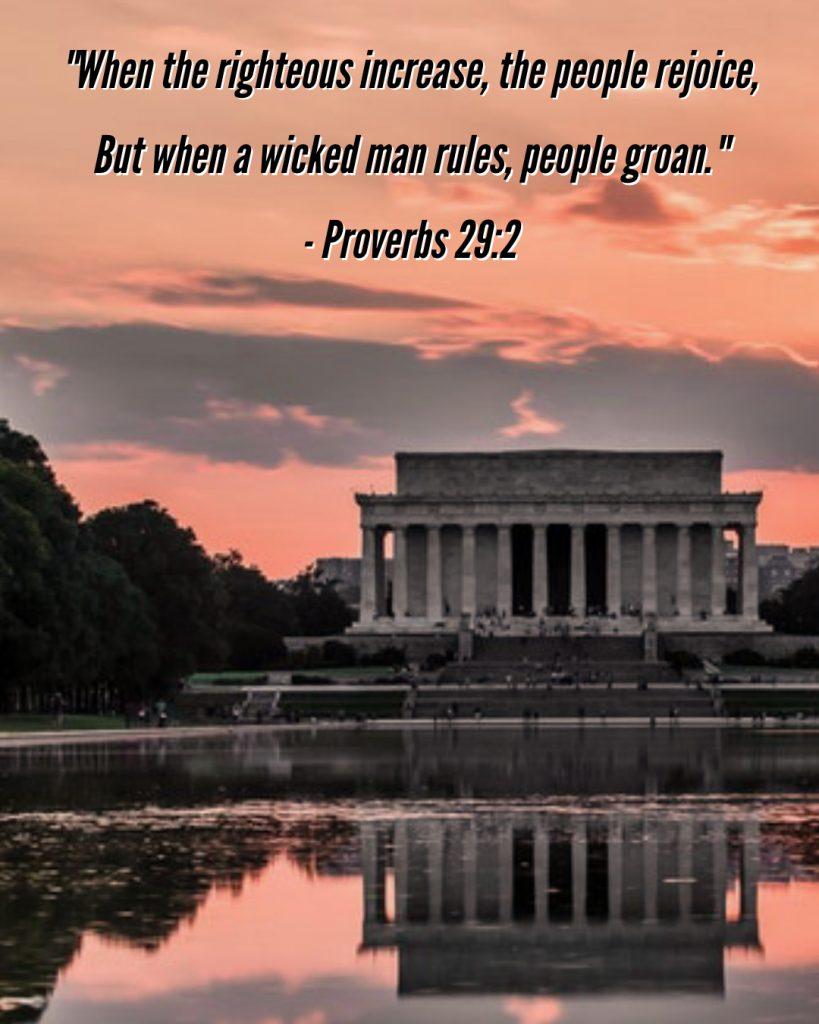
Pray for your government to practice justice, and be a source for Jesus’ justice3
Use your God-given influence to bring justice and hope. Solomon proclaimed that the righteous can bring the people joy while the wicked can bring sorrow (Prov. 28:12; 11:10-11). Jesus fulfilled the prophecy of the Messiah bringing hope and comfort to people in need (Lk. 4:18-19; Is. 61:1-3; Ps. 146:7-9). In whatever circle of influence that God has given you, be a source of His justice, mercy, grace, and hope “He has told you, mortal one, what is good; and what does the LORD require of you but to do justice, to love kindness, and to walk humbly with your God?” (Micah 6:8). “Learn to do good; seek justice, rebuke the oppressor, obtain justice for the orphan, plead for the widow’s case.” (Is. 1:17; Jam. 1:27; Prov. 31:8-9). You can also pray for leaders (1 Tim. 2:1-2).
To be a source of God’s justice, avoid people who may corrupt your walk. Those who keep company with physically or spiritually adulterous people eventually fall into sin and either physical or spiritual poverty. They then can no longer be an effective force for justice. They also bring dishonor to their parents. “3 A man who loves wisdom makes his father glad, but he who involves himself with prostitutes wastes his wealth.” (Prov. 29:3). “Children of any age bring happiness to their parents when they love and live wisdom. It gives the parents a justified pride in their children and gives peace about their children’s future. A companion of harlots wastes his wealth: This is one example of a foolish life, someone who chooses harlots and others of low character as their companions. This fool wastes his wealth on the harlots and other similar interests, showing they are the opposite of the one who loves wisdom.” (David Guzik on Prov. 29:3).4
Ungodly companions will frequently corrupt your walk. A child’s obedience to godly family instruction is so important to God that it is His Fifth Commandment (Ex. 20:12; Dt. 5:16). Children therefore honor their parents when they obey God’s wisdom (Prov. 10:1; 15:20; 17:25; 23:24-25; 28:7; 29:3). But keeping immoral companions eventually corrupts a believer’s walk. This compromises a believer’s ability to be a source for Jesus’ justice in the world. This also dishonors the believer’s parents. “I wrote to you in my letter not to associate with sexually immoral people;” (1 Cor. 5:9). “Do not be deceived: ‘Bad company corrupts good morals.”’ (1 Cor. 15:33). “Do not be mismatched with unbelievers; for what do righteousness and lawlessness share together, or what does light have in common with darkness?” (2 Cor. 6:14). “One who walks with wise people will be wise, but a companion of fools will suffer harm.” (Prov. 13:20).
God-fearing leaders frequently bring justice. While god-fearing leaders can bring peace, those who seek self-gain bring injustice. “4 The king gives stability to the land by justice, but a person who takes bribes ruins it.” (Prov. 29:4). “The phrase ‘By justice a king gives a country stability’ encapsulates the foundational role of justice in fostering a harmonious and thriving society. A leader who governs with equity and honesty paves the way for peace and order to prevail, ensuring the well-being of their people. Conversely, the stark warning of ‘But those who are greedy for bribes tear it down’ underscores the destructive nature of corruption and greed. When leaders prioritize personal gain over the common good, it inevitably leads to the downfall of a nation, plunging it into chaos and suffering.” (Reverend Michael Johnson on Prov. 29:4).5
Lead with Jesus’ example of justice and integrity. Solomon urged leaders to pray for God’s wisdom to lead with perfect justice. “By me kings reign, and rulers decree justice. By me princes rule, and nobles, all who judge rightly.” Prov. 8:15-16). “A Psalm of Solomon. Give the king Your judgments, God, and Your righteousness to the king’s son may he judge Your people with righteousness and Your afflicted with justice.” (Ps. 72:1-2). Like all godly wisdom, this begins with the fear of the Lord. “The God of Israel said it; the Rock of Israel spoke to me: ‘He who rules over mankind righteously, who rules in the fear of God,” (2 Sam. 23:3; Is. 32:1). Those who fail to fear the Lord are more likely to distort God’s justice by accepting bribes: “You shall not take a bribe, for a bribe blinds the clear-sighted and subverts the cause of the just.” (Ex. 23:8; Dt. 16:19; 2 Chr. 19:7). This type of evil leadership is an abomination to God. “It is an abomination for kings to commit wicked acts, because a throne is established on righteousness.” (Prov. 16:12; 28:15-16). You are Jesus’ ambassador (2 Cor. 5:22), and His light (Matt. 5:14). To avoid sin and stumbling others, He calls upon you to follow His righteous example: “so that you may approve the things that are excellent, in order to be sincere and blameless until the day of Christ; having been filled with the fruit of righteousness which comes through Jesus Christ, to the glory and praise of God.” (Phil. 1:11).
God’s perfect justice is corrupted with flattery, lies, and deceit. A person who uses flattery to persuade another may engage in deceit and may also inflame pride. These are the devil’s tools and undermine God’s perfect order. “5 A man who flatters his neighbor is spreading a net for his steps.” (Prov. 29:5). “We are first drawn to the word ‘flattereth.’ It suggests an insincere form of praise or compliments, which often masks ulterior motives. Flattering someone might feel comfortable or harmless. Still, it does not contribute to growth or honesty; instead, it acts as a shortcut that leads us away from genuine relationships. The net described in this verse symbolizes the entrapment created by deceitful words. Just as a net ensnares its prey, flattery can ensnare those who become overly confident or prideful. Once caught in that net, individuals may struggle to find their way out. This imagery reminds us of the pitfalls that soft words can bring, leading to disastrous outcomes for both parties. Hence, we should remain vigilant, recognizing the serious consequences of insincere praise.” (Christianitypath.com on Prov. 29:5).6
Flattery may cause pride and sin to spread. Like Solomon, David lamented those who spoke with deceitful flattery. “There is nothing reliable in what they say; their inward part is destruction itself. Their throat is an open grave; they flatter with their tongue.” (Ps. 5:9). “They speak lies to one another; they speak with flattering lips and a double heart.” (Ps. 12:2). Satan uses flattery to puff people up with pride. When you accept flattery, sin can quickly spread in your life like yeast in bread. When you flatter others instead of giving the credit to God, you can also cause sin to spread amongst others: “A lying tongue hates those it crushes, and a flattering mouth works ruin.” (Prov. 26:28; 28:23). “The wicked, in the haughtiness of his countenance, does not seek Him. All his thoughts are, ‘There is no God.’” (Ps. 10:4). “For such people are slaves, not of our Lord Christ but of their own appetites; and by their smooth and flattering speech they deceive the hearts of the unsuspecting.” (Ro. 16:18). “Pride goes before destruction, and a haughty spirit before stumbling.” (Prov. 16:18; 18:12; Matt. 23:12; Lk. 14:11).
God will judge unrepentant sin. While God protects those who repent, sin will ensnare those who embrace evil. “6 By wrongdoing an evil person is ensnared, but the righteous sings and rejoices.” (Prov. 29:6). “The peril of a sinful way. There is not only a punishment at the end of it, but a snare in it. One sin is a temptation to another, and there are troubles which, as a snare, come suddenly upon evil men in the midst of their transgressions; nay, their transgression itself often involves them in vexations; their sin is their punishment, and they are holden in the cords of their own iniquity, … but righteous men are kept from those snares, or delivered out of them; they walk at liberty, walk in safety, and therefore they sing and rejoice.” (Matthew Henry on Prov. 29:6).7
Unrepentant sinners will reap what they sow. Jesus warns believers to stay on His narrow path to find protection (Matt. 7:13-14). Unrepentant sinners will one day reap what they sow. For example, Haman died with the trap that he set for Mordecai (Esther 7:10). “One who sows injustice will reap disaster, and the rod of his fury will perish.” (Prov. 22:8). “One who digs a pit will fall into it, and one who rolls a stone, it will come back on him.” (Prov. 26:27). “He has dug a pit and hollowed it out, and has fallen into the hole which he made. His harm will return on his own head, and his violence will descend on the top of his own head.” (Ps. 7:15-16). “The nations have sunk down into the pit which they have made; in the net which they hid, their own foot has been caught.” (Ps. 9:15; 57:6). “One who digs a pit may fall into it, and a serpent may bite one who breaks through a wall.” (Ecc. 10:8). “You have plowed wickedness, you have harvested injustice, you have eaten the fruit of lies.” (Hos. 10:13a). “Do not be deceived, God is not mocked; for whatever a person sows, this he will also reap.” (Gal. 6:7).
3. Love: To Walk in Jesus’ Wisdom, Show Love to Others in Need. Prov. 29:7.
The fruit of your salvation should include love and compassion for the needy. In order to walk in Jesus’ wisdom, you must have love and concern to help people who are in need. “7 The righteous is concerned for the rights of the poor; the wicked does not understand such concern.” (Prov. 29:7). “Ignorance is not bliss, nor an excuse, when it comes to the poor. Wicked men do not think about them or make any effort to know their situations or troubles. But a righteous man considers the poor and explores their circumstances to learn what they need and how he can help. Ignorance is not bliss, nor an excuse, in this matter, for God will punish the selfish man that neglects to think about the poor and take care of them (Pr 21:13; 28:27). Selfish and stingy persons, who are the wicked of this proverb, do not think or care about the poor.” (LetGodbeTrue.com on Prov. 29:7).8

To walk in Jesus’ wisdom, show love and compassion by helping others in need9
Faith without compassion for others in need is dead. The Bible has harsh words for those who are selfish and have no concern for the poor. First, their religion is defiled. “Pure and undefiled religion in the sight of our God and Father is this: to visit orphans and widows in their distress, and to keep oneself unstained by the world.” (Jam. 1:27). Second, their faith may be “dead”. “If a brother or sister is without clothing and in need of daily food, and one of you says to them, ‘Go in peace, be warmed and be filled,’ yet you do not give them what is necessary for their body, what use is that? In the same way, faith also, if it has no works, is dead, being by itself.” (Jam. 2:15-17). Third, they have committed sins directly against Jesus. “For I was hungry, and you gave Me something to eat; I was thirsty, and you gave Me something to drink; I was a stranger, and you invited Me in; naked, and you clothed Me; I was sick, and you visited Me; I was in prison, and you came to Me.” (Matt. 25:35-36). Finally, the love of God is not evident in that person’s walk. “But whoever has worldly goods and sees his brother or sister in need, and closes his heart against him, how does the love of God remain in him? Little children, let’s not love with word or with tongue, but in deed and truth.” (1 Jo. 3:17-18).
4. Restraint: To Walk in Jesus’ Wisdom, Restrain Your Flesh. Prov. 29:8-11.
Restrain your tongue and only speak words of hope and healing. People who stir up unnecessary conflict as opposed to bringing hope and reconciliation in Jesus are not walking in His wisdom. “8 Arrogant people inflame a city, but wise people turn away anger.” (Prov. 29:8). “The term ‘scornful’ refers to those who mock or deride others, often leading to discord and strife within a community. Their actions can ensnare a city, suggesting that negativity and contempt can have far-reaching consequences, affecting not just individuals but entire societies. On the other hand, ‘wise men’ are depicted as those who possess the understanding and discernment to defuse tensions. They turn away wrath, implying that wisdom involves not just knowledge, but also the ability to navigate conflicts constructively. This verse serves as a reminder that our approach to disagreements can either escalate problems or foster harmony, making it crucial for us to cultivate wisdom in our interactions.” (BibleVerseExplained.com on Prov. 29:8).10
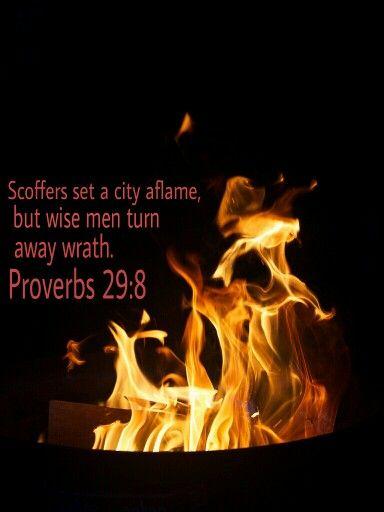
You cannot claim to walk in Jesus’ wisdom if you cannot control your tongue11
A person who misuses their tongue to cause unnecessary harm is not walking with Jesus. Believers are warned regarding the great damage that an unguarded tongue can inflict. “So also the tongue is a small part of the body, and yet it boasts of great things. See how great a forest is set aflame by such a small fire! And the tongue is a fire, the very world of unrighteousness; the tongue is set among our body’s parts as that which defiles the whole body and sets on fire the course of our life, and is set on fire by hell.” (Jam. 3:5-6). Unless a person is confronting sin through love, believers are called upon to use their words for peace and reconciliation. “Blessed are the peacemakers, for they will be called sons of God.” (Matt. 5:9; Ro. 12:18). “And the fruit of righteousness is sown in peace by those who make peace.” (Jam. 3:18). “And the work of righteousness will be peace, and the service of righteousness, quietness and confidence forever.” (Is. 32:17).
When attacked, respond with gentleness and calm. When you have sinned, confess your sins (Jam. 5:5). In circumstances where you face unfounded, angry, charges, forgive and do not respond in anger. “9 When a wise person has a controversy with a foolish person, the foolish person either rages or laughs, and there is no rest.” (Prov. 29:9). “If a wise person confronts the fool in court, the latter rages and scoffs (flies off the handle and rants and raves in an attempt to have the case tossed out of court) and there is no calm (that is, the fool will not stop). Wise people, however, calmly submit their case to arbitration, confident that the evidence-based claim will win in the long run. The proverb advises the disciple to ignore the irrational response of fools should they become involved in litigation with them.” (Bruce Waltke and Ivan De Silva on Prov. 29:9).12
Respond to even unfounded charges with gentleness and respect. When another person rejects your efforts at forgiveness and reconciliation, respond to their attacks with calmness and grace. “Do not answer a fool according to his foolishness, or you will also be like him. Answer a fool as his foolishness deserves, so that he will not be wise in his own eyes.” (Prov. 26:4-5). “A gentle answer turns away wrath, but a harsh word stirs up anger.” (Prov. 15:1). “but sanctify Christ as Lord in your hearts, always being ready to make a defense to everyone who asks you to give an account for the hope that is in you, but with gentleness and respect;” (1 Pet. 3:15). “Your speech must always be with grace, as though seasoned with salt, so that you will know how you should respond to each person.” (Col. 4:6). “You know this, my beloved brothers and sisters. Now everyone must be quick to hear, slow to speak, and slow to anger;” (Jam. 1:19).
Even when you are hated, respond with Jesus’ love. Those who are under the enemy’s control will be driven to hate what believers stand for. Believers must resist the temptation to respond with evil and instead show Jesus’ love for them. “10 People of bloodshed hate the blameless person, but the upright are concerned for his life.” (Prov. 29:10). “Because of the very difference in their lives, bloodthirsty men hate those who are upright, even as ‘Cain, who was of the wicked one, and slow his brother because his own works were evil, and his brother’s righteous’ (1 John 3:12). Holiness and godliness invariably provide the malice of wicked men, who see what is right and good as the condemnation of their own vile ways. The just, on the other hand, are glad to be what Cain was not – their brother’s keeper – seeking to preserve his life and care for his soul. This concern for the blessing of those about him is one of the first and strongest evidences that a man has been born of God.” (Ronald Young, Prov. 29:10).13
Respond to hatred with forgiveness and love. Because believers live in a fallen world, they should expect the world to hate them when they walk with Jesus (1 Jo. 15:18-19). The temptation will always exist to seek revenge when others hurt you. But believers must forgive their attackers to receive forgiveness. “For if you forgive other people for their offenses, your heavenly Father will also forgive you. But if you do not forgive other people, then your Father will not forgive your offenses.” (Matt. 6:14-15). Believers are further called upon to love and pray for their enemies. “But I say to you, love your enemies and pray for those who persecute you,” (Matt. 5:44; Lk. 6:27-29).
When you are angry, restrain your temper. A person who lashes out in anger does not walk in God’s wisdom. “11 A fool always loses his temper, but a wise person holds it back.” (Prov. 29:11). “The fool expresses his feelings openly and without restraint, often wearing his heart on his sleeve. On the contrary, a wise man displays a level of self-control and restraint, choosing to weigh his emotions before expressing them. The key to this verse lies in the contrast between the two types of people. The fool reacts impulsively, allowing his spirit to control his actions, while the wise person takes a step back, reflects, and chooses how he will respond.” (Jamie Wilson on Prov. 29:11).14
People who cannot control their anger are fools in God’s eyes. The Bible repeatedly warns believers to restrain their anger and show restraint when provoked. “One who is slow to anger has great understanding; but one who is quick-tempered exalts foolishness.” (Prov. 14:29). “A hot-tempered person stirs up strife, but the slow to anger calms a dispute.” (Prov. 15:18). “Do not make friends with a person given to anger, or go with a hot-tempered person,” (Prov. 22:24). “Do not be eager in your spirit to be angry, for anger resides in the heart of fools.” (Ecc. 7:9). “You know this, my beloved brothers and sisters. Now everyone must be quick to hear, slow to speak, and slow to anger; for a man’s anger does not bring about the righteousness of God.” (Jam. 1:19-20).
5. Righteousness: To Walk in Jesus’ Wisdom, Be Righteous. Prov. 29:12-15.
Leaders who give heed to lies and deceit spread evil to those who follow them. Leaders who are drawn to evil eventually corrupt the people who serve under them. “12 If a ruler pays attention to falsehood, all his ministers become wicked.” (Prov. 29:12). “The ruler represents those in positions of authority, whether it be a king, president, or any leader guiding a group of people. The verse suggests that when a ruler listens to falsehoods or dishonest information, it eventually leads to corruption among his officials. This indicates a domino effect, where the actions and decisions of a leader influence those around them. Listening to lies can create an environment where dishonesty thrives, overpowering truth and wisdom. It emphasizes the importance of discerning truth from falsehood, not just for the leader, but for the whole community or nation. When leaders fail to uphold this integrity, they pave the way for unrighteousness to seep into their circle, resulting in a breakdown of trust and moral standards.” (William David on Prov. 29:12).15
King Rehoboam caused a civil war after turning to wicked counselors. Following Solomon’s death, many people asked Rehoboam to change Solomon’s forced labor and taxation practices. Rehoboam at first wisely sought the advice of Israel’s elders. But he rejected their counsel when they wisely urged him to show compassion (1 Kgs. 12:1-8). Rehoboam then sought the advice of his young servants. His young servants knew Rehoboam and appealed to his vanity and pride by urging him to use oppression in response to the people’s complaints (1 Kgs. 12:9-11). Rehoboam then responded to the people’s complaints by threatening to punish them with labor and tax requirements far worse than any sacrifice that they had to make under Solomon (1 Kgs. 12:12-15). Rehoboam’s threats allowed Jeroboam to incite the northern tribes into breaking away from Judah to form the separate kingdom of Northern Israel (1 Kgs. 12:16-20).
Do not show favoritism to people based upon their wealth or status. Although worldly people favor the rich and powerful, God is impartial and fair. “13 The poor person and the oppressor have this in common: the Lord gives light to the eyes of both.” (Prov. 29:13). “In a world often divided by wealth and status, Proverbs 29:13 reminds us of a profound truth: before God, we are all equal. This verse highlights the divine justice that transcends human inequalities. Whether we find ourselves in abundance or need, the Lord illuminates our way, showing us the path of righteousness… This verse reveals the impartiality and justice of God. It teaches us that regardless of worldly status, God’s wisdom and guidance are offered to all.” (HearJesusNow.com on Prov. 29:13).16
Treat all people with love and respect without favoring rich and powerful people. God is impartial and shows no favoritism based upon a person’s wealth or status. “But from those who were of considerable repute (what they were makes no difference to me; God shows no favoritism)—well, those who were of repute contributed nothing to me.” (Gal. 2:6). Peter also said: “‘I most certainly understand now that God is not one to show partiality,”’ (Acts 10:34). He does not show partiality in judging sin (1 Pet. 1:17-19). “Who shows no partiality to the prominent, nor regards the rich as above the poor, since they are all the work of His hands?” (Job 34:19). God wants His people to have integrity in their dealings with each other the same way He was and is with them (Dt. 1:17; 10:17; 2 Chr. 19:7). Believers are also warned not to favor people based upon their status, wealth, race, or gender: “You shall do no injustice in judgment; you shall not be partial to the poor nor defer to the great, but you are to judge your neighbor fairly.” (Lev. 19:15).
Jesus calls upon believers to follow His righteous example by protecting people. As our example, Jesus reigns in truth and brings justice to those in need. “14 If a king judges the poor with truth, his throne will be established forever.” (Prov. 29:14). “The king that faithfully judgeth the poor,.... such a king was Solomon; and especially the Messiah, of whom he was a type, Psalm 72:1; his throne shall be established for ever; be secure to him as long as he lives, and to his posterity after; justice to all men, and mercy to the poor, are the support of a prince's throne;” (John Gill’s Commentary on Prov. 29:14).17
Jesus will reign with perfect righteousness. Jesus is our righteous judge (2 Tim. 4:8). “I can do nothing on My own initiative. As I hear, I judge; and My judgment is just, because I do not seek My own will, but the will of Him who sent Me.” (Jo. 5:30). “But even if I do judge, My judgment is true; for I am not alone in it, but I and the Father who sent Me.” (Jo. 8:16). While David, Solomon, and Israel’s other kings sinned, Jesus never will. His reign will be perfect, just, and righteous. “1 Then a shoot will spring from the stem of Jesse, and a Branch from his roots will bear fruit. 2 The Spirit of the Lord will rest on Him, the spirit of wisdom and understanding . . . with righteousness He will judge the poor, and decide with fairness for the humble of the earth; . . . 5 Also righteousness will be the belt around His hips, and faithfulness the belt around His waist.” (Is. 11:1-5). “There will be no end to the increase of His government or of peace, on the throne of David and over his kingdom, to establish it and to uphold it with justice and righteousness from then on and forevermore.” (Is. 9:7; 16:5). “Behold, a king will reign righteously, and officials will rule justly.” (Is. 32:1). ‘“Behold, the days are coming,’ declares the LORD, ‘When I will raise up for David a righteous Branch; and He will reign as king and act wisely and do justice and righteousness in the land.”’ (Jer. 23:5; Is. 24:15; 42:4; Zech. 9:9-10). Believers should respond by following His example.
To raise children in Jesus’ righteous example, they need discipline. Parents are stewards of God-given children. Thus, parents have an obligation to raise their children with loving discipline to help them become God-fearing believers. “15 The rod and a rebuke give wisdom, but a child who gets his own way brings shame to his mother.” (Prov. 29:15). “Left to himself (KJB) - The condition of one who has been pampered and indulged. The mother who yields weakly is as guilty of abandoning the child she spoils, as if she cast him forth; and for her evil neglect, there shall fall upon her the righteous punishment of shame and ignominy.” (Albert Barnes’ Notes on the Bible, Prov. 29:15).18
Believers should discipline children out of love. Solomon warned parents to be faithful stewards by disciplining their children. “24 He who withholds his rod hates his son, but he who loves him disciplines him diligently.” (Prov. 13:24; 22:6; 23:13-14). Failing to correct a child can again lead to a child feeling entitled and lacking self-discipline. But a loving parent should discipline children the way that God disciplines believers. “So you are to know in your heart that the LORD your God was disciplining you just as a man disciplines his son.” (Dt. 8:5). “Those whom I love, I rebuke and discipline; therefore be zealous and repent.” (Rev. 3:19). “Discipline your son while there is hope, and do not desire his death.” (Prov. 19:18). “Do not withhold discipline from a child; though you strike him with the rod, he will not die. You shall strike him with the rod and rescue his soul from Sheol.” (Prov. 23:13-14). “Train up a child in the way he should go, even when he grows older he will not abandon it.” (Prov. 22:6). But discipline should only be done out of love and not out of anger. “Fathers, do not provoke your children to anger, but bring them up in the discipline and instruction of the Lord.” (Eph 6:4). “Fathers, do not antagonize your children, so that they will not become discouraged.” (Col. 3:21).
6. Trust: To Walk in Jesus’ Wisdom, Put Your Trust in Him. Prov. 29:16-19.
Trust in God’s judgment of evil in His perfect timing. Satan is the temporary ruler of the world (Eph. 2:2; Jo. 12:31; 1 Jo. 5:19). When his evil is unrestrained, wickedness will increase. But Jesus has promised that He will return, overthrow the devil, and restore His perfect order. “16 When the wicked increase, wrongdoing increases; but the righteous will see their downfall.” (Prov. 29:16). “When the wicked are multiplied, transgression increases: There is something of a multiplication effect in the advance of wickedness. In some way, when the number of wicked people is doubled, then it seems transgression increases four or five times over ... The righteous will see their fall: This is welcome assurance when it seems that transgression increases. The righteous must not despair; God is still in control. Though the wicked are multiplied, God will not allow them to triumph in the end and they will fall.” (David Guzik on Prov. 29:16).19
Trust that evil will one day vanish before Jesus. Throughout the Bible, Jesus promises that evil will disappear under His judgment: “the wicked sprouted up like grass . . they might be destroyed forevermore.” (Ps. 92:7). “The grass withers, the flower fades, when the breath of the LORD blows upon it; the people are indeed grass!” (Is. 40:7). “For they will wither quickly like the grass, and decay like the green plants . . . For evildoers will be eliminated, but those who wait for the LORD, they will inherit the land.” (Ps. 37:2, 9). “As for man, his days are like grass; like a flower of the field, so he flourishes.” (Ps. 103:15). “but the rich person is to glory in his humiliation, because like flowering grass he will pass away. For the sun rises with its scorching heat and withers the grass; and its flower falls off and the beauty of its appearance is destroyed; so also the rich person, in the midst of his pursuits, will die out.” (Jam. 1:10-11). Thus, believers should put their trust in Jesus when evil becomes pervasive. Jesus has already won the war.
Disciplining children helps them to become God-fearing believers. Godly correction restores a wayward child, and it also brings the blessings of family joy. “17 Correct your son, and he will give you comfort; he will also delight your soul.” (Prov. 29:17). “Discipline, properly measured and administered, teaches a child to avoid wrongdoing and to do what is pleasing to the Lord and his parents (Proverbs 8:32–35; 29:15). A child needs to learn early to distinguish right from wrong. This instruction must begin in the home. Parents must not leave the responsibility to classroom teachers, pastors, or society at large. Parents will have no peace or joy if they fail to discipline their child early in life. It is futile and dangerous to wait until a son or daughter is a teenager to attempt to guide their moral path (Proverbs 13:24; 19:18).” (BibleRef.com on Prov. 29:17).20
David’s failure to discipline his children created chaos. David showed the consequences that follow when a parent fails to discipline his children. He failed to discipline his son Amnon after he raped his half-sister Tamar (2 Sam. 13:1-8). Besides a temporary exile, he failed to discipline his son Absalom when he avenged his sister by killing Amnon (2 Sam. 13:23-39). Because his children failed to respect him and because David failed to discipline them, his son Absalom led a rebellion against him (2 Sam. 15:1-12). Likewise, his son Adonijah tried to seize power. Solomon later killed Adonijah for his actions (1 Ki. 2:13-25). When a parent exercises godly discipline out of love, God commands children to submit to Spirit-led parental authority for their benefit: “Children, obey your parents in the Lord, for this is right.” (Ep. 6:1). Children, be obedient to your parents in all things, for this is well-pleasing to the Lord.” (Col 3:20). When a child obeys Spirit-led authority, it helps the child. It also brings joy to the parents. “A wise son makes a father glad, but a foolish man despises his mother.” (Prov. 15:20; 10:1; 17:21, 25).
Trust in God’s Word can also guide you to life and joy and keep you from darkness. Through faith and the Holy Spirit, God’s Word provides the vision or revelation to walk His truth. “18 Where there is no vision, the people are unrestrained, but happy is one who keeps the Law.” (Prov. 29:18). The word “ן” (ḥā·zō·wn) is translated in the NASB and the KJB as “vision.” In the NKJB and the NIV it is “revelation”. “Where a society lacks the sages’ wisdom to guide it, presumably due to a failure in rearing youth and in exemplary leadership, the people fall into anarchy. But where people communicate and obey the sages’ revelation, they become worthy of the pronouncement blessed (see 3:13) … ‘People are only truly happy when they earnestly and willingly subordinate themselves to the word of God.”’ (Bruce Waltke and Ivan De Silva on Prov. 29:18).21
Pray for the Holy Spirit to speak to you. Then trust Him when He guides you. God lamented that His people had brought destruction upon themselves because they did not know or listen to His Word. “My people are destroyed for lack of knowledge. Since you have rejected knowledge, I also will reject you from being My priest. Since you have forgotten the Law of your God, I also will forget your children.” (Hos. 4:6; Is. 5:13). ‘“Vision’ is actually spiritual understanding. It is the work of the Holy Spirit in the life of the believer to give him understanding of the Word of God. We read in 1 Samuel 3:1 ‘…And the word of the LORD was precious in those days; there was no open vision.’ The Word of the Lord is precious or rare. There was no understanding of the Word of God, and thereafter, it was precious in those days. God had to raise up Samuel, a seer, to meet that need…Spiritual discernment is one of the gifts that God has given to the church – that is, an understanding of the Word of God.” (J. Vernon McGee on Prov. 29:18).22
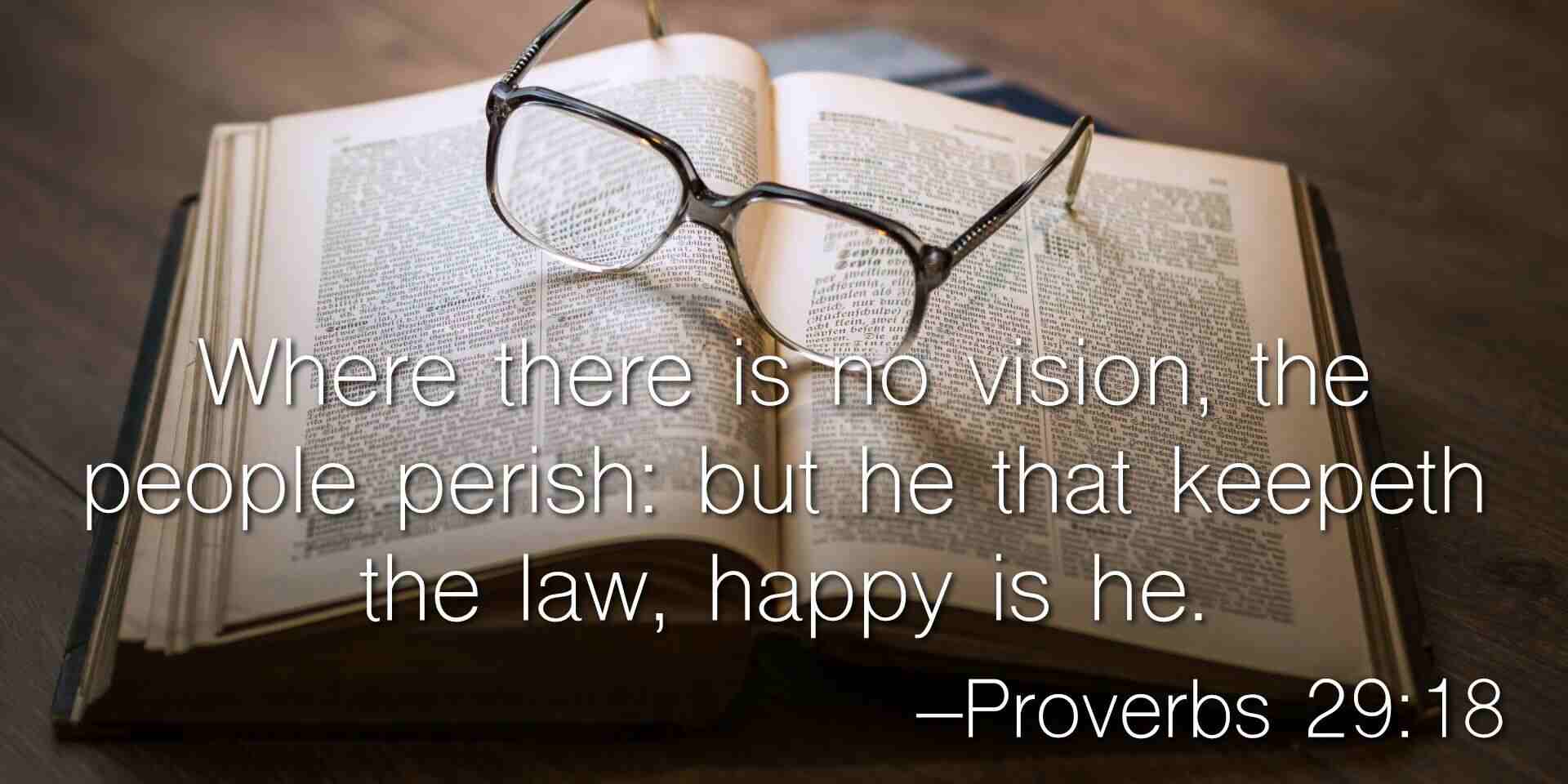
Trust in Jesus’ Word and the Holy Spirit to guide you23
Trust Jesus’ Word to transform your mind. Without a receptive heart, God’s Word is less likely to transform the person who hears it. “19 A slave will not be instructed by words alone; for though he understands, there will be no response.” (Prov. 29:19). “The Word of God will change the heart of any where it is received. Therefore the servant that Solomon is here speaking of must be a stubborn one, because though he understands, he will not allow it to change him.” (Ronald Young, Prov. 29:19).24
Submit to Jesus and pray for the Holy Spirit to transform your mind. It is sometimes not enough to read the Word to overcome worldly ways of thinking. Jesus also wants you to submit and pray for the Holy Spirit to also transform your mind. “But I say, walk by the Spirit, and you will not carry out the desire of the flesh.” (Gal. 5:16). “For the mind set on the flesh is death, but the mind set on the Spirit is life and peace,” (Ro. 8:6). “And do not be conformed to this world, but be transformed by the renewing of your mind, so that you may prove what the will of God is, that which is good and acceptable and perfect.” (Ro. 12:2). “and that you are to be renewed in the spirit of your minds,” (Eph. 4:23).
7. Fearing Jesus: To Walk in Jesus’ Wisdom, Avoid Evil. Prov. 29:20-27.
Fear Jesus and hate evil by controlling your tongue. The fear of the Lord is defined as hating evil (Prov. 8:13). You cannot claim to fear Jesus and hate evil, if you fail to restrain your tongue from saying unnecessarily hurtful things. “20 Do you see a person who is hasty with his words? There is more hope for a fool than for him.” (Prov. 29:20). “This verse warns us about the dangers of speaking hastily without fully considering our words. When we speak too quickly, without careful thought or understanding of the impact of our words, we risk saying things that are hurtful, wrong, or unwise. It suggests that it is better to remain silent and avoid speaking in haste, rather than saying something that may cause harm or regret later.” (Reverend Michael Johnson on Prov. 29:20).25
Guard your tongue from saying unnecessarily hurtful words. This verse is similar to Solomon’s warning about venting anger (Prov. 29:11). To walk in the Spirit, you must sometimes restrain your mouth from saying what you think. “One who guards his mouth protects his life; one who opens wide his lips comes to ruin.” (Prov. 13:3). “One who withholds his words has knowledge, and one who has a cool spirit is a person of understanding.” (Prov. 17:27). “Do not be quick with your mouth or impulsive in thought to bring up a matter in the presence of God. For God is in heaven and you are on the earth; therefore let your words be few.” (Ecc. 5:2). “You know this, my beloved brothers and sisters. Now everyone must be quick to hear, slow to speak, and slow to anger; for a man’s anger does not bring about the righteousness of God.” (Jam. 1:19-20).
Encourage others to fear Jesus by submitting to godly instruction. Just as you must submit to Jesus and obey Him as His devoted servant, you should also develop children, employees, servants or others under your authority with loving instruction and discipline. “21 One who pampers his slave from childhood will in the end find him to be rebellious.” (Prov. 29:21). “This verse teaches us that how we treat those under our care can significantly influence their behavior and expectations. A person who raises their servant or someone they manage with a heavy hand, indulging them and allowing them to avoid responsibility, runs the risk of creating an individual who lacks maturity and who will come to expect pampering and care from everyone around them. When we think of the word “servant,” it applies not just to household workers of ancient times but also to contemporary relationships such as employees, children, or even friends. Each interaction shapes their views, attitudes, and behaviors. As we nurture others, it’s important to engage them in a way that encourages growth, personal accountability, and independence. This principle can transform anyone into a capable individual who can stand on their own two feet.” (Christianitypath.com on Prov. 29:22).26
People in authority should lead and develop others through Jesus’ example. Unless they are asked to do evil, children, servants, and employees have an obligation to submit to authority. “Now I say, as long as the heir is a child, he does not differ at all from a slave, although he is owner of everything, but he is under guardians and managers until the date set by the father.” (Gal. 4:1-2; Eph. 6:5-9; Col. 3:22-25; 1 Tim. 6:1-2; Titus 2:9-10; 1 Pet. 2:18-20). In the case of children, they would be released from a parent’s authority upon becoming an adult. In the case of a servant, the servant had to be released upon the seventh year, if not sooner (Ex. 21:2-6; Lev. 25:39-43). To ensure that a servant did not fall back into financial bondage, the master had to give the servant resources. They could not leave “empty-handed.” (Dt. 15:12-18). In the same way, a parent, employer, or master had to ensure that the child or servant did not fall into “spiritual bondage.” This required the same kind of loving discipline that Jesus provides for His servants. “Those whom I love, I rebuke and discipline; therefore be zealous and repent.” (Rev. 3:19).
People who fail to control their anger do not hate evil. People who claim to submit to God’s authority must also remove feelings of anger to avoid sins against God and others. “22 An angry person stirs up strife, and a hot-tempered person abounds in wrongdoing.” (Prov. 29:22). “See here the mischief that flows from an angry, passionate, furious disposition. 1. It makes men provoking to one another: An angry man stirs up strife, is troublesome and quarrelsome in the family and in the neighborhood, blows the coals, and even forces those to fall out with him that would live peaceable and quietly by him. 2. It makes men provoking to God: A furious man, who is wedded to his humors and passions, cannot but abound in transgressions. Undue anger is a sin which is the cause of many sins; it not only hinders men from calling upon God’s name, but it occasions their swearing, and cursing, and profaning God’s name.” (Matthew Henry on Prov. 29:22).27
People who fail to control their anger will face God’s discipline or judgment. To God, an angry person who stirs up strife is a fool. “A quick-tempered person acts foolishly, and a person of evil devices is hated.” (Prov. 14:17). People who lash out in hatred and fail to repent also face God’s judgment. “But I say to you that everyone who is angry with his brother shall be answerable to the court; and whoever says to his brother, ‘You good -for-nothing,’ shall be answerable to the supreme court; and whoever says, ‘You fool,’ shall be guilty enough to go into the fiery hell.” (Matt. 5:22). “Everyone who hates his brother or sister is a murderer, and you know that no murderer has eternal life remaining in him.” (1 Jo. 3:15). Thus, unless you are seeking to stop evil, believers must put away all forms of anger. “All bitterness, wrath, anger, clamor, and slander must be removed from you, along with all malice.” (Eph. 4:31). “But now you also, rid yourselves of all of them: anger, wrath, malice, slander, and obscene speech from your mouth.” (Col. 3:8).
Prideful people fail to show that they fear God by hating evil. People who are prideful are not walking in Jesus’ wisdom. They face discipline or judgement, and they ruin their own reputation. “23 A person’s pride will bring him low, but a humble spirit will obtain honor.” (Prov. 29:23). “Shall bring him low, because both God and man conspire against him, and abhor him …the humble in spirit shall hold their honour, shall be honoured by God and men. Thus honour, like a shadow, flees from them that pursue it, and follows them who flee from it.” (Matthew Poole’s Commentary on Prov. 29:23).28
Humility brings honor. Pride is one of the things that God “hates” (Prov. 6:16-17). God therefore condemns all pride. “When pride comes, then comes dishonor; but with the humble there is wisdom.” (Prov. 11:2). “Everyone who is proud in heart is an abomination to the Lord; be assured, he will not go unpunished …Pride goes before destruction, and a haughty spirit before stumbling.” (Prov. 16:5,18). To be honored in your relationships with God and others, be humble. “Before destruction the heart of a person is haughty, but humility goes before honor.” (Prov. 18:12). “For the LORD is exalted, yet He looks after the lowly, but He knows the haughty from afar.” (Ps. 138:6).
Fear Jesus and hate evil by avoiding evil people. Believers who choose to become friends with evil people may become compromised in their walk and fail to act as Jesus’ salt and light. “24 One who is a partner with a thief hates his own life; he hears the oath but tells nothing.” (Prov. 29:24). “This verse from Proverbs highlights the consequences of associating with dishonest or wicked individuals. It begins with a statement about the partner of a thief, someone who consorts with those who steal. The essence of the verse suggests that being involved in dishonest activities can have grave implications on one’s life. A person who is complicit in wrongdoing hears the repercussions and the curses that come from such acts but chooses to remain silent. When we share in the company of those who engage in misconduct, we not only put ourselves at risk but also compromise our moral integrity. Loyalty to dishonest friends can lead us down paths that damage our reputations and relationships. This teaching serves as a reminder for us to carefully consider those with whom we associate, guiding our decisions about who to call our friends and partners.” (Jamie Wilson on Prov. 29:24).29
Avoid becoming unequally yoked with people who may corrupt you. God condemns those who associate with immoral people. “When you see a thief, you become friends with him, and you associate with adulterers.” (Ps. 50:18). Under the Law, every believer was required to offer truthful testimony if another engages in sin. “Now if a person sins after he hears a public order to testify when he is a witness, whether he has seen or otherwise known, if he does not tell it, then he will bear his punishment.” (Lev. 5:1). But a person who makes an unrepentant immoral person their friend, will frequently feel tempted to stay silent about the other person’s sins. Such a person fails to act as Jesus’ salt, which is an irritant in the wound of sin (Matt. 5:13). Even worse, an immoral friend frequently corrupts the believer’s walk as well. “Do not be deceived: ‘Bad company corrupts good morals.”’ (1 Cor. 15:33). “One who walks with wise people will be wise, but a companion of fools will suffer harm.” (Prov. 13:20; Ps. 1:1). “Do not be mismatched with unbelievers; for what do righteousness and lawlessness share together, or what does light have in common with darkness?” (2 Cor. 6:16).
The fear of the Lord does not include fearing evil people. When believers fear people, they frequently become filled with the sins of fear and doubt. To avoid such fear, believers need to place their trust in only Jesus. “25 The fear of man brings a snare, but one who trusts in the Lord will be protected.” (Prov. 29:25). “The confusion and wretchedness in which the fear of what men can do entangles us, is contrasted with the security of one, who not only ‘fears’ the Lord, so as to avoid offending Him, but trusts in Him as his protector and guide.” (Albert Barnes’ Notes on the Bible, Prov. 29:25).30

When you are under attack, fear Jesus alone and take refuge in Him31
In the face of evil, put your trust in Jesus by taking refuge in Him, and He will become your shield. When he walked with God, David proclaimed in faith, “When I am afraid, I will put my trust in You. In God, whose word I praise, in God I have put my trust; I shall not be afraid. What can mere mortals do to me?” (Ps. 56:3-4). The author of the book of Hebrews repeated this psalm to state the confidence that you can have when you trust in Jesus: “so that we confidently say, ‘The LORD is my helper, I will not be afraid. What will man do to me?” (Heb. 13:6). Jesus also promises to be a shield to all who submit to Him: “He is a shield to all who take refuge in Him.” (2 Sam. 22:31; Prov. 30:5).
You cannot claim to fear Jesus if you place your trust in people. Just as you should not fear powerful people, you also should not put your trust in them. Instead, place your trust in Jesus. “26 Many seek the ruler’s favor, but justice for mankind comes from the Lord.” (Prov. 29:26). “Men study to please their rulers, and to ensure their favour, by their obliging behaviour, humble petitions, and various other means, supposing that to be the only way to procure either right or preferment; but every man’s judgment cometh from the Lord — The decision of his cause, and the success of all his endeavours, depend wholly upon God, who rules and inclines the minds and hearts of princes and governors, as well as of other men, as it pleaseth him.” (Joseph Benson on Prov. 29:26).32
Powerful people cannot offer salvation and can only offer limited help. Many people place their hope in charismatic or powerful politicians in times of need. But no person can offer what Jesus offers. “Do not trust in noblemen, in mortal man, in whom there is no salvation.” (Ps. 146:3). “It is better to take refuge in the LORD than to trust in people. It is better to take refuge in the LORD than to trust in noblemen.” (Ps. 118:8-9). “Take no account of man, whose breath of life is in his nostrils; For why should he be esteemed?” (Is. 2:22). People who place their trust in other people over God are in fact cursed. “This is what the LORD says: ‘Cursed is the man who trusts in mankind and makes flesh his strength, and whose heart turns away from the LORD.”’ (Jer. 17:5).
Fear Jesus by avoiding compromise with evil. In Solomon’s final proverb, he highlighted that god-fearing people should abhor and avoid associations with evil. “27 An unjust person is an abomination to the righteous, and one who is upright in the way is an abomination to the wicked.” (Prov. 29:27). “This great moral contrast, marked and universal, is a fitting close to the book. The word ‘abomination’ (toebah) occurs more than twenty times in the Proverbs; it is appropriate here because the good man looks upon the sinner as the enemy of God, … He that is upright in the way is abomination to the wicked; because he is a standing reproach to him, and by every tone and look and action seems to express his condemnation…” (Pulpit Commentary on Prov. 29:27).33
Be Jesus’ light to the lost. Jesus is the light of the world (Jo. 8:12). His light shines through you (Matt. 5:14-16). But many will resent you when your light exposes their sins. “For everyone who does evil hates the Light, and does not come to the Light, so that his deeds will not be exposed.” (Jo. 3:20). When this happens, you must avoid the temptation to compromise with sin to find acceptance. “Love must be free of hypocrisy. Detest what is evil; cling to what is good.” (Ro. 12:9). If you become compromised by sin, your ability to convict sinners is impaired. “You are the salt of the earth; but if the salt has become tasteless, how can it be made salty again? It is no longer good for anything, except to be thrown out and trampled underfoot by people.” (Matt. 5:13).
Image credit: Wisdom of the Day from Proverbs 29↩︎
Proverbs 29:5 Meaning & Explanation (with Related Verses) - Christianity Path↩︎
Proverbs 29 Commentary - Matthew Henry Commentary on the Whole Bible (Complete) | Bible Study Tools↩︎
Image credit: The poor – Diocese of Darwin↩︎
Proverbs 29:8 - Meaning, Context, and Spiritual Reflection↩︎
Image credit: Pin on Book of Proverbs 29 - 31↩︎
B. Waltke and I. De Silva, Proverbs, A Shorter Commentary, (Grand Rapids, MI: Wm. B. Eerdmans Publishing Co., 2021), p. 404 (italics in original).↩︎
R. Young, Proverbs, A Commentary on the Book of Proverbs (SureWord Publications, Baltimore, MD, 2005), p. 383-84.↩︎
B. Waltke and I. De Silva, Proverbs, A Shorter Commentary, (Grand Rapids, MI: Wm. B. Eerdmans Publishing Co., 2021), p. 407 (italics in original), quoting F. Delitizsch, Proverbs, p. 432.↩︎
J. Vernon McGee, Thru the Bible, Commentary Series, Proverbs (Thomas Nelson, Inc., Nashville TN 1991), pgs. 241↩︎
Image credit: Proverbs 29:18 — Berea Project↩︎
R. Young, Proverbs, A Commentary on the Book of Proverbs (SureWord Publications, Baltimore, MD, 2005), p. 386..↩︎
Proverbs 29:21 Meaning & Explanation (with Related Verses) - Christianity Path↩︎
Proverbs 29 Commentary - Matthew Henry Commentary on the Whole Bible (Complete) | Bible Study Tools↩︎
Image credit: Fear of Man - Proverbs 29:25 - NewCREEations↩︎