Proverbs 30: Lessons for Finding and Walking Jesus’ Wisdom
Introduction: Proverbs 30 restates a conversation between Agur and Ithiel and Ucal about finding Yahweh’s wisdom. Some Jewish scholars believed that Agur was Solomon. But there is no proof of that. The style of Proverbs 30 also does not match Solomon’s proverbs. These three individuals may have instead been gentile foreigners who converted to accept Yahweh as their God (Thomas Thomason Perowne, Cambridge Bible for Schools and Colleges, Prov. 30:1).1 God likely told Proverbs 30 through unknown individuals to reveal an important lesson: His wisdom is freely available to all. You don’t need to be a famous person or an elite scholar to access it. All you need is Jesus. You can find and walk in Jesus’ wisdom through: (1) His Word, (2) contentment with His provision, (3) fearing Him by hating evil, (4) submitting to Him, (5) obedience, (6) trusting Him, and (7) turning to Him for the strength to serve Him in humility.
First, in verses one through six, Agur professed that he was ignorant of Yahweh’s wisdom. But he revealed that Yahweh’s wisdom is available through God’s Son who ascended and descended from heaven. Jesus came to fulfill this promise. His wisdom is freely available through His Word and prayer. Second, in verses seven through nine, Agur asked for neither riches nor poverty. He asked for the power to be content with Yahweh’s provision. Jesus gives you the power to be content and walk in His wisdom. Third, in verses 10 through 17, Agur listed several types of evil for believers to avoid. The theme of Proverbs is to fear the Lord, which is defined as hating evil (Prov. 8:13). To walk in Jesus’ wisdom, you also need to fear Him by hating what He defines as evil in His Word. Fourth, in verses 18 through 20, Agur expressed his marvel at the unfathomable wisdom of the Creator. To maintain your walk with Jesus, you must also submit to His wisdom as being greater than your own, even when you do not understand it. Fifth, in verses 21 through 23, Agur warned against the evils that come from challenging Yahweh’s order. To walk in Jesus’ wisdom, you must also obey His perfect will as stated in His Word and as revealed through the Holy Spirit. Sixth, in verses 24 through 28, Agur used examples of small insects and animals to emphasize the importance of trusting Yahweh and diligently serve Him with others. To walk in Jesus’ wisdom, He also wants you to diligently be serving under His authority, working in unity with other believers. Finally, in verses 29 through 33, Agur gives examples of how Yahweh can give power to His creation. To walk in Jesus’ wisdom, He wants you to seek His strength to serve in humility for His glory and not your own.
1. Jesus’ Word: Jesus Fulfilled Agur’s Prophecy. His Wisdom is Available to All Who Study His Word and Pray for the Holy Spirit’s Guidance. Prov. 30:1-6.
Wisdom from the “God’s Son” is available to all who humble themselves. Agur, a man of no known fame, began by professing his lack of knowledge of Yahweh’s wisdom. He asked for God’s Son who ascended into heaven to provide it. “1 The words of Agur the son of Jakeh, the pronouncement. the man declares to Ithiel, to Ithiel and Ucal: 2 I am certainly more stupid than any man, and I do not have the understanding of a man; 3 nor have I learned wisdom, nor do I have the knowledge of the Holy One. 4 Who has ascended into heaven and descended? Who has gathered the wind in His fists? Who has wrapped the waters in His garment? Who has established all the ends of the earth? What is His name or His Son’s name? Surely you know!” (Prov. 30:1-4). “This Scripture is a proof of Christ’s being the eternal Son of God; of his equality with his divine Father as such, their name and nature being alike ineffable; of his co-existence with his Father as such; and of his omnipresence and omnipotence, expressed by the phrases here used of ascending, &c. and of his distinct personality from the Father; the same question being distinctly put of him as of the Father.” (John Gill on Prov. 30:1-4).2
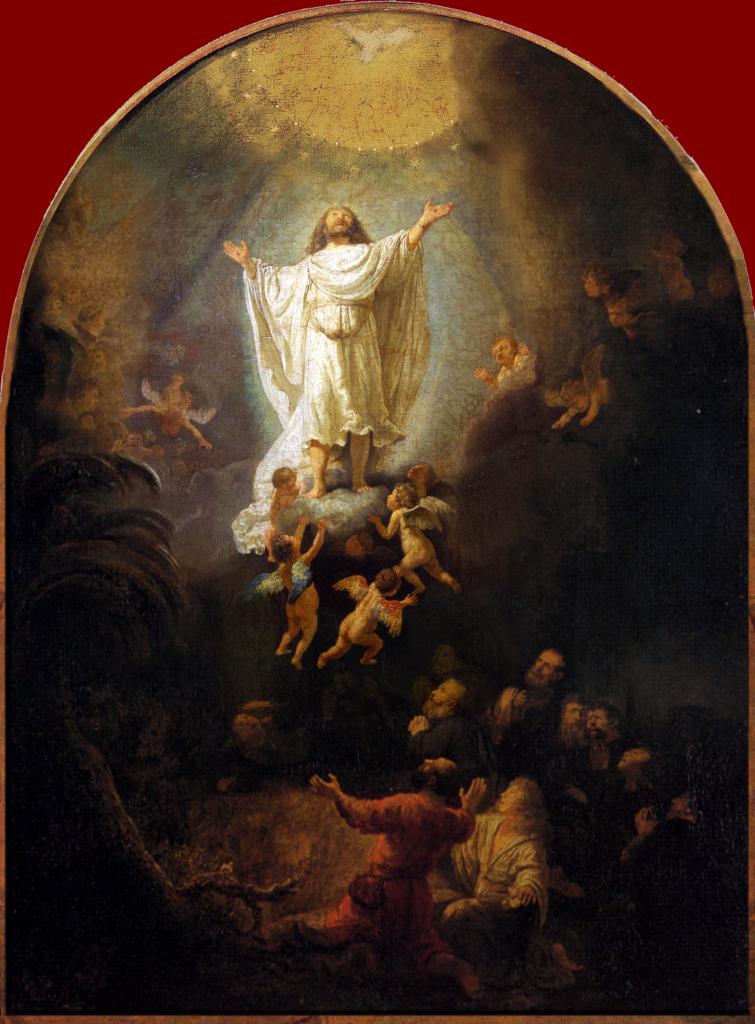
Rembrandt Harmenaz van Rijn (1606 – 1669 A.D.) (oil painting “The Ascension”)3
True wisdom is found through God and not in worldly intelligence. Possibly as a gentile, Agur professed his lack of knowledge compared to other Jews. “2 I am certainly more stupid than any man, and I do not have the understanding of a man; 3 nor have I learned wisdom, nor do I have the knowledge of the Holy One. ” (Prov. 30:2-3). Some might feel that they are well educated and therefore not like Agur. But you cannot rely on your own intellect to gain godly wisdom (Prov. 3:5-6; Jer. 9:23). Instead, like Agur, you must be humble. “Take care that no one deceives himself. If anyone among you thinks that he is wise in this age, he must become foolish, so that he may become wise. For the wisdom of this world is foolishness in the sight of God…” (1 Cor. 3:18-19a). “For the foolishness of God is wiser than mankind, and the weakness of God is stronger than mankind.” (1 Cor. 1:25). Thus, Solomon also confessed that he could not be wise on his own. “I tested all this with wisdom, and I said, ‘I will be wise,’ but wisdom was far from me.” (Ecc. 7:23). Job also stated that true wisdom does not come from mankind. “But where can wisdom be found? And where is the place of understanding? “Mankind does not know its value, nor is it found in the land of the living.” (Job 28:12-13).
The fear of the Lord and the understanding of God’s wisdom include humility. Solomon also made clear that the fear of the Lord is the first step to learning Yahweh’s wisdom. “The fear of the LORD is the beginning of knowledge; fools despise wisdom and instruction.” (Prov. 1:7). The fear of the Lord is defined as hating evil, which includes pride (Prov. 8:13). Thus, like Agur, humility is needed to understand godly wisdom.
Jesus fulfilled Agur’s prayer to God’s Son who offers wisdom to all. Agur sought wisdom from “God’s son” who “ascended and descended from heaven”. “4 Who has ascended into heaven and descended? … What is His name or His Son’s name? Surely you know!” (Prov. 30:4). Jesus is the only person who fulfills this description. “No one has ascended into heaven, except He who descended from heaven: the Son of Man.” (Jo. 3:13). Agur also described God’s Son as the Creator. “Who has established all the ends of the earth?” (Prov. 30:4). Jesus again uniquely meets this description (Jo. 1:1-3; Col. 1:16-17). Solomon stated that true wisdom comes from “Yahweh”. “For the LORD gives wisdom; from His mouth come knowledge and understanding.” (Prov. 2:6) But Jesus revealed that Yahweh (the great “I AM”) is another name for Him (Jo. 8:58; Ex. 3:14). Jesus is the incarnate wisdom of God. “But it is due to Him that you are in Christ Jesus, who became to us wisdom from God, and righteousness and sanctification, and redemption,” (1 Cor. 1:30). “in whom are hidden all the treasures of wisdom and knowledge.” (Col. 2:3). Whenever you need His wisdom, you only need to read His Word and pray in humility. “But if any of you lacks wisdom, let him ask of God, who gives to all generously and without reproach, and it will be given to him.” (Jam. 1:5).
Jesus’ wisdom also protects you. In addition to being our revealed wisdom, Jesus’ Word offers you protection. “5 Every word of God is pure; He is a shield to those who take refuge in Him.” (Prov. 30:5). ‘“Word’ is here imrah, which does not occur elsewhere in our book, which is the case also with Eloah, the term used for ‘God.’ Every declaration of God in the inspired record, the Torah, is pure, as if refined in the fire (Psalm 18:30).… God’s words are true, sincere, with no mixture of error, certain of accomplishment (comp. Psalm 12:6; Psalm 119:140). He is a shield. He is perfect protection to all those who, relying on the word of revelation, fly to him for refuge (see on Proverbs 2:7). The knowledge of God is obtained in two ways - by his revelation in his Word, and by the experience of those who trust in him.” (Pulpit Commentary on Prov. 30:5).4

Take refuge in Jesus and trust in His Word to protect you when you are attacked5
Jesus will be your shield when you take refuge in Him. David also promised that Yahweh is our shield. But He will not be your shield unless you take refuge in Him. “As for God, His way is blameless; the word of the LORD is refined; He is a shield to all who take refuge in Him.” (Ps. 18:30; 2 Sam. 22:31). “The words of the LORD are pure words; like silver refined in a furnace on the ground, filtered seven times.” (Ps. 12:6).
Jesus will severely judge those who add to or modify His Word. Because Jesus’ Word is our revealed wisdom and protection, He will judge any who try to change it or preach a new or modified gospel. “6 Do not add to His words or He will rebuke you, and you will be proved a liar.” (Prov. 30:6). “The Bible is totally sufficient for all righteousness, wisdom, and truth (II Tim 3:16-17; II Pet 1:19-21). There is no need for further revelation, human rationalization, or religious tradition (I Tim 6:3-5,20-21). Adding your thoughts to His inspired words is only arrogance and folly (Deut 4:2; 12:32; Matt 28:20). Since He has magnified His word above all His name, He will not take any profane additions lightly (Ps 138:2). He will judge men severely for adding their lying thoughts to His pure words (Pr 30:5; Re 22:18) … But Bible corrupters have been around for a long time (II Cor 2:17). They have added to and taken away from the Scriptures from the beginning, when Satan began his conquest of the human family by altering the words of God to Eve (Gen 3:1-6). And they are worse today than ever, as Paul warned Timothy (I Tim 4:1-3; II Tim 3:13) … Seventh Day Adventists add the visions of Ellen Harmon. The Mormons add the plagiarized fantasies of Joseph Smith. The Jehovah’s Witnesses add the failed forecasts of the perjured Charles Russell.” (LetGodbeTrue.com on Prov. 30:6).6
Anyone who adds to or modifies Jesus’ Word will be cursed. Augur’s warning against adding to Yahweh’s Word is repeated in the New Testament. Any person or organization that does this is “cursed”. “But even if we, or an angel from heaven, should preach to you a gospel contrary to what we have preached to you, he is to be accursed!” (Gal. 1:8) “I testify to everyone who hears the words of the prophecy of this book: if anyone adds to them, God will add to him the plagues that are written in this book; and if anyone takes away from the words of the book of this prophecy, God will take away his part from the tree of life and from the holy city, which are written in this book.” (Rev. 22:18-19).
2. Contentment: To Walk in Jesus’ Wisdom, be Content. Prov. 30:7-9.
Live modesty to follow Jesus. After receiving Jesus’ wisdom, living a modest life helps believers to depend upon Him and stay on His narrow path. “7 Two things I have asked of You; do not refuse me before I die: 8 Keep deception and lies far from me, give me neither poverty nor riches; feed me with the food that is my portion, 9 So that I will not be full and deny You and say, ‘Who is the Lord?’ And that I will not become impoverished and steal, and profane the name of my God.” (Prov. 30:7-9). ‘“Two things’ look ahead to the numerical sayings in vv. 10-31 …His reasons for the golden mean are that he neither disowns I AM nor dishonors his name. On the one hand, if he has too much (otherwise I may be stated), even Agur may dissemble (act against his better knowledge) and haughtily ask, ‘Who is I AM?’- that is, say, ‘I have no need to depend on I AM or reason to obey him’ (cf. Deut. 8:12-14). On the other hand, if Agur became indigent (I may become poor) he would need to steal to survive and so do violence to the name of (a metaphor for defaming)…God. His stealing would imply he does not trust God to provide for his needs and that he is a hypocrite. In sum, the glory of God, not his own need, motivates Agur’s two requests.” (Bruce Waltke and Ivan De Silva, Prov. 30:7-9).7
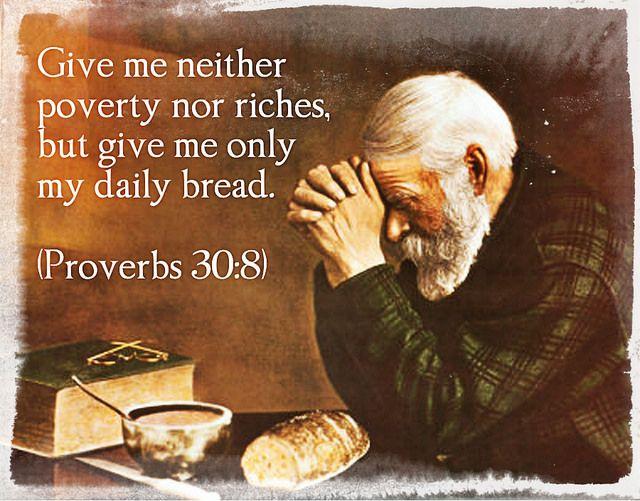
Live modestly and pray for Jesus to provide for your daily needs, not your wants.8
Depend upon Jesus, not your wealth. Jesus warns believers to avoid the sin of greed (Lk. 12:15-21). Those who trust in wealth over Jesus ultimately face disappointment, discipline or judgment (Jam. 5:1-3; Prov. 11:28). Believers should instead serve Jesus and store up their treasures in heaven, not on Earth. “Do not store up for yourselves treasures on earth, where moth and rust destroy, and where thieves break in and steal. But store up for yourselves treasures in heaven, where neither moth nor rust destroys, and where thieves do not break in or steal;” (Matt. 6:19-20). “Instruct those who are rich in this present world not to be conceited or to set their hope on the uncertainty of riches, but on God, who richly supplies us with all things to enjoy. Instruct them to do good, to be rich in good works, to be generous and ready to share,” (1 Tim. 6:17-18).
Be content with Jesus’ provision. To avoid being pulled off your walk by the desires for money, believers are called upon to be content with Jesus’ provision. “Not that I speak from need, for I have learned to be content in whatever circumstances I am. I know how to get along with little, and I also know how to live in prosperity; in any and every circumstance I have learned the secret of being filled and going hungry, both of having abundance and suffering need.” (Phil. 4:11-12). “But godliness actually is a means of great gain when accompanied by contentment. For we have brought nothing into the world, so we cannot take anything out of it, either.” (1 Tim. 6:6-7; Heb. 13:5). “As he came naked from his mother’s womb, so he will return as he came. He will take nothing from the fruit of his labor that he can carry in his hand.” (Ecc. 5:15). “He said, ‘Naked I came from my mother’s womb, and naked I shall return there. The LORD gave and the LORD has taken away. Blessed be the name of the LORD.”’ (Job 1:21).
Ask Jesus to provide for your daily needs, not wants. To be content, believers should only ask for their daily provision. “Give us this day our daily bread.” (Matt. 6:11; Lk. 11:3). Believers who acquire too much wealth risk placing their trust in their wealth and not in Jesus. “And again I say to you, it is easier for a camel to go through the eye of a needle, than for a rich person to enter the kingdom of God.” (Matt. 19:24; Mk. 10:25; Lk. 18:25). Thus, if you pray to get rich, Jesus is unlikely to answer your prayers (Jam. 4:3).
3. Fearing Jesus: To Walk in Jesus’ Wisdom, Fear Him by Hating What He Defines as Evil in His Word. Prov. 30:10-17.
Jesus’ wisdom never includes slander. The fear of the Lord is defined as hating evil (Prov. 8:13). After receiving Yahweh’s wisdom in response to his humble plea, Agur gave warnings to Ithiel and Ucal about avoiding evil. The first evil to avoid was slander, especially against those without the power to defend themselves. “10 Do not slander a slave to his master, or he will curse you and you will be found guilty.” (Prov. 30:10). “This proverb has to do with harsh, unfair criticism (malign) spoken to another about a third party not present. It shouldn’t be done, and doing it without the knowledge of the one spoken against makes it even worse. If it is wrong to do this in regard to a servant, it is even worse to do it against someone else … The one spoken against may rightfully speak a curse against the one who secretly maligns others. The curse may in fact come to pass if the one who maligns is found guilty of the offense.” (David Guzik, Prov. 30:10).9
Fools also fail to take God’s warnings about slander seriously. God warns believers not to slander others: “You shall not go about as a slanderer among your people; and you are not to jeopardize the life of your neighbor. I am the LORD.” (Lev. 19:16; Ex. 23:7) “‘You shall not steal, nor deal falsely, nor lie to one another.’” (Lev. 19:11; Ex. 23:1-2). Lying is so offensive to God that it violates the Ninth Commandment (Ex. 20:16; Dt. 5:20). Lies are also one of the sins that God “hates.” “There are six things which the Lord hates, yes, seven which are an abomination to Him: . . . a lying tongue, and . . . a false witness who utters lies, and one who spreads strife among brothers.” (Prov. 6:16-19). “Lying lips are an abomination to the Lord, but those who deal faithfully are His delight.” (Prov. 22:22). Satan is the father of all liars. When you lie, you are under his influence: “You are of your father the devil, and you want to do the desires of your father . . . Whenever he speaks a lie, he speaks from his own nature, for he is a liar and the father of lies.” (Jo. 8:44). Thus, no matter what the reason, never slander others.
Jesus’ wisdom never includes cursing or dishonoring parents. Agur next warned the generation of his day who cursed and dishonored their parents, serious sins before Yahweh. “11 There is a kind of person who curses his father and does not bless his mother.” (Prov. 30:11) “In a spiritual context, the verse calls attention to the importance of honoring one’s parents, a theme prevalent in many religious and ethical teachings. The act of cursing or disrespecting one’s father and mother is not merely a social faux pas; it signifies a deeper moral decay that can seep into the fabric of society. The phrase ‘does not bless its mother’ suggests a failure to recognize the sacrifices and love that parents often invest in their children. This lack of appreciation can lead to a cycle of negativity, potentially affecting future generations.” (BibleVerseExplained.com on Prov. 30:11).10
People who curse their parents will impose upon themselves a curse. The Fifth Commandment requires children to honor their parents (Ex. 20:12; Dt. 5:16; Lev. 19:3). This also requires that children obey their parents. “Children, obey your parents in everything, for this is pleasing to the Lord.” (Col. 3:20; Eph. 6:1-3; Matt. 15:4; 19:19; Mk. 7:10; 10:19; Lk. 18:20). Fools despise their parents. “A wise son makes a father glad, but a foolish man despises his mother.” (Prov. 15:20; 17:25). Those who curse their parents will themselves be cursed. “Cursed is one who treats his father or mother contemptuously.’ And all the people shall say, ‘Amen.’” (Dt. 27:16). “He who curses his father or his mother, his lamp will go out in time of darkness.” (Prov. 20:20).
Jesus’ wisdom never includes self-righteousness. Agur further warned against his generation’s sin of self-righteousness. “12 There is a kind who is pure in his own eyes, yet is not washed from his filthiness.” (Prov. 30:12). “Several lessons in this passage begin with the translated phrase ‘there are those.’ This can also be translated as ‘there is a generation,’ and comes from a single Hebrew word … Self-righteous individuals think they are morally and spiritually clean. Yet their self-centered, pretentious attitude makes them filthy in God’s sight. The Israelites in Isaiah's day thought adherence to religious ceremonies and sacrifices made them acceptable to God, but they were mistaken. God said they were sinful and loaded down with iniquity (Isaiah 1:4). He commanded: ‘Wash yourselves; make yourselves clean; remove the evil of your deeds from before my eyes; cease to do evil, learn to do good; seek justice, correct oppression; bring justice to the fatherless, plead the widow's cause’ (Isaiah 1:16–17). He issued an invitation to reasonable thought and repentance (Isaiah 1:18).” (BibleRef.Com on Prov. 30:12).11
Be humble because everyone is a sinner. All have sinned and fallen short before God (Ecc. 7:20; Rom. 3:23). Thus, God condemns those who claim to be self-righteous. “Who say, ‘Keep to yourself, do not come near me, for I am holier than you!’ These are smoke in My nostrils, a fire that burns all the day.” (Is. 65:5). Jesus condemned the Pharisee who thanked God that he was not like a tax collector who was praying near him (Lk. 18:11-12). He also condemned the self-righteous Pharisees who presented outward acts of piety while concealing the rebellion in their hearts against God. (Matt. 23:28).
Jesus’ wisdom never includes pride and arrogance. Agur also warned against his generation’s sin of sin. “13 There is a kind—oh how lofty are his eyes! And his eyelids are raised in arrogance.” (Prov. 30:13). “He speaks of them with amazement at their intolerable pride and insolence: ‘Oh how lofty are their eyes! With what disdain do they look upon their neighbors, as not worthy to be set with the dogs of their flock! What a distance do they expect everybody should keep; and, when they look upon themselves, how do they strut and vaunt like the peacock, thinking they make themselves illustrious when really they make themselves ridiculous!’ There is a generation of such, on whom he that resists the proud will pour contempt.” (Matthew Henry on Prov. 30:13).12
Take Jesus’ warnings about pride seriously. Pride leads to dishonor and judgment if a person fails to repent of this sin. “When pride comes, then comes dishonor; but with the humble there is wisdom.” (Prov. 11:2). “Everyone who is proud in heart is an abomination to the Lord; be assured, he will not go unpunished …Pride goes before destruction, and a haughty spirit before stumbling.” (Prov. 16:5,18). To be honored in your relationships with God and others, be humble. “Before destruction the heart of a person is haughty, but humility goes before honor.” (Prov. 18:12). “For the LORD is exalted, yet He looks after the lowly, but He knows the haughty from afar.” (Ps. 138:6).
Jesus’ wisdom also never includes mistreating the poor and defenseless. Agur further warned against his generation’s sin of mistreating the poor and helpless. “14 There is a kind of person whose teeth are like swords and his jaw teeth like knives, to devour the poor from the earth and the needy from among mankind.” (Prov. 30:14). ‘“Teeth as Swords’: This imagery represents aggression and predation. It signifies how some individuals may approach relationships with a harmful intent, using their power to dominate others. ‘Jaws as Knives’: The jaws serve as a further metaphor for the means by which harm is enacted. Just as knives cut, so too can the actions of the unscrupulous divide and destroy the lives of the needy. ‘Devouring the Poor’: This phrase highlights the urgency of the issue addressed in the verse. The poor are robbed of dignity and quality of life when they become targets of exploitation. Recognizing the most vulnerable among us should lead to an impetus to protect them.” (William David on Prov. 30:14).13
God condemns both those who abuse the poor and also those who fail to help them. Those who mistreat the poor face God’s judgment (Ps. 14:4; Amos 8:4; Micah 3:1-3). Those who proclaim to believe but fail to help the poor have a faith that may be “dead”. (Jam. 2:15-17). In both cases, unrepentant sinners face Jesus’ judgment. “For I was hungry, and you gave Me something to eat; I was thirsty, and you gave Me something to drink; I was a stranger, and you invited Me in; naked, and you clothed Me; I was sick, and you visited Me; I was in prison, and you came to Me.” (Matt. 25:35-36).
Those who give into covetousness will never be satisfied. As part of his condemnations, Agur also warned against greed and coveting. “15 The leech has two daughters: ‘Give’ and ‘Give.’ There are three things that will not be satisfied, four that will not say, ‘Enough’ 16 Sheol, the infertile womb, Earth that is never satisfied with water, and fire that never says, ‘Enough.’” (Prov. 30:15-16). “Proverbs 30:15-16, nestled within the sayings of Agur in the Book of Proverbs, paints a vivid picture of human nature and the unquenchable thirst for more. The imagery of the leech’s daughters crying out, ‘Give! Give!’ symbolizes insatiable greed, portraying those who are perpetually dissatisfied, always clamoring for additional gratification. This portrayal of relentless desire is further emphasized through the poetic structure of listing three things that are never satisfied, followed by a fourth that never says, ‘Enough!’ Each element – the grave, the barren womb, land thirsty for water, and fire never satiated – represents different forms of unfulfilled longing or need.” (Reverend Michael Johnson on Prov. 30:15-16).14
The love of money frequently leads to sorrow. Solomon warned that greed and covetousness can never be satisfied. “One who loves money will not be satisfied with money, nor one who loves abundance with its income. This too is futility.” (Ecc. 5:10). The love of money leads many “into ruin and destruction”: “But those who want to get rich fall into temptation and a trap, and many foolish and harmful desires which plunge people into ruin and destruction. For the love of money is a root of all sorts of evil, and some by longing for it have wandered away from the faith and pierced themselves with many griefs.” (1 Tim. 6:9-10). “Come now, you rich people, weep and howl for your miseries which are coming upon you. Your riches have rotted and your garments have become moth-eaten. Your gold and your silver have corroded, and their corrosion will serve as a testimony against you and will consume your flesh like fire. It is in the last days that you have stored up your treasure!” (Jam. 5:1-3; Lk. 12:15; Mk. 4:19).
God will judge the unsaved who curse their parents. Agur further warned about those who curse their parents and fail to repent. They will one day face God’s judgment. “17 The eye that mocks a father and scorns a mother, the ravens of the valley will pick it out, and the young eagles will eat it.” (Prov. 30:17). “A person that will not honor his or her parents takes upon himself or herself the curse that goes with their transgression. The judgment is hideous and without mercy.” (Ronald Young on Prov. 30:17).15
Take God’s warnings against cursing your parents seriously. God’s warning against cursing parents is repeated in the Torah. “And one who curses his father or his mother shall certainly be put to death.” (Ex. 21:17). “‘If there is anyone who curses his father or his mother, he shall certainly be put to death. He has cursed his father or his mother, and has brought his own death upon himself.” (Lev. 20:9; Dt. 21:18-21; Matt. 15:4).
4. Submission: To Maintain Your Walk with Jesus, Submit to His Wisdom as Greater Than Your Own, Even When You Do Not Understand It. Prov. 30:18-20.
Creation shows how God’s wisdom is both superior to and beyond our understanding. As another sign of his reverent fear, Agur stressed that Yahweh’s wisdom was beyond even his understanding. “18 There are three things which are too wonderful for me, four which I do not understand: 19 The way of the eagle in the sky, the way of a snake on a rock, the way of a ship in the middle of the sea, and the way of a man with a virgin.” (Prov. 30:18-19). “Four creations amaze Agur …I do not know them expresses his inability to fully appreciate such wonders … What amazes Agur about the way of an eagle is its artless, yet so artful, gravity-defying and seemingly endless circling high in the sky. The serpent on the rock amazes because it appears to glide over the rock despite lacking legs and anything to grasp. Agur probably chose a ship, not a fish, both to turn away from animal skills to human skills and for its gliding motion in common with the other three things. In the heart of the sea (the remote open seas) evokes the ship’s defiance of the unfathomable depths. Of a man with (or ‘in’) a virgin refers to …romantic love, limited in this case to one man and woman. All four ways demonstrate the paradox of freedom within boundaries.” (Bruce Waltke and Ivan De Silva, Prov. 30:18-19).16
You can trust that God’s wisdom is superior to yours. After initially questioning God, Job also confessed that God’s wisdom was beyond his understanding. “Who is this who conceals advice without knowledge?’ Therefore I have declared that which I did not understand, things too wonderful for me, which I do not know.” (Job 42:3). David also confessed that God’s wisdom was beyond his understanding. “Such knowledge is too wonderful for me; it is too high, I cannot comprehend it.” (Ps. 139:6). Solomon also confessed that God’s wisdom is beyond human understanding. “Just as you do not know the path of the wind, and how bones are formed in the womb of the pregnant woman, so you do not know the activity of God who makes everything.” (Ecc. 11:5). God also makes clear that our thoughts are not His thoughts (Is. 55:9). Jesus’ love for mankind also shows His unfathomable wisdom and love. “Oh, the depth of the riches, both of the wisdom and knowledge of God! How unsearchable are His judgments and unfathomable His ways!” (Ro. 11:33). Because Jesus knows everything, you can trust in Him: “Trust in the LORD with all your heart and do not lean on your own understanding.” (Prov. 3:5). “Commit your way to the LORD, trust also in Him, and He will do it.” (Ps. 37:5). “Trust in Him at all times, you people; pour out your hearts before Him; God is a refuge for us. Selah” (Ps. 62:8). “Behold, God is my salvation, I will trust and not be afraid; for the LORD GOD is my strength and song, and He has become my salvation.” (Is. 12:2).
Because God is omnipotent, don’t reject His wisdom. The fool rejects the wisdom of the Creator of the universe and His definition of sin to adopt the false wisdom of the world and do what feels right in his or her eyes. “20 This is the way of an adulterous woman: She eats and wipes her mouth, and says, ‘I have done no wrong.’” (Prov. 30:20). “What Agur had said of a man above, he now applies to the practiced adulteress, whose sin cannot be traced. She eateth. This is a euphemism for the sin which she commits, ‘Stolen waters are sweet, and bread eaten in secret is pleasant’ (Proverbs 9:17; comp. Proverbs 5:15). And wipeth her mouth, as if to leave no trace of her illicit repast. And saith, I have done no wickedness. As she has sinned in secret, and there is no outward proof of her guilt, she boldly denies it … She forgets him who seeth in secret, and is quite content to escape detection at man's eyes, and to assume the character of a virtuous wife, which popular report assigns to her.” (Pulpit Commentary on Prov. 30:20).17
Do not reject God’s laws of morality for your own. Moral relativism is popular because it validates everyone in their attempt to do what feels right in their eyes. But this is a foolish path that leads to judgment and sorrow. “Do not be wise in your own eyes; fear the LORD and turn away from evil.” (Prov. 3:7). “Do you see a person wise in his own eyes? There is more hope for a fool than for him.” (Prov. 26:12). “Woe to those who are wise in their own eyes and clever in their own sight!” (Is. 5:21). “Take care that no one deceives himself. If anyone among you thinks that he is wise in this age, he must become foolish, so that he may become wise.” (1 Cor. 3:18). Just as dangerous as adopting your own morality is pretending to be righteous and refusing to repent of your sins. “Woe to you, scribes and Pharisees, hypocrites! For you are like whitewashed tombs which on the outside appear beautiful, but inside they are full of dead men’s bones and all uncleanness. So you too, outwardly appear righteous to people, but inwardly you are full of hypocrisy and lawlessness. Woe to you, scribes and Pharisees, hypocrites! For you build the tombs for the prophets and decorate the monuments of the righteous,” (Matt. 23:27-29).
5. Obedience: To Walk in Jesus’ Wisdom, Obey His Will. Prov. 30:21-23.
Fools reject the wisdom of God’s intended social order for their own. Agur next used parables to warn against challenging the wisdom of Yahweh’s order. “21 Under three things the earth quakes, and under four, it cannot endure: 22 Under a slave when he becomes king, and a fool when he is satisfied with food,” (Prov. 30:21-23). “Using the three-and-four phrasing once again (previously in Proverbs 30:15 and 18), Agur spoke of four things that trouble the earth: things that are fundamentally not right. Agur gave his list of four unbearable things. A servant when he reigns: Agur did not mean a man with a servant’s heart like Jesus would later perfectly display. He meant a man with a servile, debased mind, who thought and lived as a slave instead of a free man. It is unbearable when such a man reigns…A fool when he is filled with food: When a fool is satisfied, it only rewards his folly and gives him the energy and the resources to be even more foolish. This, Agur tells us, is unbearable.” (David Guzik on Prov. 30:21-22).18
Jeroboam was an ignorant servant who became king and led Northern Israel to its doom. Jeroboam is representative of a servant who became king and then tried to rule without either God’s wisdom or even the wisdom that normally comes with age. “Then Jeroboam the son of Nebat, an Ephraimite of Zeredah, Solomon’s servant, whose mother’s name was Zeruah, a widow, also rebelled against the king.” (1 Kgs. 11:26). Jeroboam squandered his chance to lead Northern Israel by openly embracing idolatry and by creating a counterfeit priesthood that was not from the tribe of Levi (1 Kgs. 12:31). He also created his own festivals with his counterfeit priests sacrificing calves in association with the Canaanite gods El and Baal (1 Kgs. 12:32-33). This caused the Levite priests within the 10 northern tribes to flee to Judah for protection (2 Chr. 11:13-15). Jeroboam led his nation into idolatry out of a misplaced belief that he needed to do this to preserve his power (2 Kgs. 17:21). He also took steps to prevent people from being able to travel to Judah. He further fortified Shechem, the northern capital (1 Kgs. 12:25). He also built up Penuel east of the Jordan River to assert his control over those Jewish territories. God sent a prophet to warn Jeroboam (1 Kgs. 13:1-10). But Jeroboam would not listen. Thus, God sent the prophet Ahijah to judge Jeroboam (1 Kgs. 14:10-11). But Jeroboam refused to repent. This began a process of spiritual decline. Without the priests to guide them, the Jews of Northern Israel fell further into sin. Jeroboam would lose this battle. He would then die from his wounds. Because his descendants continued these sins, their apostasy eventually culminated in Northern Israel’s exile to Assyria (2 Kgs. 17:20-23).
Fools also abuse God’s grace by having more than one spouse. God meant for people to have one spouse (e.g., 1 Tim. 3:2). Those who receive God’s grace and then take a second or a mistress violate God’s intended order and create harm. “23a under an unloved woman when she gets a husband, and a female servant when she dispossesses her mistress.” (Prov. 30:23). “Agur introduced this section by referring to ideas which create instability and chaos… The third thing identified as extremely unsettling is an unloved woman who gets married. The implication is a woman who feels rejected or scorned, causing her bitterness. When she eventually finds a husband, she may carry that cynicism with her. Or she may be prone to lashing out at those who ignored her in the past. Or the arrangement may be a disruption to family dynamics, which were extremely important in a communal society like Israel…Agur also points to turmoil caused when a female servant ‘displaces’ the master’s earlier wife. This may carry the sense of a scandal, resulting in hurt feelings and infighting.” (BibleRef.com, Prov. 30:23).19
Elkanah’s polygamy created jealousy. The book of 1 Samuel began with a Levite named Elkanah with confused moral integrity. He violated God’s law by taking two wives (1 Sam. 1:1-11). His selfish actions led to conflict and jealousy within his house. God gave one wife named Peninnah grace by allowing her to have children. But God closed the second wife Hannah’s womb. (1 Sam. 1:3-7). As the wife with children, Peninnah’s firstborn son was entitled to a double portion of Elkanah’s future estate. (Dt. 21:17). This would guarantee that Peninnah and her future heirs would have financial supremacy over Hannah and her future heirs. But Peninnah still resented Hannah. Thus, Peninnah tormented Hannah with jealous attacks. “Her rival, moreover, would provoke her bitterly to irritate her, because the LORD had closed her womb.” (1 Sam. 1:6). Even though Elkanah caused the conflict, Peninnah showed scorn after receiving God’s grace.
Abram’s sexual relations Hagar also caused jealousy. When Sarai gave up on waiting for a child, she asked Abram to sleep with her servant Hagar. But when Hagar became pregnant, Sarai became jealous. “Then he had relations with Hagar, and she conceived; and when Hagar became aware that she had conceived, her mistress was insignificant in her sight. So Sarai said to Abram, ‘May the wrong done to me be upon you! I put my slave woman into your arms, but when she saw that she had conceived, I was insignificant in her sight. May the LORD judge between you and me.”’ (Gen. 16:4-5). Abram and Sarai failed to trust God’s promises. Their decision led to chaos and sorrow.
6. Trust: Trust Jesus by Diligently Serving Him with Others. Prov. 30:24-28.
Work together to serve Jesus, just as a lowly ant serves a colony. Through the wisdom Jesus provides to some of His smallest creatures, He gives insights for serving Him. “24 Four things are small on the earth, but they are exceedingly wise: 25 The ants are not a strong people, but they prepare their food in the summer;” (Prov. 30:24-25). “Agur, having specified four things that seem great and yet are really contemptible, here specifies four things that are little and yet are very admirable, great in miniature, in which, as bishop Patrick observes, he teaches us several good lessons; as, 1. Not to admire bodily bulk, or beauty, or strength, nor to value persons or think the better of them for such advantages, but to judge men by their wisdom and conduct, their industry and application to business, which are characters that deserve respect. 2. To admire the wisdom and power of the Creator in the smallest and most despicable animals, in an ant as much as in an elephant. 3. To blame ourselves who do not act so much for our own true interest as the meanest creatures do for theirs. 4. Not to despise the weak things of the world; …Those he specifies are, 1. The ants, minute animals and very weak, and yet they are very industrious in gathering proper food, and have a strange sagacity to do it in the summer, the proper time. This is so great a piece of wisdom that we may learn of them to be wise for futurity, ch. 6 6. When the ravening lions lack, and suffer hunger, the laborious ants have plenty, and know no want.” (Matthew Henry on Prov. 30:24-25).20
Use your time, talent, and treasure to diligently serve Jesus. Solomon also looked to the lowly but diligent aunt as an example for people to follow. “Go to the ant, you lazy one, observe its ways and be wise, which, having no chief, officer, or ruler, prepares its food in the summer and gathers its provision in the harvest.” (Prov. 6:6-8; 10:5; 20:4). Jesus will condemn those who fail to serve Him with the talents He gives them. “But his master answered and said to him, ‘You worthless, lazy slave! Did you know that I reap where I did not sow, and gather where I did not scatter seed?” (Matt. 25:26).
Take refuge in Jesus. As our example, Jesus gave even the lowliest animals with protection through His creation. “26 the rock hyraxes are not a mighty people, yet they make their houses in the rocks;” (Prov. 30:26). These are called the hyrax syriacus. “They have long hair, a short tail, and round ears. They are ‘feeble’ and defenseless. They are not able to burrow in the ground, which makes them vulnerable little creatures; so they hide in the rocks to find a place of safety. They are included in the Leviticus list of unclean animals. The [hyraxes] has a message for man. Like the [hyraxes], man is poor, helpless, and unclean. We are sinners, and we need to recognize our pitiful plight. This is why David prays, ‘…Lead me to the rock that is higher than I’ (Ps. 61:2) … That Rock is none other than the Lord Jesus Christ.” (J. Vernon McGee on Prov. 30:26).21
Jesus protects the humble who take refuge in Him. When you depend upon Jesus and take refuge in Him, He will be your shield: “Every word of God is tested; He is a shield to those who take refuge in Him.” (Prov. 30:5). “My God, my rock, in whom I take refuge; my shield and the horn of my salvation, my stronghold.” (Ps. 18:2). “He is a shield to all who take refuge in Him.” (2 Sam. 22:31; Ps. 28:7; 31:20; 32:7; 119:114).
Find protection within Jesus’ Church. As our example from the animal kingdom, Jesus offers both order and protection when believers serve together in His Church. “27 the locusts have no king, yet all of them go out in ranks;” (Prov. 30:27). “[T]he most striking fact in the flight of the locust-swarms was their apparent order and discipline, sweeping over the land like the invasion of a great army.” (Albert Barnes on Prov. 30:27).22
The locust is harmless by itself but powerful when it works together with other locusts. Although locusts are an insect, they are still considered a Kosher food (Lev. 11:22). Thus, John the Baptist ate them (Matt. 3:4; K. 1:6). But despite being small insects, locusts cause great devastation when they attack in large swarms. Thus, they are a sign of God’s judgment (Ex. 10:12-15; Ps. 105:34-35; Jer. 46:23; Joel 2:25; Rev. 9:3-7).
Jesus provides for His creation. Although a king’s palace is heavily guarded, Jesus provides even the smallest creatures with the ability to enter them with ease. “28 the lizard you may grasp with the hands, yet it is in kings’ palaces.” (Prov. 30:28). The word “ית” (mā·mîṯ) is translated as “lizard” in NASB, NIV, Berean, and Amplified Bibles. But it is translated as “spider” in the KJB and NKJB. “Agur’s message reflects the principle found throughout scripture that values humility and cleverness over brute strength and grandeur. This perspective invites readers to consider the inherent wisdom within ordinary life, urging them not to disregard the significant insights that may arise from unexpected sources. Such reflections resonate with the idea that God’s ways and wisdom can often surprise us, teaching us that true strength lies in adaptability and purposefulness, regardless of stature or circumstance. This teaching aligns closely with the broader themes of humility and wisdom found throughout Proverbs, highlighting the worthiness of all creation in God’s design.” (TheBibleSays.com on Prov. 30:28).23
Because Jesus provides for the smallest creatures, you can trust Him to provide for you. Jesus loves all His creation, and provides for every creature. “Look at the birds of the sky, that they do not sow, nor reap, nor gather crops into barns, and yet your heavenly Father feeds them. Are you not much more important than they?” (Matt. 6:26). The message is that you can trust in the wise and loving Creator to provide for you as well.
7. Strength to Humbly Serve: To Walk in Jesus’ Wisdom, Seek His Strength to Serve in Humility for His Glory and Not Your Own. Prov. 30:29-33.
Jesus gives you the strength to serve Him. Like mighty animals or kings with armies, Jesus provides the strength to serve Him when you are faithful and obedient. “29 There are three things which are stately in their march, even four which are stately when they walk: 30 the lion, which is mighty among animals and does not retreat from anything, 31 the strutting rooster or the male goat, and a king when his army is with him.” (Prov. 30:29-31). “The passage begins by highlighting three things that move with stately bearing, followed by a list of examples that embody dignity and confidence … The lion, described as mighty among beasts and unyielding in the face of challenges, symbolizes courage and strength. This portrayal resonates with the biblical image of Jesus as the ‘Lion of Judah,’ representing ultimate power and authority. Similarly, the strutting rooster, the he-goat, and the secure king each represent confidence and leadership in their respective spheres. The rooster’s strut signifies pride and self-assurance, while the he-goat symbolizes guidance and protection, akin to the biblical concept of God as a shepherd leading His people.” (Reverend Michael Johnson on Prov. 30:29-31).24

Through the Holy Spirit, Jesus empowers to serve Him for His glory, not yours25
Turn to Jesus to find the strength to serve Him. In the book of Job, God made clear that He strengthens and provides for His creation. “Do you give the horse his might? Do you clothe his neck with a mane?” (Job 39:19). He can also strengthen you when you step out in faith to serve Him. “Yet those who wait for the LORD will gain new strength; they will mount up with wings like eagles, they will run and not get tired, They will walk and not become weary.” (Is. 40:31). “But the Lord stood with me and strengthened me, so that through me the proclamation might be fully accomplished, and that all the Gentiles might hear; and I was rescued out of the lion’s mouth.” (2 Tim. 4:17). In Agur’s examples, the animals or armies are in motion. Jesus also empowers you when you serve Him, not yourself. “He makes my feet like deer’s feet, and sets me up on my high places.” (Ps. 18:33). “The Lord GOD is my strength, and He has made my feet like deer’s feet, and has me walk on my high places. For the choir director, on my stringed instruments.” (Habb. 3:19). Jesus is the King of Kings (Rev. 19:16). His army is in motion. With Spirit’s power (2 Tim. 1:7), He calls on His people to boldly serve.
Serve in humility. Having Jesus strengthen you is a beautiful sign of His grace. But it is a sin when His grace is misused to glorify yourself or to retaliate against another person. “32 If you have been foolish in exalting yourself, or if you have plotted evil, put your hand on your mouth. 33 For the churning of milk produces butter, and pressing the nose produces blood; so the churning of anger produces strife.” (Prov. 30:32-33). “The beginning of the verse connects with what we read in the previous section about proud-seeming animals that strut around like kings: lions, songbirds, he-goats. They behave the way God made them. If you have been foolish enough to exalt yourself and to act that way without deserving it, then you must humble yourself, or you will be humbled … Beginning with “for,” verse 33 is the conclusion to what we have read before. Three kinds of pressure give results. Pressing on milk makes cheese (or butter, with a churn). Pressing or tweaking the nose will cause bleeding … To sum up: Don’t push when you slip into sin. If there is a temptation, clap your hand over your mouth before it goes too far. Or if you find yourself sinfully pressuring someone, let up before it gets out of hand. Catching yourself while you are in the middle of sinful, regrettable words or actions is not an easy step to take. There are many people who, once on a path of a sin, seem incapable of turning around. But that’s the function of the conscience. It calls up God’s law, compares us with God’s holy will, and it sends us a report of just how sinful we are. It shows us that we need a Savior.” (Pastor Timothy Smith on Prov. 30:32-33).26
Jesus will humble the prideful. Pride is one of the things that Jesus “hates” (Prov. 6:16-17). Thus, He condemns pride. “When pride comes, then comes dishonor; but with the humble there is wisdom.” (Prov. 11:2). “Everyone who is proud in heart is an abomination to the Lord; be assured, he will not go unpunished …Pride goes before destruction, and a haughty spirit before stumbling.” (Prov. 16:5,18). “Before destruction the heart of a person is haughty, but humility goes before honor.” (Prov. 18:12). “For the LORD is exalted, yet He looks after the lowly, but He knows the haughty from afar.” (Ps. 138:6). He will judge those who exalt themselves. But He will exalt you if you humble yourself before Him. “Whoever exalts himself shall be humbled, and whoever humbles himself shall be exalted.” (Matt. 23:12; Lk. 14:11). “But He gives a greater grace. Therefore it says, ‘God is opposed to the proud, but gives grace to the humble.’ … Humble yourselves in the presence of the Lord, and He will exalt you.” (Jam. 4:6, 10).
Image credit: Rembrandt Harmensz. van Rijn: Passion series: Ascension↩︎
Image credit: October 10, 2025 - Bible verse of the day - DailyVerses.net↩︎
B. Waltke and I. De Silva, Proverbs, A Shorter Commentary, (Grand Rapids, MI: Wm. B. Eerdmans Publishing Co., 2021), p. 416-17 (italics in original).↩︎
Image credit: Proverbs 30:8 | joshtinpowers | Flickr↩︎
Proverbs 30:11 - Meaning, Context, and Spiritual Reflection↩︎
Proverbs 30 Commentary - Matthew Henry Commentary on the Whole Bible (Complete) | Bible Study Tools↩︎
Proverbs 30:14 Meaning and Commentary - The Bible Outlined↩︎
R. Young, Proverbs, A Commentary on the Book of Proverbs (SureWord Publications, Baltimore, MD, 2005), p. 398.↩︎
B. Waltke and I. De Silva, Proverbs, A Shorter Commentary, (Grand Rapids, MI: Wm. B. Eerdmans Publishing Co., 2021), p. 421-22 (italics in original).↩︎
Proverbs 30 Commentary - Matthew Henry Commentary on the Whole Bible (Complete) | Bible Study Tools↩︎
J. Vernon McGee, Thru the Bible, Commentary Series, Proverbs (Thomas Nelson, Inc., Nashville TN 1991), p. 249.↩︎
Image credit: Pin on GOD'S HOLY WORD THE BIBLE↩︎
God's Wisdom for You - Proverbs 30:32-33 put your hand over your mouth | St. Paul's Lutheran Church↩︎