Song of Solomon 4: Lessons Regarding Jesus’ Love for His Church
Introduction: The groom had just married his bride (SoS 3:11). Here, he expressed his love for her. Before the 20th Century, Christian commentators almost uniformly interpreted this song as a celebration of Jesus’ love for the Church He will marry in heaven (Rev. 19:7-9; 21:2). But in recent years, some commentators have invented a new way to interpret this song. Commentator Daniel Akin argues that the Song of Solomon is part of a “theology of sexuality,” with the “shepherd-king” preparing his bride for seduction “with the most important sex organ we have: the brain!”1 Agreeing with this view, commentator Tom Gledhill observes how Solomon only describes his bride above the waistline and concludes, “We are left in a state of suspended excitement, wondering in our imaginations how the rest of her body is to be described.”2 Commentator Iain Duguid agrees. He finds the man’s description of his bride to be “erotic,” and he contemplates how the woman’s breasts are “now accessible to his touch.”3 But the Song of Solomon is not the Hindu “Kama Sutra”. Commentator Don Fortner responds that “the Song of Solomon is to be interpreted spiritually … Here the church is spoken of as both Christ’s sister [v. 9] and spouse. It would be atrocious to think that Solomon had taken his sister to be his bride! … The church is called his sister because he took upon himself our nature in the incarnation, and he makes us partakers of his nature in regeneration … Christ owns his church and loves us as his sister, because we are children of God the Father … Now, in 4:1-15, the Lord Jesus Christ speaks lovingly and admirably of his church, expressing his love and esteem for every true believer.”4 Using the interpretation held for almost 2,000 years, this song provides seven lessons regarding Jesus’ love for His Church and how the Church should respond. As a believer transformed by faith, Jesus loves your: (1) inner beauty; (2) continual prayers; (3) righteousness in Him, (4) obedience, (5) adoring fellowship, (6) purity for His use, and (7) service for His glory.
First, the groom identified seven features of his bride that he found beautiful. Each feature symbolized a different character trait. Jesus also finds true beauty in a believer’s heart and character. Second, the groom described the beauty of the bride’s fragrant aroma, which is a symbol of prayer in the Bible. Jesus also loves the pleasing aroma of their ongoing prayers. Third, using a term used for sacrifices, the groom declared that the bride’s beauty was “without blemish”. Jesus removes the blemishes of sin. He loves it when you then live according to His righteousness. Fourth, the groom called upon his bride to follow him so that they could enjoy a deeper relationship. Jesus also desires your obedience so that you will grow in your relationship with Him. Fifth, the groom praised his bride for her adoring words and actions. Jesus will also praise you for your adoration and desire for fellowship. Sixth, the groom celebrated his bride’s purity. Jesus also loves your attempts to remain pure for Him. Finally, the bride invited the groom to let her serve him as his wife. Jesus also desires that you serve Him for His glory.
1. Inner Beauty: For Those Transformed Through Faith, Jesus Loves their Inner Beauty, Character, and Heart. SoS 4:1-5.
Through faith, Jesus transforms believers into beautiful, new creations. The groom professed his love for his bride. As a sign of completeness, he described her transformed beauty through seven features. “1 How beautiful you are, my darling, how beautiful you are! Your eyes are like doves behind your veil; your hair is like a flock of goats that have descended from Mount Gilead. 2 Your teeth are like a flock of newly shorn sheep which have come up from their watering place, all of which bear twins, and not one among them has lost her young. 3 Your lips are like a scarlet thread, and your mouth is beautiful. Your temples are like a slice of a pomegranate behind your veil. 4 Your neck is like the tower of David, built with layers of stones on which are hung a thousand shields, all the round shields of the warriors. 5 Your two breasts are like two fawns, twins of a gazelle that graze among the lilies.” (SoS 4:1-5). “Contrast with the bride’s state by nature (Isa 1:6) her state by grace (So 4:1-7), ‘perfect through His comeliness put upon her’ (Eze 16:14; Joh 15:3). The praise of Jesus Christ, unlike that of the world, hurts not, but edifies; as His, not ours, is the glory (Joh 5:44; Re 4:10, 11). Seven features of beauty are specified (So 4:1-5) (‘lips’ and ‘speech’ are but one feature, So 4:3), the number for perfection.” (Jamieson-Fausset-Brown Bible Commentary on SoS 4:1-5).5
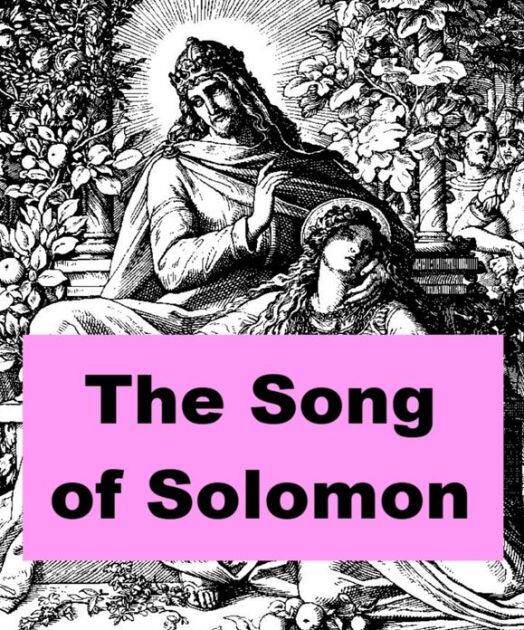
Jesus transforms believers into beautiful new creations for His use.6
Jesus makes you a beautiful, new creation. When you accept Jesus as your Lord and Savior, you become a “new creation.” “Therefore if anyone is in Christ, this person is a new creation; the old things passed away; behold, new things have come.” (2 Cor. 5:17). Jesus will also be spiritually joined with His people for all eternity in heaven (Rev. 19:7-9; 21:2; Jo. 3:16; 3:29; Mk. 2:19-20). He calls His bride beautiful. “Then the King will crave your beauty. Because He is your Lord, bow down to Him.” (Ps. 45:11).
Jesus finds beauty in a believer’s character, not the person’s exterior. Does the Song of Solomon mean that Jesus will define the beauty of His bride by outward appearances? No. The Bible makes clear that Jesus does not care about your outward beauty. Instead, He values most your inner character, beliefs, and obedience. “But the LORD said to Samuel, ‘Do not look at his appearance or at the height of his stature, because I have rejected him; for God does not see as man sees, since man looks at the outward appearance, but the LORD looks at the heart.”’ (1 Sam. 16:7). Thus, to properly interpret the bride’s beauty, you must look at what lies below each physical feature.
(1) The bride’s eyes – The Holy Spirit. The groom said that the bride’s “eyes are like doves behind your veil;” (SoS 4:1b). For emphasis, this was the second time the groom made this comparison. “How beautiful you are, my darling, how beautiful you are! Your eyes are like doves.” (SoS 1:15). “The song in which the king extols his bride will be understood by those who know that the imputed righteousness of the Lord Jesus put upon the saints a perfect comeliness, so that they are ‘all fair’ in the sight of God. Every single line has its meaning, …” (Charles Spurgeon on SoS 4:1-7).7 “The dove is a powerful symbol in the Bible, representing peace, purity, and the Holy Spirit.”8 “After He was baptized, Jesus came up immediately from the water; and behold, the heavens were opened, and he saw the Spirit of God descending as a dove and settling on Him,” (Matt. 3:16). Jesus’ death ripped the temple veil and allowed believers to direct access to God (Matt. 27:51). But to enter heaven, a believer must be “born again” (Jo. 3:3). The Holy Spirit enters your heart and transforms you into a new creation. “But we all, with unveiled faces, looking as in a mirror at the glory of the Lord, are being transformed into the same image from glory to glory, just as from the Lord, the Spirit.” (2 Cor. 3:18).
(2) The bride’s hair – dependance upon Jesus’ righteousness. The groom also compared the bride’s “hair” to “a flock of goats that have descended from Mount Gilead.” (SoS 4:1c). Jesus “is also the head of the body, the church…” (Col. 1:18a). Jesus numbers every hair in His Church. “But even the hairs of your head are all counted.” (Lk. 12:7). This means that you are dependent upon Him, and He knows and owns you. The goat is a symbol of sin, separation, and judgment (Lev. 16:21-22).9 You would be separated from Jesus and judged without His imputed righteousness. “I am the vine, you are the branches; the one who remains in Me, and I in him bears much fruit, for apart from Me you can do nothing.” (Jo. 15:5). “Now the hair of the church may be interpreted … [as] members of the church of Christ; the hairs of the head are numerous, grow upon the head, and have their nourishment from it; are weak in themselves, but depend upon the head … and as a flock of goats on Mount Gilead; and is a covering, though not from divine justice…is influenced by grace…from Christ, the Head.” (John Gill on SoS 4:1c).10
(3) The bride’s teeth – purity through submission to Jesus’ Word. The groom described that the bride’s “teeth” as being like “a flock of newly shorn sheep which have come up from their watering place, all of which bear twins, and not one among them has lost her young.” (SoS 4:2). Sheep are considered vulnerable, innocent, and require guidance.11 White wool further symbolizes purity through faith in Jesus. “Though your sins are as scarlet, they shall become as white as snow; though they are red like crimson, they shall be like wool.” (Is. 1:18b). The sheep’s teeth symbolize chewing. Believers cannot live on bread alone. Instead, they must also live on Jesus’ Word (Matt. 4:4). A person of faith should also chew on and then consume Jesus’ Word. “Your words were found and I ate them, ...” (Jer. 15:16a). Believers must also submit to and obey the Good Shepherd, like the sheep marching in order and with all accounted for (Jo. 10:11). When you submit to His Word and repent, He washes you pure of your sins. “so that He might sanctify her, having cleansed her by the washing of water with the word,” (Eph. 5:26).
(4) The bride’s lips and mouth – speaking truth with love. The groom also compared the bride’s “lips” to “a scarlet thread,” and he called her “mouth” “beautiful”. (SoS 4:3a). After being purified by Jesus’ blood, a transformed believer should speak truth with love. “Sanctify them in the truth; Your word is truth.” (Jo. 17:17). “You are the most handsome of the sons of mankind; grace is poured upon your lips; therefore God has blessed you forever.” (Ps. 45:2). “Your speech must always be with grace, as though seasoned with salt, so that you will know how you should respond to each person.” (Col. 4:6). “The lips of the wise spread knowledge, but the hearts of fools are not so.” (Prov. 15:7). “The communication or discourse of believers is edifying, and comfortable, and acceptable to God and to serious men.” (Matthew Poole on SoS 4:3a).12
(5) The bride’s temples – pure thoughts from meditating on God’s law. The groom also described the bride’s “temples” as being “like a slice of a pomegranate behind your veil.” (SoS 4:3b). The temples are above the mind, and they symbolize the “temple” of the Holy Spirit (1 Cor. 6:19-20). The beauty “behind your veil” spoke of her pure hidden thoughts. The pomegranate was proof of God’s faithfulness in leading the people to the Promised Land (Nu. 13:23). The pomegranate was also part of the High Priest’s robe (Ex. 28:33-34; 39:24-26). The red color symbolized atonement, and the seeds represent God’s perfect law, which leads a sinner to repentance (Ro. 7:7). One Jewish commentator observes, “Some Jewish traditions hold that the pomegranate’s 613 seeds correspond with the 613 laws in the Torah; ...”13 The beautiful believer meditates on God’s law to avoid sin. “But his delight is in the Law of the LORD, and on His Law he meditates day and night.” (Ps. 1:2). “I have treasured Your word in my heart, so that I may not sin against You …I shall delight in Your statutes; I will not forget Your word.” (Ps. 119:11, 16). “Finally, brothers and sisters, whatever is true, whatever is honorable, whatever is right, whatever is pure, whatever is lovely, whatever is commendable, if there is any excellence and if anything worthy of praise, think about these things.” (Phil. 4:8).
(6) The bride’s neck – a believer’s foundation in Jesus is built on humble faith. The groom analogized that the bride’s “neck” to “the tower of David, built with layers of stones on which are hung a thousand shields, all the round shields of the warriors.” (SoS 4:4). “In the ancient world, the neck was one part of the body thought to reflect character.” (David Guzik on SoS 4:4).14 “In beautiful contrast to the blushing temples, the Savior beholds the neck of the bride and compares it to an erect tower of David. It is not stiff neck of unbroken pride (Isa. 48:4; Acts 7:51), or the burdened neck of legal bondage (Lam. 1:14; Acts 15:10), but the erect neck of gospel freedom in Christ (Isa. 52:2).” (Don Fortner on SoS 4:4).15 The neck also has meaning because it supports the head. “And what is this but our faith? Does not the neck join the body to the head, and is not faith that connecting link by which we are united to Christ? Oh, for that faith which is like the tower of David builded for an armory! It is sure to be assaulted, let it, therefore, be firmly founded, and fully armed.” (Charles Spurgeon on SoS 4:4).16
(7) The two breasts – A child-like, dependent love that is hidden in the believer’s heart. The groom described how the bride’s “breasts” were like “two fawns, twins of a gazelle that graze among the lilies.” (SoS 4:5). God used the symbol of a nursing mother to depict both His faithfulness and the child-like dependent love of a believer. “Can a woman forget her nursing child and have no compassion on the son of her womb? Even these may forget, but I will not forget you.” (Is. 49:15). Jesus also explained, “Truly I say to you, unless you change and become like children, you will not enter the kingdom of heaven.” (Matt. 18:3). For these and other reasons, Jews and Christians have almost uniformly interpreted these words in a non-sexual manner for thousands of years. James Burton Coffman (1905 -2006) summarized this history as follows: “(a) The Jews saw the maiden’s two breasts as representing the two Messiah’s (one the Suffering Servant, and the other as the Glorious Conqueror), and the two brethren who led Israel, Moses and Aaron. (b) Christian writers saw these as the Old Testament and the New Testament, the outer and the inner man, or the blood and water from the side of Jesus on the Cross!”.17 Church father Cyril of Alexandria (376-444 A.D.) argued how the breasts symbolized the nourishment that a believer obtains from the Old and New Testaments. Critic Iain Duguid, however, observes with derision how this “approach enabled Bernard of Clairvaux [1090-1153] to preach eighty-six sermons on the opening chapters of the Song of Songs to a congregation of monks!”18 But this alleged tragedy was not something that Protestant reformers sought to correct. Instead, Protestant writers reaffirmed the historic Christian interpretation. These include, but are not limited to, the Anglican commentator John Trapp (1601-1669),19 Presbyterian minister Matthew Henry (1662-1714),20 and Baptist minister John Gill (1697-1771). Gill explained how the ‘“breasts … contain the whole sincere milk of the word”.21 Each feature speaks to an attribute that God admires (1 Sam. 16:7). “It is the glory of God to conceal a matter, but the glory of kings is to search out a matter.” (Prov. 25:2). In this case, the breasts are directly above the heart. Jesus finds beauty when you love and depend upon Him the way a nursing child loves and depends upon his or her mother. “And He said to him, ‘You shall love the Lord your God with all your heart, and with all your soul, and with all your mind.’ This is the great and foremost commandment.” (Matt. 22:37-38; Mk. 12:30-31; Lk. 10:27-28; Dt. 6:5). This includes the complete Word of God, found within the two gospels. “I have treasured Your word in my heart, so that I may not sin against You.” (Ps. 119:11; Dt. 11:18).
Cherish your spouse’s character. Like Jesus, spouses should also cherish, love, and be content with each other based upon their character and actions, not their appearance. “But godliness actually is a means of great gain when accompanied by contentment.” (1 Tim. 6:6). If you only value your spouse’s exterior, that beauty will fade “like grass.” (1 Pet. 1:24; Is. 40:6; Ps. 90:5-6). True inner beauty can last throughout the entire marriage.
2. Continual Prayers: For Those Transformed Through Faith, Jesus Loves the Pleasing Aroma of Their Ongoing Prayers. SoS 4:6.
Jesus considers the ongoing prayers of those made righteous by faith to be a sweet aroma. The bride’s smell reminded him of an ongoing sweet aroma of myrrh and frankincense. “6 Until the cool of the day when the shadows flee, I will go my way to the mountain of myrrh and to the hill of frankincense.” (SoS 4:6). Myrrh and frankincense were not native to the Promised Land. Thus, many believe that the references to the “mountain” or “hill” is the temple mount in Jerusalem where “incense …ascended up to God every morning and evening.” (Keil and Delitzsch OT Commentary on SoS 4:6).22
The prayers of the righteous are a sweet aroma to Jesus. The bride previously declared that her groom had “a pleasing fragrance, …;” (SoS 1:3a). When he approached her with columns of smoke, it was also “perfumed with myrrh and frankincense,” (SoS 3:6). The priests used frankincense for their “thank offerings” (Lev. 2:2). They also used pure frankincense for the altar of incense. When burned, the incense created smoke that was a “sweet aroma” to God (Lev. 24:7; Ex. 30:22-37). Because it was valuable, frankincense was brought to Jesus by the wise men at His birth (Matt. 2:11). His sacrifice was a fragrant aroma for His bride (Eph. 5:20). Today, instead of smoke, any believer in Christ can offer prayers as a sweet aroma to Him “May my prayer be counted as incense before You; the raising of my hands as the evening offering.” (Ps. 141:2). “When He had taken the scroll, the four living creatures and the twenty-four elders fell down before the Lamb, each one holding a harp and golden bowls full of incense, which are the prayers of the saints.” (Rev. 5:8). “Another angel came and stood at the altar, holding a golden censer; and much incense was given to him, so that he might add it to the prayers of all the saints on the golden altar which was before the throne. And the smoke of the incense ascended from the angel’s hand with the prayers of the saints before God.” (Rev. 8:3-4). “For we are a fragrance of Christ to God among those who are being saved and among those who are perishing:” (2 Cor. 2:15). “All Your garments are fragrant with myrrh...” (Ps. 45:8).
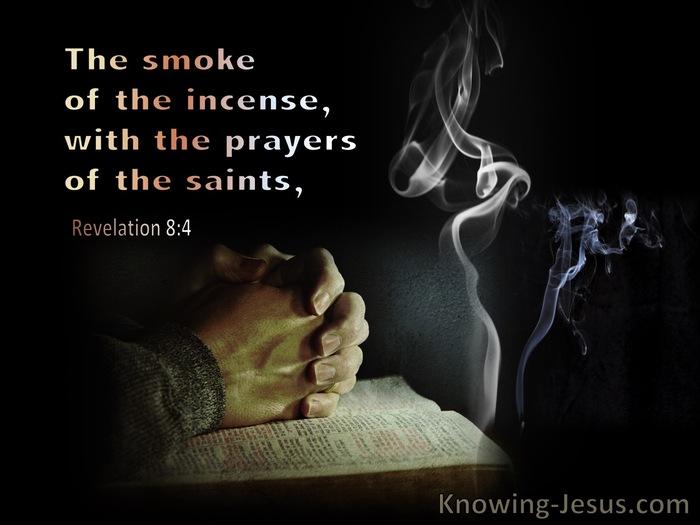
Your prayers are a beautiful, sweet aroma to Jesus.23
Unrepentant sinners may find their prayers hindered or ignored. Jesus may not consider every prayer to be beautiful. When you fail to repent of your sins, your prayers may be “hindered” or ignored (1 Pet. 3:7; Jo. 9:31; Ps. 66:18; Prov. 28:9; Isa. 1:15). Thus, you should always confess your sins: “Therefore, confess your sins to one another, and pray for one another so that you may be healed. The effective prayer of a righteous man can accomplish much.” (Jam. 5:16). Also, pray without doubt in Jesus (Jam. 1:6-8).
Your prayer life should remain constant. The groom sought out the bride’s sweet incense “Until the cool of the day when the shadows flee,” (SoS 4:6). This symbolized ongoing prayer. As a symbol of prayer, the priests created a soothing aroma in the Temple both in the morning and again at twilight (E.g., Ex. 30:7-8; Lev. 6:20; Nu. 28:4, 8). David followed these instructions by praying in the morning (Ps. 5:3; 88:13; 59:16; 92:2; 119:147). He also prayed at twilight (E.g., Ps. 63:6; 141:2). Twilight happened in the mid afternoon at the ninth hour. Peter and John also followed these instructions when they went “to the temple at the ninth hour, the hour of prayer.” (Acts 3:1). Christ also fulfilled these rules by being crucified at the time of the morning sacrifice and dying at the appointed time of the mid-afternoon sacrifice (Mk. 15:25, 34). This suggests that Jesus wants us to create a soothing prayer aroma to Him at least twice a day (1 Chron. 23:30; 1 Thess. 5:17; Rom. 12:12; Col. 4:2; Jam. 5:16). God also commanded that His people offer a “perpetual incense” throughout the generations (Ex. 30:8). This suggests that we should be in constant prayer before God (Rom. 12:12; Col. 4:2; Jam. 5:16). David also went beyond the minimum expected morning and evening prayers by also praying at noon as well: “Evening and morning and at noon, I will complain and moan, and He will hear my voice.” (Ps. 55:17). In the New Testament, believers are also encouraged to “pray without ceasing,” (1 Thess. 5:17). “With every prayer and request, pray at all times in the Spirit, and with this in view, be alert with all perseverance and every request for all the saints,” (Eph. 6:18). When you do this out of love, it is beautiful to Jesus.
3. Righteousness in Jesus: For Those Transformed Through Faith, Jesus Loves When You Live According to Righteousness That He Provides. SoS 4:7.
For those who believe, Jesus removes the blemishes of sin. The groom looked at his bride with deep love. After listing seven of her features, he found no blemish. “7 You are altogether beautiful, my darling, and there is no blemish on you.” (SoS 4:7). The bride having “no blemish” used the Hebrew word [וּמ֖וּם (ū·mūm], “describing the perfect sacrificial animals which were required (cf. Mal. 1:12-14) (G. Lloyd Carr on SoS 4:7).24
Through faith, Jesus gives you the beauty of His righteousness. The groom declared “there is no blemish on you.” (SoS 4:7). Jesus makes believers righteous through faith in His sacrifice “but it is the righteousness of God through faith in Jesus Christ for all those who believe; for there is no distinction,” (Ro. 3:22). “He made Him who knew no sin to be sin in our behalf, so that we might become the righteousness of God in Him.” (2 Cor. 5:21). “yet He has now reconciled you in His body of flesh through death, in order to present you before Him holy and blameless and beyond reproach—” (Col. 1:22).

Through faith in Jesus’ atoning death, you become a new creation without flaw.25
Live a holy life worthy of the righteousness that Jesus paid for on the cross. Jesus finds true beauty when you honor Him by seeking to live a life worthy of His righteousness. “Blessed are those who hunger and thirst for righteousness, for they will be satisfied.” (Matt. 5:6). “One who pursues righteousness and loyalty finds life, righteousness, and honor.” (Prov. 21:21). “Sow for yourselves, with a view to righteousness; harvest in accordance with kindness. Break up your uncultivated ground, for it is time to seek the LORD until He comes and rains righteousness on you.” (Hos. 10:12). “[B]ecause it is written: ‘You shall be holy, for I am holy.”’ (1 Pet. 1:16; Lev. 19:2; 20:7). “For God has not called us for impurity, but in sanctification.” (1 Thess. 4:7). “Therefore I urge you, brothers and sisters, by the mercies of God, to present your bodies as a living and holy sacrifice, acceptable to God, which is your spiritual service of worship.” (Ro. 12:1).
4. Obedience: As a “New Creation”, Jesus Desires Your Obedience to His Calling with the Goal of Obtaining a Deeper Relationship with Him. SoS 4:8-9.
Jesus desires your obedience. The groom called upon his bride to follow him to spend time together. “8 Come with me from Lebanon, my bride, you shall come with me from Lebanon. You shall come down from the summit of Amana, from the summit of Senir and Hermon, from the dens of lions, from the mountains of leopards. 9 You have enchanted my heart, my sister, my bride; you have enchanted my heart with a single glance of your eyes, with a single strand of your necklace.” (SoS 4:8-9). “Twice here he calls her My spouse (v. 8,11) and three times My sister, my spouse, v. 9, 10, 12. …There is a marriage-covenant between Christ and his church, between Christ and every true believer. Christ calls his church his spouse, and his calling her so makes her so … he owns her in two relations, which among men are incompatible, My sister, my spouse. Abraham’s saying of Sarah, She is my sister, was interpreted as a denying of her to be his wife; but Christ’ s church is to him both a sister and a spouse, as Matt 12:50, a sister and mother. His calling her sister is grounded upon his taking our nature upon him in his incarnation, and his making us partakers of his nature in our sanctification. He clothed himself with a body (Heb. 2:14), and he clothes believers with his Spirit (1 Cor. 6:17), and so they become his sisters. They are children of God his Father (2 Cor. 6:18) and so they become his sisters; he that sanctifies, and those that are sanctified, are all of one (Heb. 2:11); and he owns them, and loves them, as his sisters … Rise up, and come away. All that have by faith come to Christ must come with Christ, in holy obedience to him and compliance with him. Being joined to him, we must walk with him.” (Matthew Henry, SoS 4:8-9).26
Out of love for Him, Jesus wants you to obey His calling. Three times, the groom asked his bride to “come with me.” (SoS 4:8). He also gave this message previously (SoS 2:10-13). This foreshadowed Jesus. He calls every person to follow Him. In 12 different conversations, He urged others 21 times (a number of completeness) to “follow me.” ((1) Matt; 4:19; Mk. 1:17; (2) Matt. 8:22; Lk. 9:59; (3) Matt. 9:9; Mk. 2:14; Lk. 5:27); (4) Matt. 16:24; Mk. 8:34; Lk. 9:23; (5) Matt. 19:21; Mk. 10:21; Lk. 18:22; (6) Lk. 14:27; (7) Jo. 1:43; (8) Jo. 10:27; (9) Jo. 12:26l (10) Jo. 13:36; (11) Jo. 21:19; (12) Jo. 21:22). The groom wanted his bride to voluntarily follow him out of loving devotion. Jesus also wants you to follow Him out of loving devotion, not obligation.
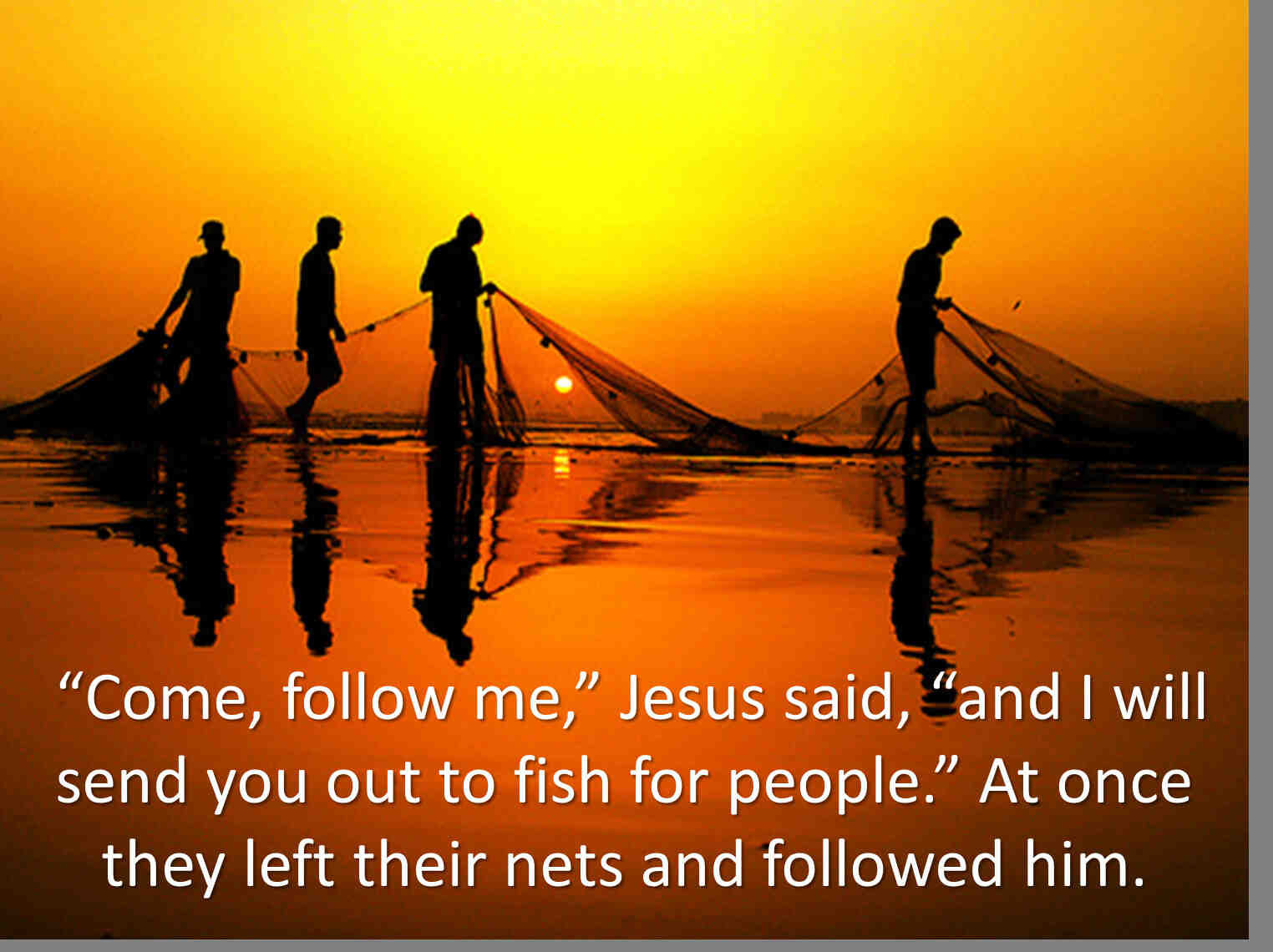
Jesus desires that you obey His calling to follow Him out of loving devotion.27
Jesus desires that you submit to His calling for a deeper relationship. The groom desired to journey together with his bride to grow closer to her because He loved her (SoS 4:8-9). Out of love, Jesus also calls you to seek out a relationship with you: “God is faithful, through whom you were called into fellowship with His Son, Jesus Christ our Lord.” (1 Cor. 1:9). But merely accepting Jesus as Lord and Savior is not enough to be in a meaningful relationship. There are plenty of people who have accepted Jesus as Lord and Savior but then make no effort to walk with Him. To grow in your walk with Jesus, your faith must be accompanied by a willingness to accept Jesus’ invitation for a deeper relationship: “Behold, I stand at the door and knock; if anyone hears My voice and opens the door, I will come in to him and will dine with him, and he with Me.” (Rev. 3:20).
Jesus is your Redeemer and Lord, not your equal. The reference to the Church being Jesus’ sister (SoS 4:9,10,12) speaks to His role as our kinsman Redeemer (Gen. 48:16; Ex. 6:6; Lev. 27:9-25; 25:47-55). He adorns believers with the beauty of salvation, symbolized by jewelry (SoS 4:9; Ezek. 16:11-13). He took on human form to die for our sins and be our Redeemer. “For both He who sanctifies and those who are sanctified are all from one Father; for this reason He is not ashamed to call them brothers and sisters,” (Heb. 2:11). In a marriage, each spouse should feel equal as one flesh (Gen. 2:24; Matt. 19:5; Mk. 10:8; Eph. 5:31). But Jesus is not equal to any human or angel. All will bow down to Him in heaven. “For this reason also God highly exalted Him, and bestowed on Him the name which is above every name, so that at the name of Jesus every knee will bow, of those who are in heaven and on earth and under the earth, and that every tongue will confess that Jesus Christ is Lord, to the glory of God the Father.” (Phil. 2:9-11).
5. Adoring Fellowship: Jesus Loves It When the Fruit of Your Faith Includes Loving Adoration and a Desire for Fellowship and Communion. SoS 4:10-11.
Jesus loves your adoration for Him and your desire for fellowship with Him. The groom found his bride’s love to be more enjoyable than wine. Her words to him were better than honey, and her smell was better than the finest fragrances. “10 How beautiful is your love, my sister, my bride! How much sweeter is your love than wine, and the fragrance of your oils than that of all kinds of balsam oils! 11 Your lips drip honey, my bride; honey and milk are under your tongue, and the fragrance of your garments is like the fragrance of Lebanon.” (SoS 4:10-11). “If I must prefer one book above another, I would prefer some books of the Bible for doctrine … but let me prefer this book above all others for fellowship and communion ... First, he praises her love [love that is better than wine]. Next, he praises her graces [the oils]. Then, he praises her words [lips that are better than honey]. Then, he praises her thoughts, the things that do not come out of her mouth, but lie under her tongue [milk and honey that remain under the tongue]. Then he finishes by praising her works [the smell of her garments]” (Charles Spurgeon on SoS 4:10-11).28
Jesus desires your worship and your desire for fellowship and communion. The groom declared his love for his bride. (SoS 4:10). Jesus also declares His love for the bride that He redeemed. “For your husband is your Maker, whose name is the LORD of armies; and your Redeemer is the Holy One of Israel, who is called the God of all the earth.” (Is. 54:5; Hos. 2:19-20). The bride’s love was sweeter than wine. (SoS 4:10). Wine is a symbol of joy (Ps. 4:7). Wine is also a symbol of Jesus’ blood of atonement. When you take communion and from the cup of His blood, you seek to place yourself in fellowship with Him (Matt. 26:27-28). This communion should include your loving adoration through worship. “saying with a loud voice, ‘Worthy is the Lamb that was slaughtered to receive power, wealth, wisdom, might, honor, glory, and blessing.”’ (Rev. 5:10)
Your godly words are a delight to Jesus. The groom enjoyed hearing his bride’s every word. “Your lips drip honey.” (SoS 4:11a). Jesus’ Word is sweeter than honey (Ps. 119:103; 19:10). Consuming or studying His Word is also sweeter than honey (Ezek. 3:3). Jesus’ wisdom is also sweeter than honey (Prov. 24:13-14). Godly words are also sweeter than honey (Prov. 16:24). When you consume and speak Jesus’ Word to uplift, correct, edify, encourage, and witness, your actions are beautiful to Jesus. “‘How beautiful are the feet of those who bring Good New of good things!”’ (Ro. 10:15).
Jesus deserves your loving thoughts for Him. The groom also knew that his bride’s thoughts for him were pure and good. “honey and milk are under your tongue,” (SoS 4:11b). If these things were under the tongue, they were not spoken. This means that your thoughts and heart should both be pure. When they are, it is beautiful to Jesus, and He will bless you. “Blessed are the pure in heart, for they will see God.” (Matt. 5:8)
Jesus deserves your loving acts of devotion. The groom also loved how his bride prepared herself for him. “the fragrance of your garments is like the fragrance of Lebanon.” (SoS 4:11). Clothing is a symbol for a person’s actions. A person’s actions apart from Jesus are like filthy rags (Is. 64:6). But Jesus has prepared pure garments for His bride (Rev. 19:7). Jesus also loves your acts of deviation for Him. “Whatever you do, do your work heartily, as for the Lord and not for people,” (Col. 3:23).
Avoid those who adopted sexual interpretations. Many modern writers refuse to see Jesus in these verses. Instead, they see a man fulfilling his lust for his bride. “[v. 11] With this verse, the man returns to a metaphorical description of different parts of the woman’s body that attract his sensual interest.” (Tremper Longman III on SoS 4:11).29
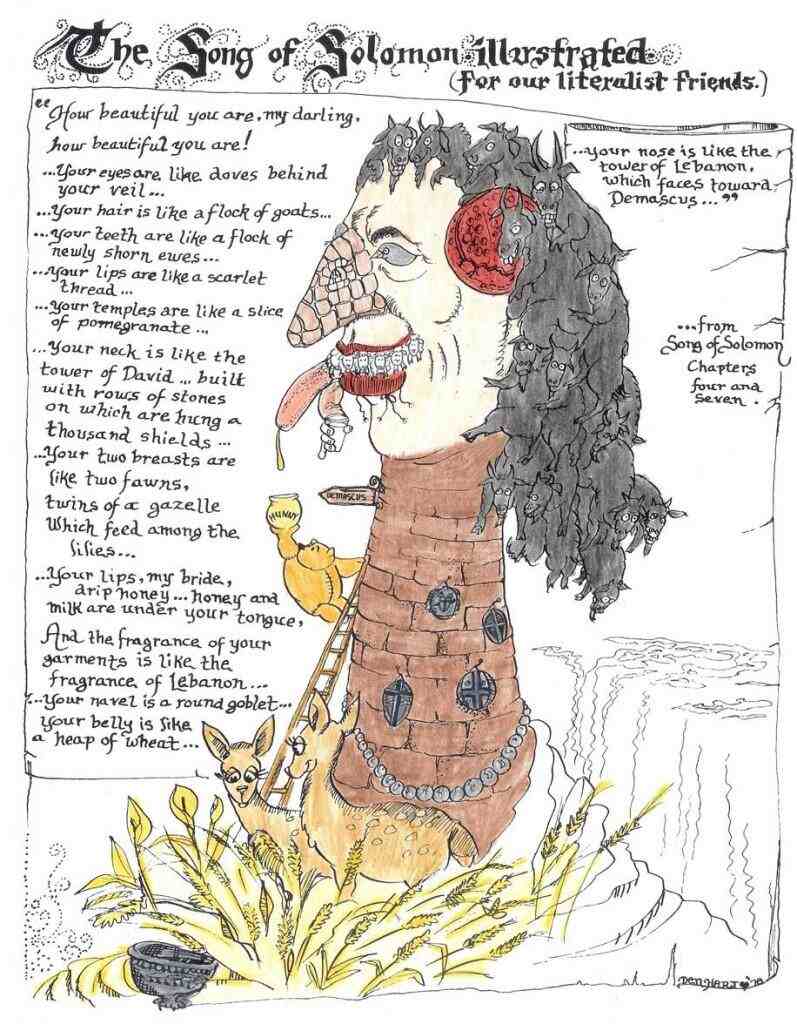
For those who reject the symbolism of the bride, this is what she would look like.30
6. Purity: Jesus Loves Your Attempts to Remain Pure for Him. SoS 4:12-15.
Jesus desires that you remain pure for Him. The groom also celebrated his wife’s purity. “12 A locked garden is my sister, my bride, a locked spring, a sealed fountain. 13 Your branches are an orchard of pomegranates with delicious fruits, henna with nard plants, 14 nard and saffron, spice reed and cinnamon, with all the trees of frankincense, myrrh, and aloes, along with all the finest balsam oils. 15 You are a garden spring, a well of fresh water, and flowing streams from Lebanon.” (SoS 4:12-15). “The closed or walled garden and the sealed fountain appear to have been established metaphors for the pure and chaste wife. For the latter, at least, there is not only the above passage in Proverbs, but a prayer still in use in Jewish marriages: ‘Suffer not a stranger to enter into the sealed fountain,”’ (Charles Ellicott’s Commentary for English Readers SoS 4:12-14).31
Be pure for Jesus’ use. Jesus also wants you to be pure for Him. “For I am jealous for you with a godly jealousy; for I betrothed you to one husband, to present you as a pure virgin to Christ.” (2 Cor. 11:2). “These verses are a further comparison of the bride in her beauty to a garden in its splendour of colour and its fertility, but a garden shut or closed to all but its lawful owner. The reference is to her modesty and chastity.” (Andrew Harper, Cambridge Bible for Schools and Colleges SoS 4:12-14).32
Stay pure so that Jesus can use you for His glory. The groom referred to his bride as a garden spring and a well of fresh water (SoS 4:15). Because you are meant to reflect Jesus’ light to the lost, He wants you to remain unpolluted from worldly sins. “Like a trampled spring and a polluted well, so is a righteous person who gives way before the wicked.” (Prov. 25:26). You are also called “salt”. Salt stings in the wound of sin, and it was used to preserve food. Thus, believers whose saltiness is compromised by sin are of little value to Him. “You are the salt of the earth; but if the salt has become tasteless, how can it be made salty again? It is no longer good for anything, except to be thrown out and trampled underfoot by people.” (Matt. 5:13; Mk. 9:50; Lk. 14:34-35). “Your silver has become waste matter, your drink diluted with water.” (Is. 1:22). Believers compromised by sin can spread their sin to others. “Is it too little a thing for you to feed in the good pasture, that you must trample with your feet the rest of your pastures? Or too little for you to drink the clear waters, that you must muddy the rest with your feet? But as for My flock, they must eat what you trample with your feet, and drink what you muddy with your feet!’” (Ezek. 34:18-19). Thus, believers are called upon to cleanse themselves of sin. “Therefore, if anyone cleanses himself from these things, he will be an implement for honor, sanctified, useful to the Master, prepared for every good work.” (2 Tim. 2:21). “Or do you not know that your body is a temple of the Holy Spirit within you, whom you have from God, and that you are not your own? For you have been bought for a price: therefore glorify God in your body.” (1 Cor. 6:19-20). “Therefore I urge you, brothers and sisters, by the mercies of God, to present your bodies as a living and holy sacrifice, acceptable to God, which is your spiritual service of worship.” (Rom. 12:1).
7. Service for Jesus’ Glory: Out of Devotion, Use Your God-Given Gifts for Jesus’ Glory. SoS 4:16.
Jesus loves it when the fruit of your faith includes a desire to serve Him out of devotion. Out of love, the bride told her husband that what she had was reserved for him as her husband. “16 Awake, north wind, and come, wind of the south; make my garden breathe out fragrance, may its balsam oils flow. May my beloved come into his garden and eat its delicious fruits!” (SoS 4:16). “This is the answer of the bride to the lavish praises of her husband. I am all his. She is yet unworthy of the king and of his love … Whether we think of the individual soul or of the Church of Christ, the true desire of those who delight in the love of the Saviour is that all the gifts and graces which can be bestowed may make them worthy of him who condescends to call his people his delight. Surely it is no mere romantic idyll that is before us.” (Pulpit Commentary on SoS 4:16).33
Jesus gave you new life to become like a garden in the desert. The wife was like a garden to her groom (SoS 4:16). Jesus transforms believers with new life to become like gardens in the desert. “The wilderness and the desert will rejoice, and the desert will shout for joy and blossom; like the crocus. It will blossom profusely and rejoice with joy and jubilation. The glory of Lebanon will be given to it, the majesty of Carmel and Sharon. They will see the glory of the LORD, the majesty of our God.” (Is. 35:1). “He will be like a tree planted by streams of water, which yields its fruit in its season, and its leaf does not wither; and in whatever he does, he prospers.” (Ps. 1:3).
Jesus created you and gave you gifts to allow you to perform good works for His glory. Jesus created you for good works. “For we are His workmanship, created in Christ Jesus for good works, which God prepared beforehand so that we would walk in them.” (Eph. 2:10). “Therefore, if anyone cleanses himself from these things, he will be a vessel for honor, sanctified, useful to the Master, prepared for every good work.” (2 Tim. 2:21). Every good gift in your life is a gift from Jesus (Jam. 1:17). When you seek to serve Jesus out of devotion, He will provide for all that you need to serve Him: “And God is able to make all grace abound to you, so that always having all sufficiency in everything, you may have an abundance for every good deed;” (2 Cor. 9:8). Jesus loves it when you use the time, talent, and treasure that He has given you for good works for His glory.
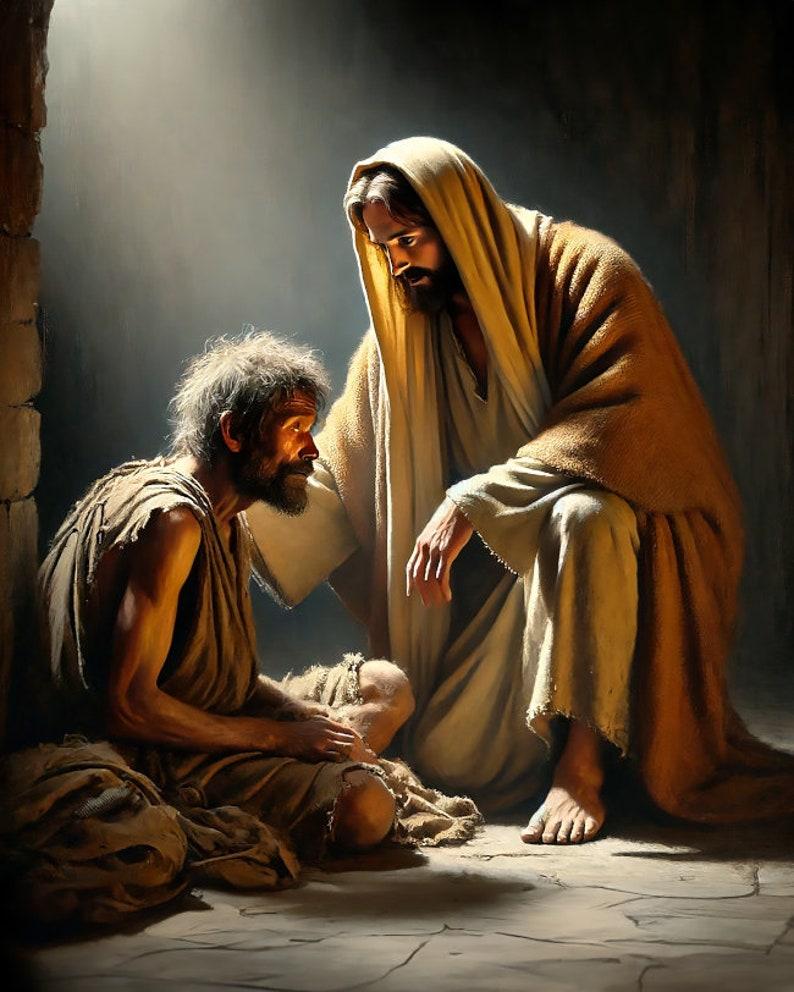
Jesus finds beauty when you use your God-given gifts to serve others.34
Daniel L. Akin, Christ-Centered Exposition, Exalting Jesus in Song of Songs, (Brentwood, TN, B&H Publishing Group, 2015) (ISBN 978-0-8054-9676-5), pgs. 115-117 (italics added).↩︎
Tom Gledhill, The Message of the Song of Songs (Downers Grove, IL, InterVarsity Press 1994) (ISBN 978-1-5140-0633-7), p. 141 (italics added).↩︎
Iain M. Duguid, Song of Songs, Reformed Expository Commentary, (Phillipsburg, NY P&R Publishing 2016) (ISBN 978-1-59638-948-9), pgs. 72-73 (italics added).↩︎
Don Fortner, Discovering Christ in the Song of Solomon (Auburn, MA, Evangelical Press USA, 2005) (ISBN 085234-581-X), pgs. 86-87.↩︎
Image credit: The Song of Solomon by Cyrus Adler | eBook | Barnes & Noble®↩︎
Charles H. Spurgeon, The Song of Solomon, (84 Sermons on the Song of Solomon, assembled by Eric Steward and Gary Morris 2020) (ISBN: 979-8-55-894256-9), pgs. 326-7; No. 43 “The Interpreter”.↩︎
Song of Solomon 4:1 - John Gill's Exposition of the Whole Bible↩︎
How are sheep depicted in the Bible, and what lessons can we learn from their symbolism?↩︎
Song of Solomon Chapter 4 - Enduring Word (italics in original).↩︎
Don Fortner, Discovering Christ in the Song of Solomon (Auburn, MA, Evangelical Press USA, 2005) (ISBN 085234-581-X), pgs. 90-91.↩︎
Song of Solomon 4 - Coffman's Commentaries on the Bible - Bible Commentaries - StudyLight.org↩︎
Iain M. Duguid, Song of Songs, Reformed Expository Commentary, (Phillipsburg, NY P&R Publishing 2016) (ISBN 978-1-59638-948-9), introduction p. xvi.↩︎
Song of Solomon 4 - Trapp's Complete Commentary - Bible Commentaries - StudyLight.org↩︎
Song of Solomon 4 Commentary - Matthew Henry Commentary on the Whole Bible (Complete) | Bible Study Tools↩︎
Image credit: 21 Bible verses about Catastrophic Events↩︎
G. Lloyd Carr, The Tyndale Old Testament Commentaries, The Song of Solomon (Downers Grove, IL, Inter-Varsity Press, 1984) (ISBN 0-87784-268), pgs. 118-119; quoting Song of Solomon 4 Keil and Delitzsch OT Commentary↩︎
Image credit: Song of Solomon 4:7 #beauty #godisgood #becomingawomanofextraordinaryfaith↩︎
Song of Solomon 4 Commentary - Matthew Henry Commentary on the Whole Bible (Complete) | Bible Study Tools (italics in original).↩︎
Image credit: HOW IN THE WORLD!!: Jesus said "follow me" reflections on Matthew 4:17-25↩︎
Charles H. Spurgeon, The Song of Solomon, (84 Sermons on the Song of Solomon, assembled by Eric Steward and Gary Morris 2020) (ISBN: 979-8-55-894256-9), p. 357; No 48 “Christ’s Estimate of His People”, Delivered on January 23, 1859 at New Park Street Chapel, Southwark, England.↩︎
Tremper Longman III, Song of Songs, (Grand Rapids, MI, William B. Eerdman’s Publishing Company, 2001) (ISBN 978-0-8028-2543-8) p. 154.↩︎
Image credit: Solomon’s Bride » linear concepts↩︎
Song of Solomon 4 Ellicott's Commentary for English Readers↩︎
Song of Solomon 4 Cambridge Bible for Schools and Colleges↩︎
Image credit: https://www.etsy.com/listing/1732592266/christian-art-blessed-be-ye-poor?gpla=1&gao=1&&utm_source=connexi↩︎